One city, two counties: why it changes who you call
Most of Fountain Inn sits in southern Greenville County, but the city also reaches into Laurens County, and much of its growth has been toward the south. Before calling anyone about a leak at the street or a permit, check two things on your bills:
- Who sends your water bill. Many Fountain Inn addresses are Greenville Water customers. Parts of southern Greenville County and the Laurens side are served by the Laurens County Water & Sewer Commission (LCWSC). A leak at the meter or a street main goes to whichever utility bills you.
- Which county your property tax bill comes from. Inside city limits, building permits go through the City of Fountain Inn. Outside them, they go to Greenville County or Laurens County depending on the side.
| If your bill says… | Water emergency at the street or meter |
|---|---|
| Greenville Water | (864) 241-6000, around-the-clock line |
| Laurens County Water & Sewer Commission | (864) 682-6516, or the number on your bill |
| Anything between the meter and your house, or inside it | A licensed plumber |
Fountain Inn quick facts
| ZIP code | 29644 |
|---|---|
| Counties | Greenville and Laurens |
| People / homes | About 12,000 people in about 4,800 housing units, and growing fast |
| Median year built | 2000, with 38% of homes built in 2010 or later |
| Owner-occupied | 75% |
| Sewer | City of Fountain Inn collection, with ReWa treatment; MetroConnects lines in some surrounding areas |
A young town: its 2010s water heaters are now 10–15 years old
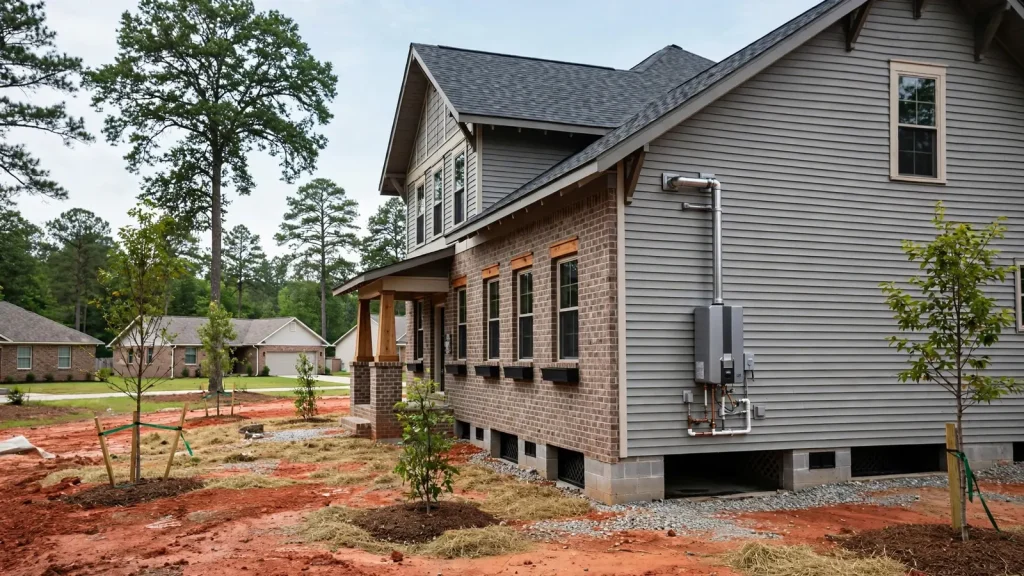
No other town in our area has as much new housing as Fountain Inn. About 38% of its homes were built in 2010 or later (Census ACS 2020–2024). That's good news for the pipes: PEX supply and PVC drains hold up well. It's less good news for the water heaters. Builder-installed tank heaters typically last about 8–12 years, so the tanks that came with houses built between 2010 and 2016 are now at or past that point.
How to read your water heater's age
Find the rating label on the side of the tank and the serial number. Most manufacturers encode the manufacture date in the first characters of the serial number, often a letter for the month and two digits for the year, or the year and week as numbers. The coding differs by brand, so search "[brand] serial number date code" if it isn't obvious. Our repair-or-replace table shows what to do at each age. A tank from 2012 is a 14-year-old tank, whatever it looks like on the outside.
Signs a builder-grade tank is near the end
- Rusty or discolored hot water (not cold)
- Rumbling or popping as it heats
- Moisture or rust at the base, or a damp drain pan
- Hot water running out faster than it used to
A leak from the tank itself can't be fixed. Plan a replacement before it fails, preferably not on a weekend, when after-hours rates apply. If water is already on the floor, shut off the cold-water valve on top of the tank and turn off its power or gas. Our water emergency steps cover the rest.
Water heater trouble in Fountain Inn?
New-house plumbing: pressure valves and expansion tanks
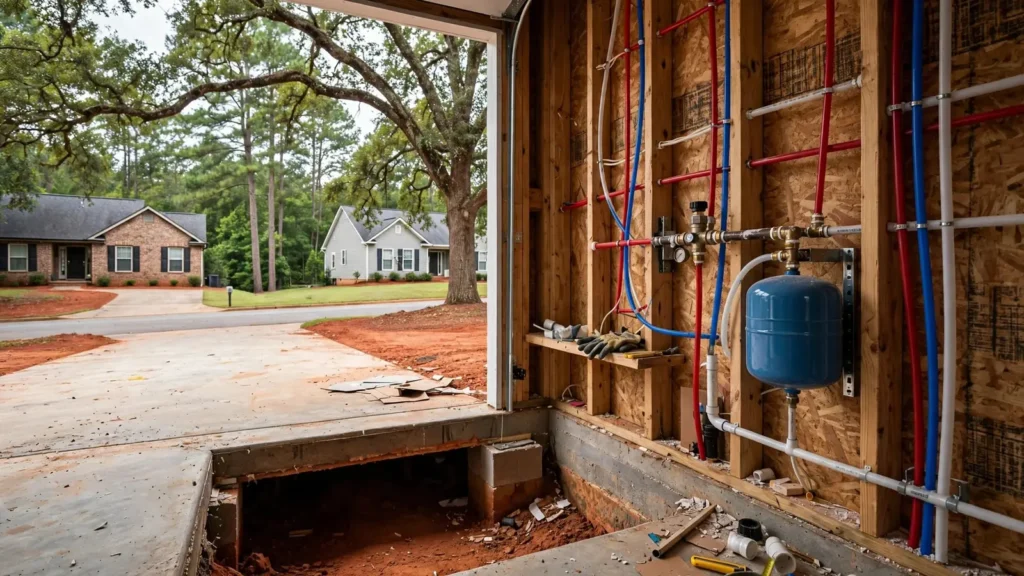
Many newer subdivisions come with a pressure-reducing valve (PRV) where the water line enters the house. It protects fixtures from high street pressure. Over time PRVs wear, and a failed one can let pressure creep up, which shows up as banging pipes, running toilets, dripping faucets, and a tank relief valve that leaks.
A PRV, or a check valve at the meter, can create a "closed" system. When water heats it expands and has nowhere to go, so codes generally call for a thermal expansion tank: the small tank mounted on the water heater's cold-water line. If yours is waterlogged, it stops working. A plumber can test house pressure with a $10 gauge on a hose bib (about 40–80 psi is a common target range) and check the expansion tank in a few minutes.
Older Fountain Inn: Main Street and the historic core
Not all of Fountain Inn is new. About 13% of homes date from the 1970s and 5% from before 1950, mostly around the historic downtown. The old train depot now houses the Fountain Inn Museum, and Burdette's Hardware anchors Main Street. Houses near the core can have the older materials you'd expect for their age: galvanized supply, cast-iron drains and clay sewer laterals. They're also where the city's sewer work is concentrated.
The Durbin Creek sewer rehab: what it means for your lateral
Fountain Inn received about $10 million from the South Carolina Rural Infrastructure Authority to rehabilitate sewer lines in the Durbin Creek basin. In September 2026, sewer rehab work closed lanes downtown (Fox Carolina). Cities fix the public mains; the lateral from your house to the main is usually the property owner's. When the main on your street is relined or replaced:
- Expect a notice and a short period when you should limit water use.
- If drains run slowly or back up after the work, tell the city first. A reconnection issue at the main is theirs to check.
- If the city's side checks out, a plumber with a sewer camera can inspect your lateral.
How do I find the best plumber in Fountain Inn?
- Experience with new-construction systems: PEX, manifolds, PRVs, expansion tanks, and tankless conversions.
- Knowing which permit office applies to your address: city, Greenville County or Laurens County.
- A South Carolina license you can check on the SC LLR website.
- A written price that names the tank size, fuel type, permit and haul-away of the old unit.
- A clear trip fee: Fountain Inn is at the south end of many companies' service areas, so ask up front.
Costs for common Fountain Inn jobs
| Job | Typical range | Source |
|---|---|---|
| Tank water heater, installed (40–50 gal) | About $1,200–$3,500 | National guides, 2026 (local prices may differ) |
| Tankless water heater repair | $146–$864 (average about $556) | HomeAdvisor, Greenville SC, 2026 |
| Drain cleaning | $152–$421 (average about $240) | HomeAdvisor, Greenville SC, 2026 |
| Trip / diagnostic fee | About $45–$89 locally, sometimes waived if you hire | Greenville-area listings, 2026 |
More prices, by job, are in our plumber cost guide.
Thinking about tankless? In a new build with a gas line, a tankless unit can make sense when the original tank fails. It costs more up front, needs proper venting and, for gas units, enough gas supply. Note that the federal 25C tax credit for water heaters ended for installs after December 31, 2025, so don't count on it in a 2026 quote. Our tankless guide covers sizing and costs.
Need a plumber in Fountain Inn?
Fountain Inn plumbing questions
Which county is my Fountain Inn house in, and does it matter?
Fountain Inn is in both Greenville and Laurens counties. It matters for permits outside city limits and sometimes for your water supplier. Your property tax bill shows the county; your water bill shows the utility.
Who supplies my water: Greenville Water or Laurens County Water & Sewer?
It depends on your address, not your ZIP code. Many homes are Greenville Water customers, and parts of the Laurens County side are served by LCWSC. Check the name on your water bill.
What does the Durbin Creek sewer rehab mean for me?
The city is rehabilitating sewer mains in the Durbin Creek basin with state funding. Your private lateral is usually still your responsibility. If you notice backups right after work on your street, report it to the city first.
My water heater is from 2014. Repair or replace?
A 12-year-old tank is past the typical 8–12 year lifespan. If it's leaking from the tank, replace it. If it's a part like a thermostat, element or gas valve and the tank is dry and rust-free, a repair can still make sense. Ask the plumber to price both.
Does my new Fountain Inn home need an expansion tank or PRV?
Many newer homes have a pressure-reducing valve, and a closed system usually needs a thermal expansion tank on the water heater. A plumber can test your house pressure and the tank in a few minutes, which is worth doing whenever you replace the water heater.
Is tankless worth it in a new build?
It can be, if you have gas, room for venting, and you plan to stay for years. It costs more to install than a tank. The federal 25C credit ended for installs after December 31, 2025, so price it without one.
Sources
- U.S. Census Bureau, ACS 2020–2024 5-year estimates for Fountain Inn city: tables B01003, B25034, B25035, B25003, B25077 (via Census Reporter).
- SC Rural Infrastructure Authority award list (Durbin Creek Basin sewer rehabilitation); Fox Carolina, Sep 10, 2026 (downtown sewer rehab work).
- Greenville Water service area; Laurens County Water & Sewer Commission (Upstate SC Alliance utility profile).
- Greenville Business Magazine (Nov 2022) on Fountain Inn's grist mill plans; Fountain Inn Museum.
- IRS guidance on the 25C Energy Efficient Home Improvement Credit (ended for property placed in service after Dec 31, 2025).
- HomeAdvisor Greenville, SC cost pages and national water heater guides, 2026.
Page history
October 2026: first published.