Where the older homes are
| Area | Median year built | Notable |
|---|---|---|
| City of Greenville | 1987 | 12% built before 1950, the most in the county: historic districts and west-side mill villages |
| Wade Hampton | 1973 | 60% built 1960–1979 |
| Gantt (south side) | 1974 | 30% built in the 1960s |
| Parker (west-side mill villages) | 1975 | 19% built before 1950 |
| Berea | 1979 | 40% built 1960–1979 |
| Taylors | 1983 | 38% built 1960–1979 |
| Piedmont | 1985 | 13% built before 1950 (mill houses) |
What's probably in your walls, by era
| Built | Supply pipe | Drains and sewer | Watch for |
|---|---|---|---|
| Before 1950 | Galvanized steel; occasionally some lead at old connections | Cast iron inside; clay tile to the street | Rust-restricted flow, pinhole leaks, root-filled laterals, lead solder |
| 1950s–1970s | Galvanized, then copper | Cast iron; clay or Orangeburg fiber pipe to the street | Low pressure, cracked cast iron, flattened Orangeburg |
| About 1978–1995 | Copper or gray polybutylene | PVC or ABS | Polybutylene fitting failures |
How to tell what you have
Look where the main water line enters the house (often in the crawlspace or at the water heater) and under sinks.
- Galvanized steel: dull gray, threaded joints. A magnet sticks to it. Scratch it with a key and it shows silver-gray.
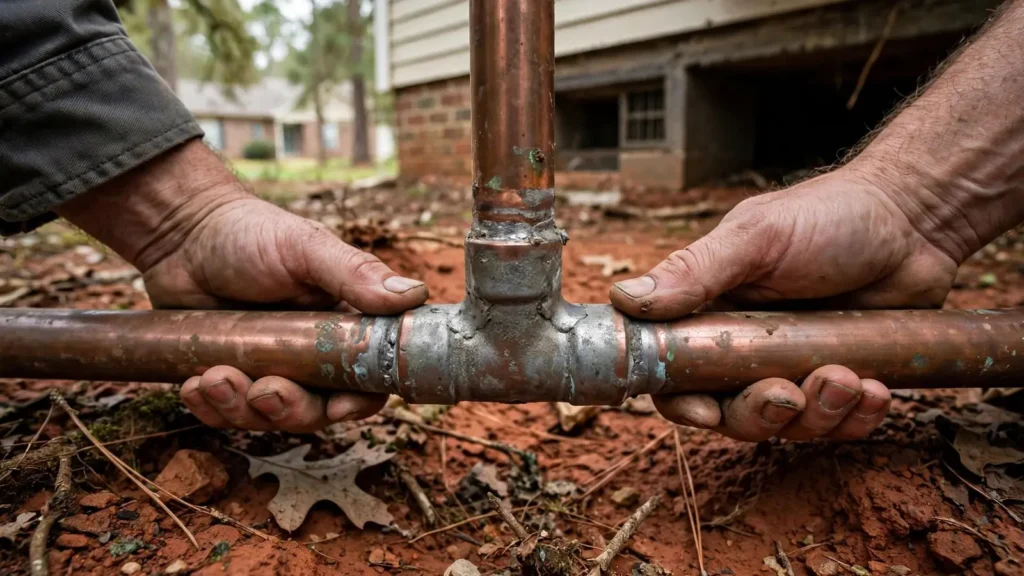
- Copper: reddish-brown or green with age, soldered joints. A magnet won't stick.
- Lead: dull gray, soft enough that a key scratch shows bright silver, often with a bulb-shaped joint. A magnet won't stick. Rare in Greenville supply lines, but possible in very old homes.
- Polybutylene: flexible gray plastic, often stamped "PB".
- Cast iron drains: heavy, black or rust-colored pipe, 3–4 inches across, with hub-shaped joints.
Lead: what Greenville Water says, and what's still in older houses
Greenville Water reports no lead service lines anywhere in its distribution system, based on its service line inventory, and its 2024 lead sampling came in at a 90th percentile of 0 ppb. It has run a corrosion-control program since the mid-1970s, adding an inhibitor because soft, low-alkalinity water can be aggressive toward metal pipe.
Inside the house is a different question. Copper pipe joined with lead solder before the 1986 federal ban, and older brass faucets and fittings, can still release small amounts of lead. If you have a pre-1986 home with young children or someone pregnant in it:
- Run the cold tap for a minute or two after water has sat overnight.
- Use cold water for drinking and cooking.
- Ask Greenville Water about testing, or use a certified lab.
- Replace old fixtures with ones labeled lead-free.
Older home with pipe problems? Call a local plumber
Galvanized pipe: repair or repipe?
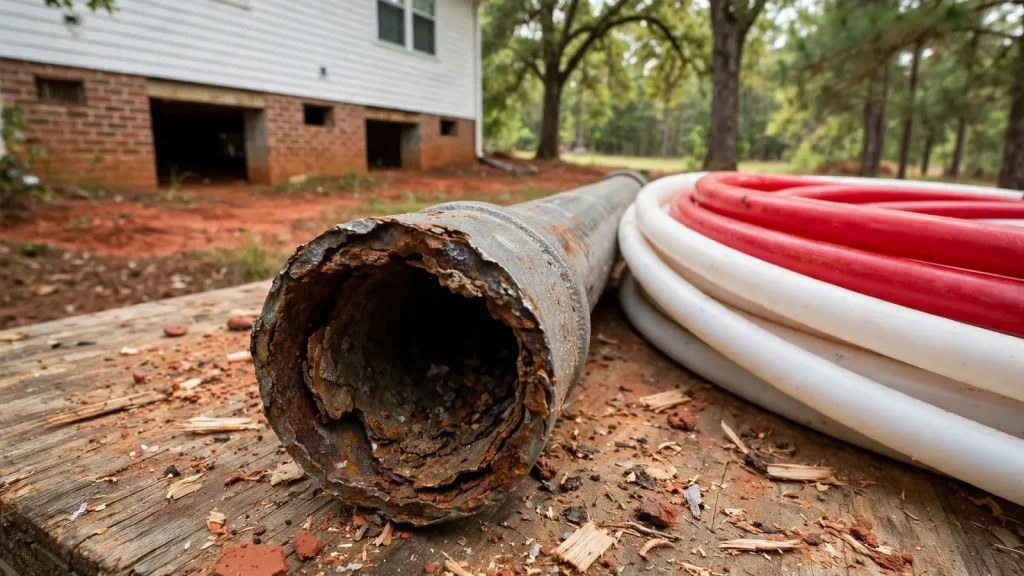
Galvanized steel rusts from the inside, narrowing until a faucet barely runs, then leaks at the threads. One leak is fixable. When you see low pressure at several fixtures, brown water after the water sits, and repeat leaks, the pipe has reached the end of its life.
- Sectional replacement of the worst run (often the line feeding a bathroom) can buy time on a budget.
- A full repipe runs about $4,500–$15,000 on national guides. Crawlspace homes, common in 1950s–80s Greenville County construction, are at the lower end, because PEX can be run underneath with few wall openings.
- Mixed metals: where copper or brass meets galvanized steel without a dielectric fitting, the joint corrodes faster. These are the first places to check.
Our repiping guide covers the process, and the cost guide covers what moves the price.
Cast-iron drains and clay laterals
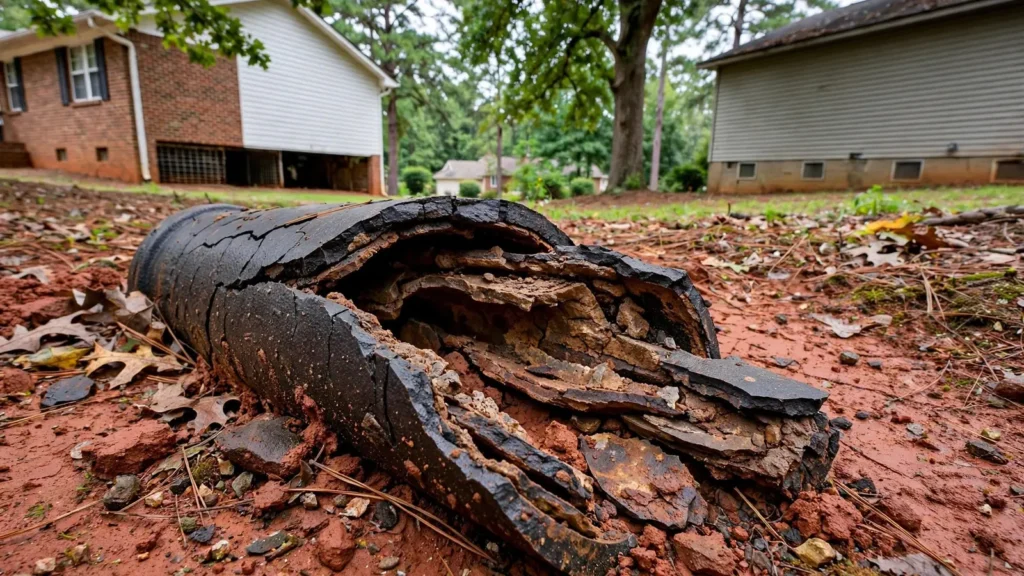
Cast iron rusts from the inside too, building scale that catches debris until drains slow throughout the house. Eventually it cracks, often along the bottom where it's hard to see. Clay laterals fail at the joints, where roots get in. Both are camera-inspection jobs; see our sewer line repair guide for the options and our who-owns guide for where your responsibility ends.
Greenville's mill villages
Greenville grew as a textile center, and its mill villages still hold some of the oldest plumbing in the county: Monaghan, Poe, Brandon, Judson, Dunean, Woodside, Mills Mill and Union Bleachery among them. Many mill houses were built with little or no indoor plumbing and had it added later, sometimes with sewer lines that ended up running under the houses themselves.
MetroConnects' Clean Water Forward program is rehabilitating about 100-year-old public sewer in several of these villages, funded partly by state SCIIP grants and federal money. Mills Mill came first, starting in 2024, with work that includes moving sewer lines from under houses out to the street. Union Bleachery's first phase was finished in May 2025, Dunean followed, and Judson was next in line.
What it means for a homeowner: the program fixes the public system. When a line is moved to the street, your house needs a working connection to the new main, so watch for notices from MetroConnects about your street, and ask what part of the reconnection it covers before hiring anyone.
Buying or renovating an older house
- Add a sewer camera inspection to the home inspection.
- Ask what the supply pipe is and test the pressure at the top floor's shower while a downstairs tap runs.
- Check for polybutylene in 1978–95 homes; some insurers ask about it.
- Plan pipe work during the remodel, while walls and floors are already open.
- Historic districts: exterior changes can need design review in the City of Greenville; interior plumbing usually needs only the normal permit. Ask the city if you're unsure.
What to fix first
- Anything leaking now, and gas or venting problems.
- The sewer lateral, if it has backed up more than once.
- Galvanized supply, if pressure or leaks are getting worse.
- The water heater, if it's past about 10–12 years.
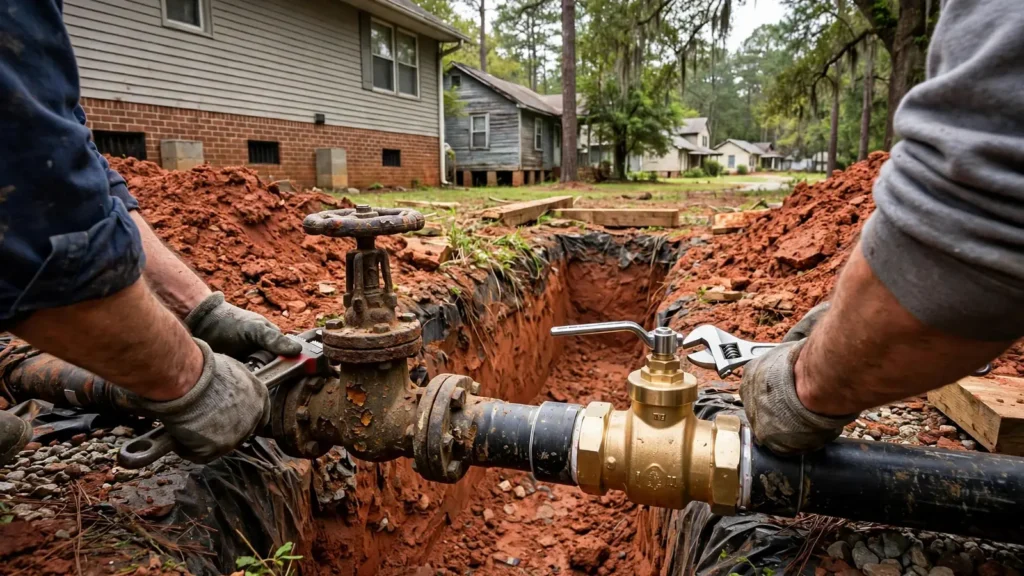
- Fixtures and shutoff valves: old gate valves often won't close when you need them.
Ready to have an older home's plumbing checked?
Older home plumbing questions
How do I know if my house has galvanized pipes?
Find the main line where it enters the house. Galvanized is dull gray with threaded joints, and a magnet sticks to it. Copper and lead don't attract a magnet.
Is there lead in Greenville's water pipes?
Greenville Water reports no lead service lines in its distribution system. Older houses can still have lead solder from before 1986 or old brass fixtures, so run the tap after water sits and use cold water for drinking.
How long do galvanized pipes last?
Often 40–60 years before low pressure and leaks become a pattern. Many in pre-1970 Greenville homes are past that.
Is it cheaper to repipe a house with a crawlspace?
Usually, yes. The plumber can run new PEX under the floor and up into each fixture with fewer wall openings than in a slab home, which saves on labor and drywall repair.
What is MetroConnects' Clean Water Forward program?
A program rehabilitating about 100-year-old public sewer systems in Greenville County mill villages, starting with Mills Mill in 2024, then Union Bleachery, Dunean and Judson. It covers the public system; private connections remain the owner's.
Should I replace an old gate valve on my main line?
If it's stiff or won't fully close, yes. Old gate valves often fail exactly when you need to shut off water in an emergency. A quarter-turn ball valve is the usual replacement.
Sources
- U.S. Census Bureau, ACS 2020–2024 5-year estimates: tables B25034 and B25035 for the City of Greenville and the Wade Hampton, Gantt, Parker, Berea, Taylors and Piedmont CDPs.
- Greenville Water: service line inventory and lead information, Consumer Confidence Report 2025 (2024 lead sampling), corrosion control program, 2026 water quality reports. greenvillewater.com
- MetroConnects: Clean Water Forward news (Mills Mill, Union Bleachery ribbon-cutting May 5, 2025, Dunean); Greenville Business Magazine (May 6, 2025); Greenville News reporting on Mills Mill.
- U.S. EPA: 1986 Safe Drinking Water Act amendments on lead-free solder and fixtures.
- National repipe cost guides (2026).
Page history
October 2026: first published.