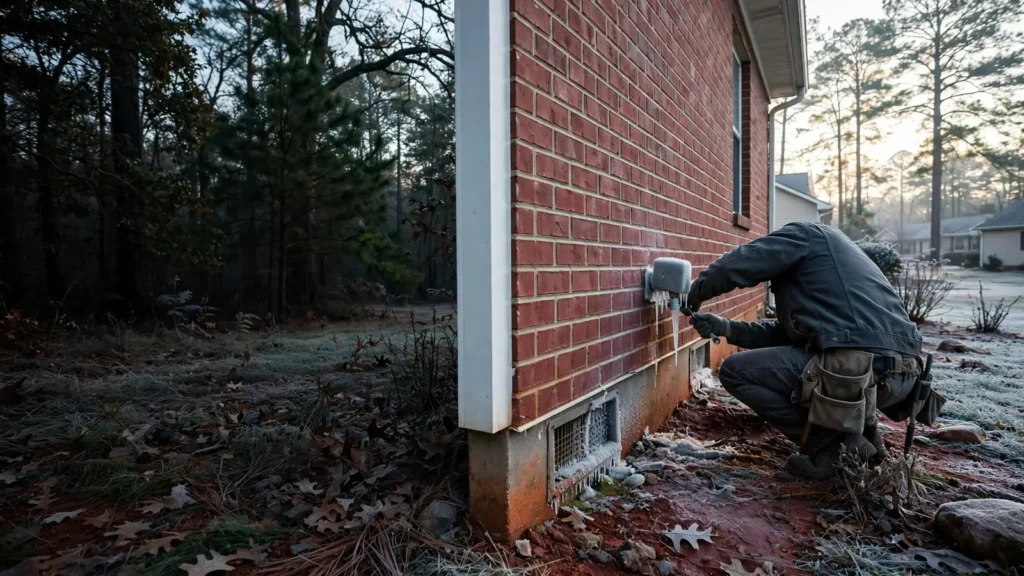
Greenville winters are mild most of the time, which is exactly why the cold nights catch people out. South Carolina Public Radio, citing the National Weather Service, puts the Upstate at more than 40 nights below freezing in a typical year. Most of those are light frosts that a house shrugs off. The trouble comes from the handful of nights in the teens, and from cold snaps that stay below freezing for two days or more. Greenville Water treats "below 20°F" as the point where pipes are at real risk.
This checklist is laid out by timing, so you can do a little now and not scramble later. The full how-to for thawing and preventing frozen pipes is in our frozen pipes guide.
In November: the one-afternoon jobs
None of this takes special tools, and most of it costs under $30 at a hardware store.
- Disconnect and drain every garden hose. A hose left on traps water in the faucet, and the split usually happens inside the wall, where you won't see it until spring.
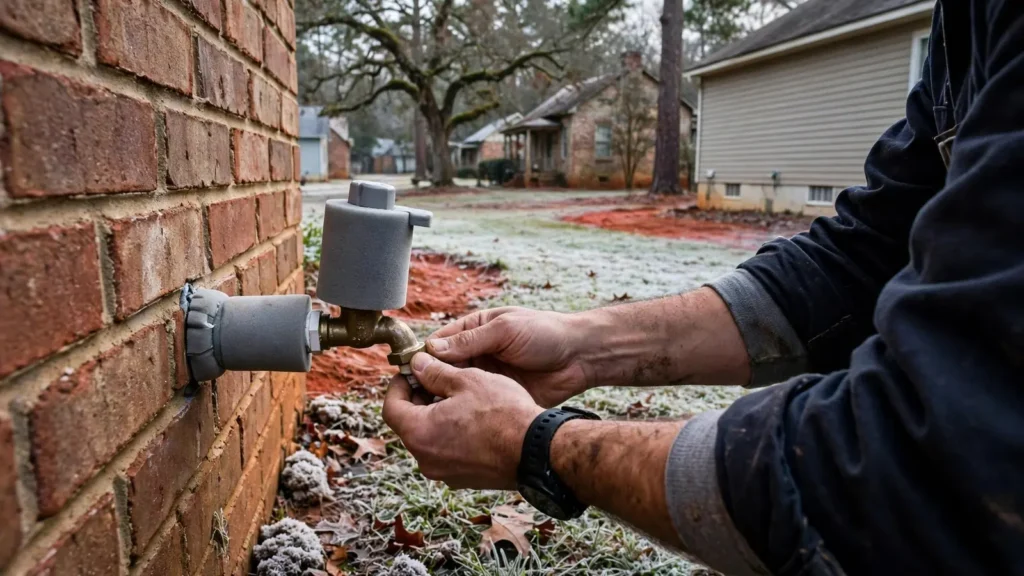
- Put a foam cover on each outdoor faucet. If there's an indoor shut-off for the outside faucet, close it and open the faucet outside to drain the line.
- Sleeve the exposed pipes in the crawlspace, the garage and any unheated utility room. Start with the runs closest to foundation vents and outside walls.
- Test the heat tape if you have it (common on manufactured homes and well lines). Plug it in and check that the indicator light comes on. Heat tape that quietly failed last year is a common surprise.
- Find your main shut-off and make sure it turns. In Greenville Water areas the meter box is usually near the street; many homes also have a valve where the line enters the house. Our burst pipe guide shows where to look.
- Buy foam vent covers for the crawlspace, or know where the vent doors are, so closing them is a five-minute job on the night it matters.
Which Greenville homes freeze first
Two houses on the same street can have very different winters. What matters is where the pipes run and how much cold air reaches them. These are the homes that most often get caught out in the Upstate:
- 1950s–1970s ranches on crawlspaces, common in Taylors, Wade Hampton, Berea and parts of Mauldin. Supply lines run under the floor, often near foundation vents, and the insulation down there is usually old or missing.
- Mill houses on piers or open foundations on the west side and in Piedmont. Some have skirting added later; some still have gaps big enough to see daylight through. Wind under the house is the problem, more than the temperature itself.
- Manufactured homes, where the lines run through the belly and rely on skirting and heat tape. A torn belly wrap or a skirting panel that blew off in a storm is enough to freeze a line.
- Newer two-story homes in Simpsonville, Five Forks, Greer and Fountain Inn. They're well insulated overall, but bonus rooms over the garage, laundry rooms on the garage wall and second-floor baths on exterior walls can have pipes in cold spots. A garage water heater is exposed too if the door stays open.
- Any house with an addition built over a separate foundation or an old porch. The plumbing that serves the addition often runs through the coldest part of the house.
If one of these describes your home, give the cold spots a few extra minutes in November: sleeve the pipes you can reach and look for gaps in the skirting or foundation.
What to buy before the first cold snap
Hardware stores around Greenville tend to sell out of faucet covers and pipe sleeves the day before the first hard freeze. Buying them in November saves the trip and the empty shelf.
| Item | What it does | Worth it for |
|---|---|---|
| Foam faucet covers | Insulates outdoor faucets | Every home with outdoor faucets |
| Foam pipe sleeves | Slows heat loss on exposed pipe | Crawlspaces, garages, unheated rooms |
| Crawlspace vent covers | Blocks cold air from foundation vents | Crawlspace homes with open vents |
| Thermostat-controlled heat cable | Warms a pipe only when it gets cold | Lines that have frozen before; well lines; manufactured homes |
| Water leak sensor or automatic shut-off | Alerts you, or closes the main, when it detects water | Homes left empty over the holidays; second-floor laundry |
Heat tape: check it before you need it
Heat tape works well when it's the right product and installed properly. It's also a fire risk when it isn't, and the U.S. Consumer Product Safety Commission has warned about fires started by old or misused heat tape. Before winter:
- Use only a product listed by a testing lab (UL or similar), and one rated for your pipe. Not all heat tape is rated for plastic pipe such as PEX or CPVC.
- Don't overlap or wrap the cable over itself unless the instructions allow it.
- Replace any cable that is cracked, brittle, charred or several seasons old.
- Plug it into a GFCI outlet, never into a chain of extension cords.
- Check the thermostat end. Most only switch on near freezing, so a dark light on a mild day doesn't mean it's broken. Test it on a cold morning.
The night before a hard freeze
When the forecast low drops under 20°F, or the high is forecast to stay below freezing:
- Close or cover the crawlspace vents. Reopen them once it warms up, to keep moisture down.
- Open the cabinet doors under sinks on outside walls.
- Let the faucets on outside walls drip, hot and cold, a thin steady drip. Greenville Water puts a dripping faucet at about a gallon a day, so the cost is pennies.
- Keep the heat at 55°F or higher, day and night.
- Move the car out and close the garage door if the water heater or any pipes are in the garage.
- Check that a flashlight and a meter key or shut-off tool are where you can find them in the dark.
Pipe already frozen or split? Call a local plumber
If you're away over the holidays
Thanksgiving and Christmas trips are when the expensive freeze damage happens, because nobody is home to hear the water running. Before you leave:
- Set the thermostat to 55°F or higher. Don't turn the heat off.
- Shut off the main water valve and open a faucet at the lowest point of the house to drain some pressure off the lines.
- Turn the water heater to "vacation" or "pilot" (gas), or switch off its breaker (electric). That way it isn't heating a tank that might lose its water supply.
- Ask a neighbor to check the house if a hard freeze hits while you're gone, and tell them where the shut-off is.
If you rent, check with your landlord before shutting off the main, and send them a photo of the faucet covers. It helps if there's ever a question about who did what.
After the cold snap
A pipe can split while frozen and only start leaking as it thaws, sometimes hours later. Once temperatures climb back above freezing:
- Look under sinks and in the crawlspace for drips or wet insulation.
- Check the water meter with every tap off. If the dial or leak indicator is moving, water is going somewhere. Our leak detection guide explains how to read it.
- Turn on each outdoor faucet briefly and listen for water inside the wall.
- Reopen the crawlspace vents.
When it's worth calling a plumber before winter
Most freeze prep is a homeowner job. A plumber earns the trip fee when:
- A pipe froze last winter in the same spot. It will probably freeze again unless it's rerouted, insulated properly or fitted with heat cable.
- Outdoor faucets are the old short-stem type on a house with no indoor shut-off. Swapping them for frost-free faucets is a small job.
- The main shut-off won't turn, or there isn't one inside the house.
- The home has old galvanized pipe that has already leaked once. Our older homes guide covers what to expect.
Typical prices for these jobs are in our Greenville plumber cost guide.
Get your home ready for winter: call a local plumber
Freeze prep questions
When should I disconnect my garden hoses in Greenville?
Before the first forecast freeze, which in the Upstate can come any time from late October on. Most people do it with the November jobs and leave the hoses off until spring.
Do frost-free outdoor faucets still need a cover?
They're much less likely to freeze, but only if the hose is disconnected and the faucet drains outward. A foam cover is cheap insurance, especially on a north-facing wall.
Should I turn off the water heater when I shut off the main for a trip?
Yes. Set a gas heater to "vacation" or "pilot" and switch off the breaker for an electric one, so it isn't heating a tank that might lose its supply.
Can heat tape go on PEX or other plastic pipe?
Only if the product says it's rated for plastic pipe. Many are made for metal pipe only. Check the label and the instructions before you install it.
Sources
- South Carolina Public Radio, "When is South Carolina's first typical frost and freeze?", October 30, 2025 (NWS data on freezing days in the Upstate).
- Greenville Water winter weather guidance (below 20°F risk threshold, dripping faucets, 55°F thermostat).
- Clemson Cooperative Extension, Home & Garden Information Center: protecting pipes from freezing.