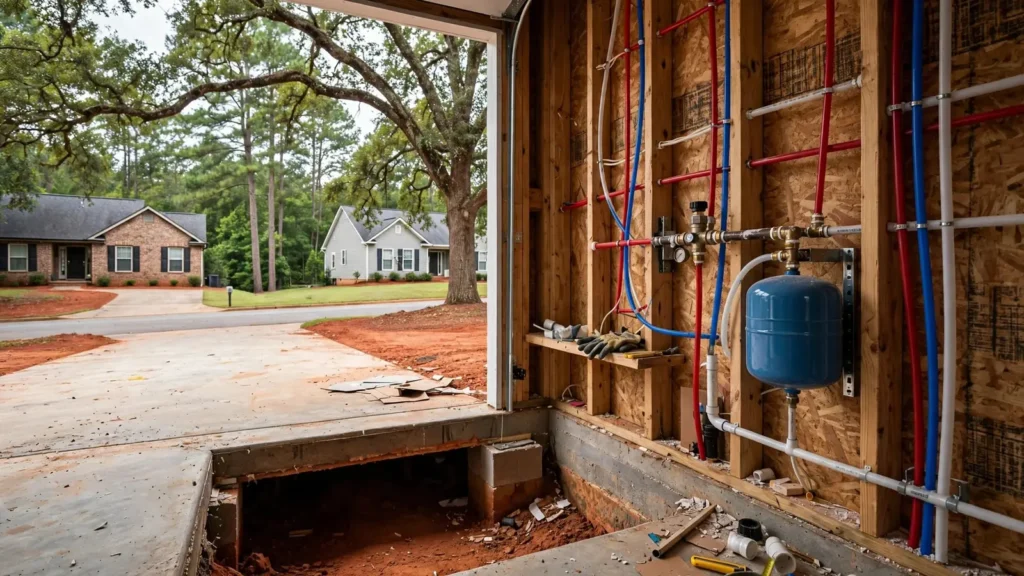
Weak water pressure is one of those problems that creeps up. The shower gets a little softer, the washer takes longer to fill, and one day you notice you can't run the dishwasher and rinse a plate at the same time. Low water pressure in Greenville County nearly always has a findable cause, and the first few checks cost nothing.
The trick is to sort it by where it shows up. One fixture, one side of the house, hot only, or every tap at once: each points to a different culprit. Here's how to work through it, with the local details that matter: who to call at Greenville Water or Greer CPW, why newer homes in Simpsonville and Fountain Inn behave differently from 1950s houses near downtown, and what's different on a well.
Low water pressure in Greenville, SC: one fixture or the whole house?
| What you notice | Most likely cause | First check |
|---|---|---|
| One faucet or shower is weak | Clogged aerator, showerhead or cartridge | Unscrew and clean the aerator or showerhead |
| Hot water weak, cold fine | Water heater shutoff partly closed, sediment, or a failing mixing valve | Check the valve on the heater's cold inlet |
| Whole house weak, suddenly | Utility main break or high demand, or a leak on your line | Ask neighbors; check the outage map; do the meter test |
| Whole house weak, gradually over years | Old galvanized pipe, or a failing pressure-reducing valve | Note the home's age and look for a PRV at the main |
| Whole house weak after plumbing or meter work | Main or curb valve not fully reopened | Open the house main fully |
| Pressure cycles up and down | Well pressure tank or switch | Watch the gauge at the tank |
When it's just one faucet or shower
Unscrew the aerator at the tip of the faucet (wrap it in a rag so pliers don't scratch it) and look inside. Grit and white or tan flakes collect on the screen, especially after the utility flushes hydrants or repairs a main nearby. Rinse it, scrub it with an old toothbrush, and put it back. Showerheads get the same treatment: soak the face in white vinegar for an hour if there's buildup.
Greenville Water is soft, so mineral scale builds slowly here. Greer CPW water is somewhat harder but still mild. That means on public water, a clogged aerator is more often sediment than scale. If cleaning doesn't help, the faucet cartridge or the shutoff valve under the sink may be the restriction. Old multi-turn stop valves under sinks sometimes don't open all the way after years of sitting.
When only the hot side is weak
If the cold runs strong and the hot is a trickle at every faucet, the problem is at or near the water heater. Check that the cold inlet valve on top of the heater is fully open. Sediment in an older tank, a clogged dip tube, or a bad heat trap fitting can also choke the flow. Our water heater repair guide covers the tank side, and no hot water covers the other end of the spectrum.
Is the main valve all the way open?
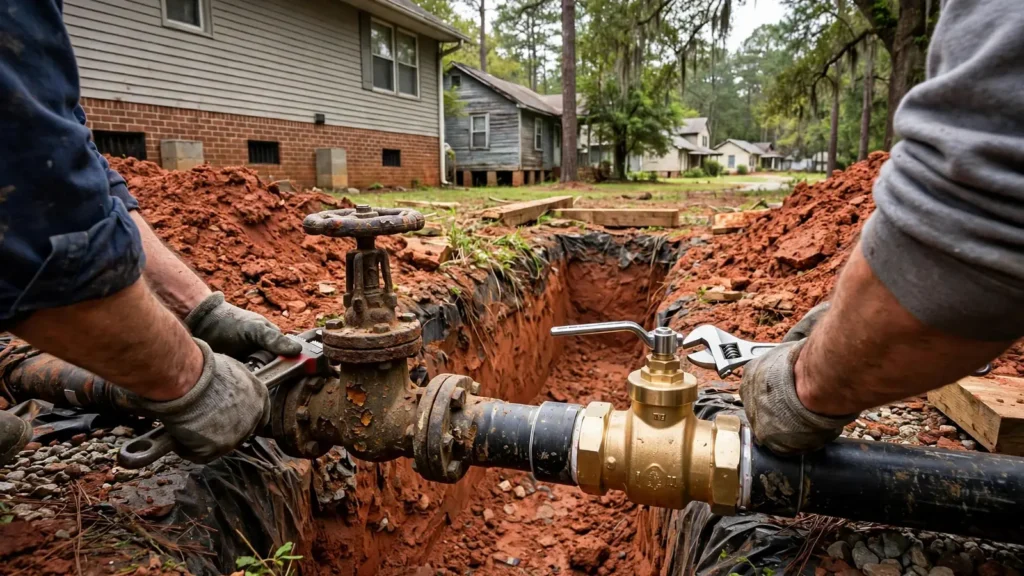
This one catches a lot of people after a repair, a winter shutoff or a meter replacement. Greenville Water's rules call for a customer shutoff within 5 feet of the meter, and many houses also have a valve where the line enters the house, in the crawlspace, garage or a closet. An old gate valve (the round wheel handle) that's only a few turns open will still pass water, just not much of it. Open it fully, then back it off a quarter turn so it doesn't stick.
Don't force a corroded gate valve. They're known to break off inside. If it won't move, that's a good time to have it replaced with a quarter-turn ball valve; see our notes on old main valves in the older Greenville homes guide.
Pressure-reducing valves in newer subdivisions
Many homes built in the last few decades, especially in growing areas like Five Forks, Simpsonville and Fountain Inn, have a pressure-reducing valve (PRV) on the main line, often in the garage near where the water comes in, sometimes with an expansion tank beside it. Greenville Water's rules recommend a PRV wherever pressure exceeds 80 psi, and the International Residential Code, which South Carolina adopts with state changes, caps static pressure inside the house at 80 psi.
A PRV has a spring and diaphragm inside, and like any valve it wears. Signs it's failing:
- Pressure drops gradually across the whole house over months.
- Pressure is fine at an outdoor faucet ahead of the PRV but weak inside.
- Pressure swings, or you hear humming or chattering from the valve.
- Someone turned the adjusting screw way down and forgot.
Most PRVs have a bolt on top that sets the outlet pressure. A plumber can test the pressure on both sides, adjust it, rebuild the valve or replace it. If you're in a newer home, our Fountain Inn and Simpsonville pages cover what's typical in those builds.
Galvanized pipe in older homes
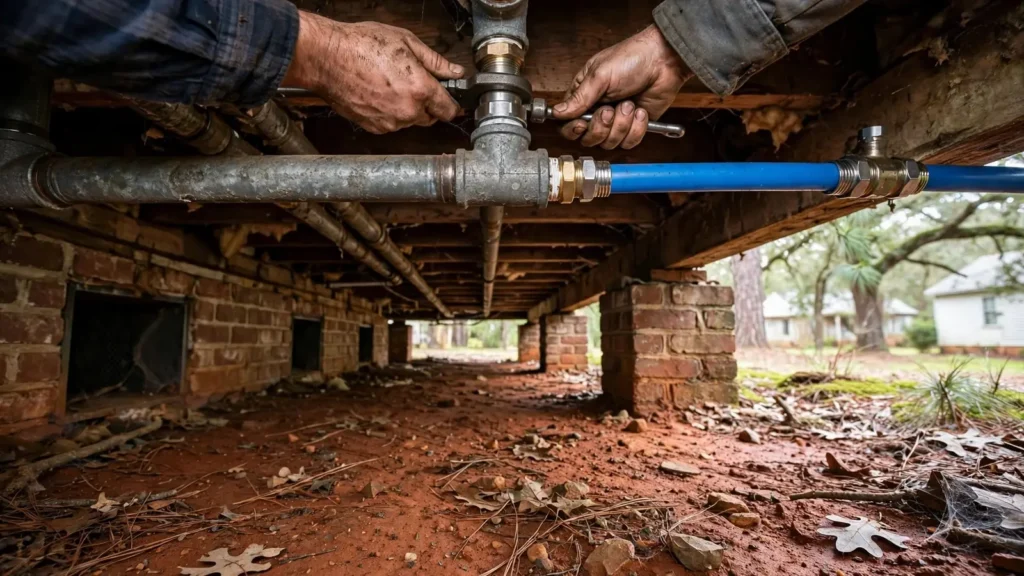
If your house dates from before about 1970 and still has its original supply piping, low pressure that worsened over years points to galvanized steel. These pipes rust from the inside, and the buildup narrows the opening until a 3/4" line passes far less water than it should. The giveaway is usually a gray, threaded pipe in the crawlspace or basement and brown water after the taps sit unused. You can't clean it out. The fix is replacing the worst runs or repiping the house; our repiping guide walks through the options, and the older homes guide shows how to identify galvanized.
Pressure low through the whole house? Call a local plumber
Elevation and the second floor
Water pressure drops about 0.43 psi for every foot you climb. A shower on a second floor 10 feet above the first-floor fixtures gets roughly 4 psi less before anything else is counted. Greenville County runs from low ground along the Reedy and Enoree rivers up to the foothills, and a house near the top of a hill or close to the same height as a nearby water tank will see lower pressure than one in a valley on the same street. That isn't a defect, but it explains why two similar houses can feel different.
If your pressure is low because of where the house sits, a booster pump is one answer. Greenville Water's rules say any pressure-increasing device such as a booster pump must be approved by Greenville Water before it's installed, so get that approval first.
How to measure your water pressure
- Buy a hose-thread pressure gauge. They're inexpensive at hardware stores.
- Screw it onto an outdoor faucet with nothing else running in the house, and open the faucet fully. That's your static pressure.
- Test at more than one faucet if you can, including one ahead of the PRV if your house has one.
- Write down the reading with the date and time. Pressure can dip during peak morning and evening use. A pattern helps a plumber or the utility.
There's no single right number, but there are two useful markers: Greenville Water recommends a PRV when pressure goes over 80 psi, and Greer CPW issues boil water advisories when system pressure drops below 20 psi. Most homes sit comfortably between those.
When it's the utility's side, and how to report it
Greenville Water's own advice: if low pressure starts suddenly, check all your faucets. If every faucet is affected, there may be a nearby main break or unusually high demand on the system. Ask the neighbors. If they have it too, call the utility. If they don't, look for a leak on your property, starting with the meter test in our high water bill guide.
- Greenville Water: 864-241-6000, any time. After hours and on holidays it connects to an answering service. Its website has a real-time water outages map.
- Greer CPW: 864-848-5500. After hours, the same number reaches its answering service, and technicians are on call around the clock. Boil water advisories are posted on its website.
- Other systems: use the number on your bill. Our water provider guide lists who serves where.
A sudden drop with water bubbling up in the yard or street is worth reporting right away. Greenville Water notes in its rules that it doesn't guarantee a fixed pressure and isn't liable for damage from pressure changes in its mains, which is one more reason a PRV is worth keeping in good shape. A leak on your own service line can also drag pressure down; see water line repair.
Low pressure on a private well
On a well, your pressure comes from the pump, the pressure switch and the pressure tank, not from a utility. Most residential switches are set to turn the pump on at 30 or 40 psi and off at 50 or 60. If pressure is weak or surges up and down:
- Check the gauge near the tank while someone runs water. Rapid on-off cycling usually means the tank has lost its air charge. Amtrol, a major tank maker, says the air precharge should be 2 psi below the switch's cut-in pressure, checked with the tank drained.
- Look at any sediment filter. A clogged cartridge drops pressure across the whole house and is the cheapest fix there is.
- If pressure never climbs to the cut-off, the pump or the well itself may be struggling.
Our post on well pump problems goes deeper on wells in the north county.
Still can't find the cause? Call a local plumber
Low water pressure questions
Why did my water pressure drop after Greenville Water worked on my street?
Main repairs can stir up sediment that lands in aerators and showerheads, and a curb valve or meter swap sometimes leaves a valve partly closed. Clean the aerators first. If the whole house stays weak, call the utility to check the meter side.
Can I adjust my pressure-reducing valve myself?
Most PRVs have an adjusting bolt, and small changes are simple with a gauge on a hose faucet. Don't go above 80 psi. If turning the bolt does nothing, the valve likely needs a rebuild or replacement.
Why is the pressure fine outside but weak in the house?
Outdoor faucets are often plumbed ahead of the PRV, so they see full street pressure. Weak indoor pressure with strong outdoor pressure points at the PRV or a partly closed valve after it.
Do I need permission to install a booster pump?
On Greenville Water, yes. Its rules say pressure-increasing equipment such as booster pumps must be approved by Greenville Water before installation. Other utilities may have similar rules, so ask yours.
Will a water softener lower my water pressure?
A properly sized softener shouldn't cause a noticeable drop, but an undersized unit or a clogged filter ahead of it can. On Greenville Water, which tests at about a third of a grain of hardness per gallon, you likely don't need a softener at all.
Sources
- Greenville Water, Customer Service FAQs: "Why would my water pressure be unusually low?" and emergency contact information.
- Greenville Water, Rules and Regulations (2020 revision, as posted): Section 5.30 Customer's Shutoff Valve, 5.40 Pressure Reducing Devices, 5.50 Pressure Increasing Devices, 6.10.2 and 6.10.3 on interruptions and pressure fluctuations.
- Greer Commission of Public Works, FAQ: after-hours emergencies and boil water advisories.
- International Code Council, International Residential Code, Section P2903.3.1 (maximum 80 psi static pressure); SC Building Codes Council, codes in effect (2021 editions with SC modifications, effective January 1, 2023).
- Amtrol, Well-X-Trol well tank FAQ and installation instructions (precharge 2 psi below cut-in).
- Greenville Water 2026 monthly water quality reports and Greer CPW 2025 water quality report (hardness).