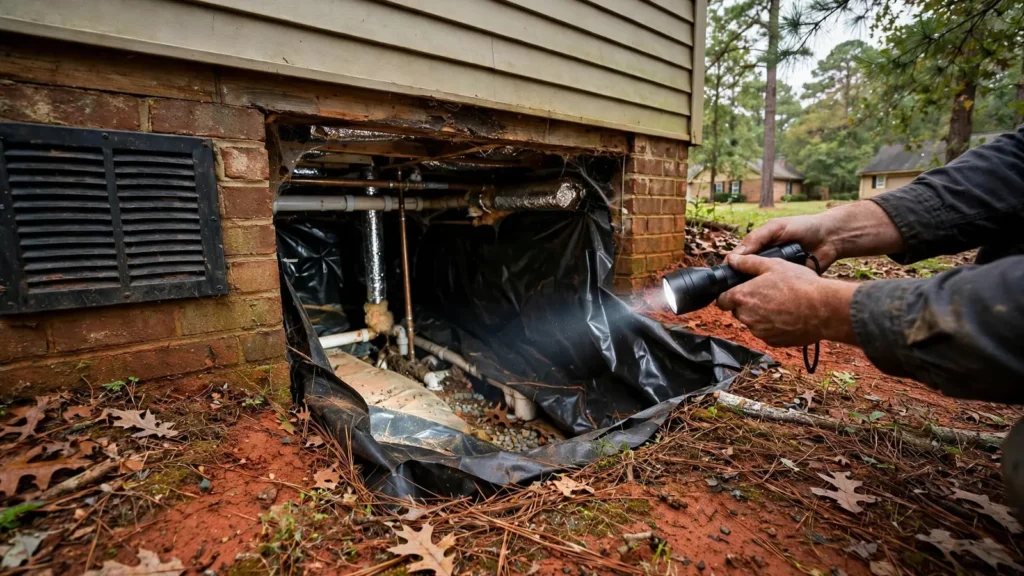
Helene reached the Upstate in the early hours of September 27, 2024, as a tropical storm, only hours after coming ashore in Florida's Big Bend as a Category 4 hurricane. By morning, news reports counted about 275,000 power outages in Greenville County alone, across all utilities. Duke Energy said more than a million of its customers in the two Carolinas were out at once, with the heaviest damage around Greenville, Spartanburg, Asheville and Charlotte. Duke described its Upstate transmission lines and substations as severely damaged, and in places destroyed. A week later, on October 3, Duke still had about 219,000 Upstate customers without power.
For a lot of households that meant several days, and for some well over a week, without electricity. Most of the plumbing questions that came out of it were the same handful. We've gathered them here, so the next long outage (storm, ice or otherwise) goes a little easier.
What kept working: city water
If you're on Greenville Water, your water most likely never stopped. Greenville Water reported that both of its treatment plants and all of its pump stations lost grid power in the high winds and kept running on backup generators. Its CEO later wrote that the utility had no transmission or distribution interruptions through the storm, and it sent water to help the Asheville area, where the city system was badly damaged.
That's worth knowing because it changes your first move in an outage. On public water, you can usually keep flushing, washing and drinking. The trouble spots are the appliances that need power to use that water.
What about boil-water advisories? We looked for a Greenville County advisory tied to Helene and couldn't find a county-wide one, and Greenville Water reported normal service. Smaller systems and individual neighborhoods can issue local notices after a main break or a pressure loss, so the rule is simple: if your water provider issues a notice, follow it, and if you're unsure, call them. SC DES posts guidance on boiling water when a notice is in effect.
Wells: no power, no water
This was the hardest part of Helene for northern Greenville County. A private well has an electric pump, so when the power goes, you get whatever water is left in the pressure tank (often just a few gallons) and then nothing. No showers, no flushing beyond what you can pour in a bucket.
What helps before the next one:
- Store drinking water. A few gallons per person is a sensible minimum for a long outage, more if you have pets or livestock.
- Fill bathtubs and buckets when a storm is forecast. That's flushing water.
- Know your pump. Most submersible well pumps run on 240 volts and need a burst of extra power to start. A small portable generator often can't start one. Ask an electrician what size you'd need.
When power comes back, the pump should restart on its own. Expect air in the lines: open a cold faucet, let it sputter until it runs smooth, then the others. If the pump won't start, check its breaker and the pressure switch before anything else. Our well pump troubleshooting guide walks through the order, including the low-pressure cutoff lever some switches have.
Water heaters after the power comes back
Here's the mistake that cost people a heating element after Helene: power returns, the electric water heater turns on, but the tank isn't full. Elements that heat in air burn out in seconds. That can happen on a well (the tank drained while you used the last of the pressure) or anywhere the water was shut off during the outage.
- Before power returns, switch the water heater's breaker off if you can safely reach the panel.
- Once water is flowing, open a hot faucet and let it run until you get a steady stream with no air. That tells you the tank is full.
- Then switch the breaker back on. A full tank of cold water takes a few hours to recover.
Gas tank water heaters with a standing pilot usually keep working without electricity. Newer power-vent gas models and nearly all tankless heaters, gas or electric, need power for their fans and controls, so they stop too. If you still have no hot water a day after power returns, our no hot water guide covers resets and pilot problems. If the tank is leaking afterward, see the water heater leaking guide.
No hot water after the outage? Call a local plumber
Sump pumps and septic pump tanks
Helene brought heavy rain to the Upstate along with the wind, and that's exactly when a sump pump is needed and exactly when the power is gone. A house with a basement and a sump can flood from groundwater during the outage even if nothing breaks.
- A battery backup sump pump is the most practical fix. It runs for a limited time, so a long outage can still beat it, but it buys hours.
- Water-powered backup pumps use city water pressure and need no electricity. They don't work on a well (no power, no pressure), and they need a proper backflow device.
- Check the pit as soon as you can after the power comes back, and test that the pump actually starts.
Our sump pump basics post covers types, backups and testing.
Most septic systems in Greenville County are gravity systems and keep working without power, as long as you have water to flush. Some properties have a pump tank or an alternative system with an electric pump, alarm or aerator. Those stop. If you have one, keep water use to a minimum during the outage, because the pump tank has limited storage. When power returns, an alarm may sound briefly while the pump catches up. If it keeps sounding, call your septic service.
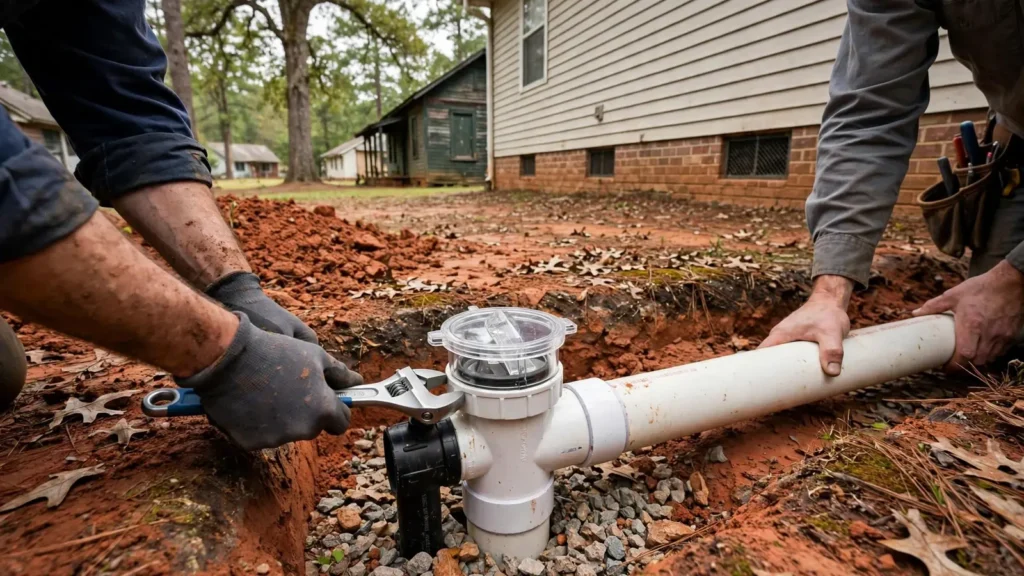
If the next long outage comes in winter
Helene hit in September, so frozen pipes weren't the issue. An ice storm in January is a different story. With no heat, a house loses temperature fast, and a crawlspace loses it faster. Greenville Water treats temperatures below 20 degrees F as the point where pipes are at real risk.
If a winter outage looks like it will last more than a day with lows in the low 20s or below:
- Close the crawlspace vents and keep cabinet doors under sinks open.
- Let faucets on outside walls drip. On a well with no power you can't, which makes the next step more important.
- If the house will drop toward freezing inside, shut the main water off and open faucets at the lowest point to drain the lines. Turn off the water heater's power or gas first.
- Don't heat pipes with an open flame, and don't run a gas oven or grill indoors for heat.
Our frozen pipes guide has the full prevention and thawing steps, and if a pipe does split, the burst pipe guide starts with finding your shutoff.
Generators and transfer switches: the safe way
A lot of people bought generators after Helene, and a lot of them were plugged in the wrong way. Duke Energy's guidance is plain: don't connect a generator directly to your breaker panel, fuse box or meter. Power can flow backward onto the lines and injure or kill a line worker who thinks the line is dead. That kind of setup is called back-feeding, and the "suicide cord" (a cord with a male plug on both ends) is the classic way people do it.
The safe options:
- Plug appliances straight into the generator with heavy-duty outdoor cords. Fine for a fridge and some lights; it won't run a 240-volt well pump.
- Have a licensed electrician install a transfer switch or interlock, so the house is disconnected from the grid whenever the generator is on. This is how you run a well pump, and it's a permitted electrical job, not a plumbing one.
- Run the generator outdoors, in a dry spot, well away from doors, windows and air intakes. Carbon monoxide from generators kills people every storm season.
- Turn the generator off when you see utility crews working nearby, as Duke asks.
Plumbing after a power outage: a short checklist
| Check | What you're looking for |
|---|---|
| Water heater | Tank full before power goes back on; no leaks at the base or the relief valve |
| Well | Pump restarts, pressure climbs, air clears from the faucets; wellhead not flooded |
| Sump pit | Pump starts on its own; pit not overflowing; discharge line clear of debris |
| Crawlspace | No standing water, no new drips at joints, insulation still in place |
| Water meter (city water) | With every tap off, the dial isn't moving. A moving dial means a leak somewhere |
| Septic alarm | Clears on its own within a few hours of power returning |
| Outdoor lines | Fallen trees or root balls haven't pulled up a water or sewer line in the yard |
That last row came up more than people expect after Helene. When a big tree goes over, the root ball can tear up whatever pipe runs underneath it. If you see a soggy strip of yard or the meter keeps spinning, our water line repair guide explains whose side of the meter the problem is on.
Leak or no water after a storm? Call a local plumber
Power outage plumbing questions
Is it safe to flush the toilet during a power outage?
On city water and a gravity sewer or septic system, yes. On a well, you can flush by pouring a bucket of water into the bowl once the pressure tank runs out. If your septic system has an electric pump tank, keep flushing to a minimum until power returns.
Why did my electric water heater stop working after the power came back?
The most common reason is a burned-out element from heating before the tank refilled, or a tripped high-limit reset. Turn the power off, make sure hot water flows from a faucet with no air, then try the reset. If it still won't heat, an element likely needs replacing.
Can a portable generator run my well pump?
Sometimes, but only through a transfer switch or interlock installed by a licensed electrician, and only if the generator is big enough to start the pump. Most submersible pumps are 240-volt and need extra power at startup.
Did Greenville Water lose service during Helene?
Greenville Water reported that its plants and pump stations lost grid power but kept running on backup generators, with no interruption in water service to customers.
Should I shut off my water before a long winter outage?
If the house is likely to drop toward freezing inside, yes. Shut off the main, turn off the water heater's power or gas, and open the lowest faucets to drain the lines. It's much cheaper than a burst pipe.
Sources
- Duke Energy news releases on Hurricane Helene restoration in the Carolinas, September and October 2024 (more than 1.05 million customers out on Sept. 27; Upstate transmission damage; 219,000 Upstate customers out as of Oct. 3), as reported by WBTV, FOX Carolina and T&D World.
- Greenville County outage count (about 275,000 on the morning of Sept. 27, 2024, all utilities): WIS and Post and Courier reporting, September 2024.
- Greenville Water: "Greenville Water remains vigilant following Tropical Storm Helene" and "A Note from CEO Jeff Boss: Tropical Storm Helene update," September and October 2024.
- Duke Energy: Generator Safety page (no direct connection to panels; transfer switch by licensed electrician; outdoor use).
- SC Department of Environmental Services: Private Wells: What to Do During and After Storms.
- Clemson Cooperative Extension, Home and Garden Information Center: How to Prepare Your Well for the Next Flood.
- Greenville Water: winter preparedness guidance (below 20 degrees F risk) and leak-check steps using the water meter.
- U.S. EPA: City of Asheville lifts systemwide boil water notice issued after Hurricane Helene, November 2024.