A water bill that jumps from $80 to $150 with no change in your routine is worth a Saturday morning. Most of the time the cause is ordinary and cheap to fix. What makes a high water bill in Greenville County sting is that the water itself is the small part. For most households, the sewer charges billed alongside it cost more per gallon than the water does, so every leaked gallon gets charged two or three times.
This guide walks through the checks in the order we'd do them, shows what a leak costs at current local rates, and explains what Greenville Water will and won't adjust. Greer CPW customers will find their numbers further down.
First, check that it's really more water
Before hunting for leaks, look at the meter section of the bill. Greenville Water bills in thousands of gallons and shows a 12-month usage history. Compare this month's gallons to the same month last year, not just last month. A few things raise a bill without any leak:
- A rate change. Greenville Water's 2026 rates took effect January 1 and showed up on February bills. The utility estimated the increase at about $0.79 a month for a household using 3,000 gallons, so a rate change alone doesn't explain a big jump.
- A longer billing period, or guests, a new baby, a filled pool or a new lawn being watered.
- An estimated read. Greenville Water says it doesn't estimate bills except in unusual cases, such as a vehicle parked over the meter for months.
EPA's WaterSense program gives a useful benchmark: if a family of four uses more than 12,000 gallons in a winter month, there could be a serious leak. MetroConnects says its average residential customer uses about 4,000 gallons a month.
Step one: the meter test
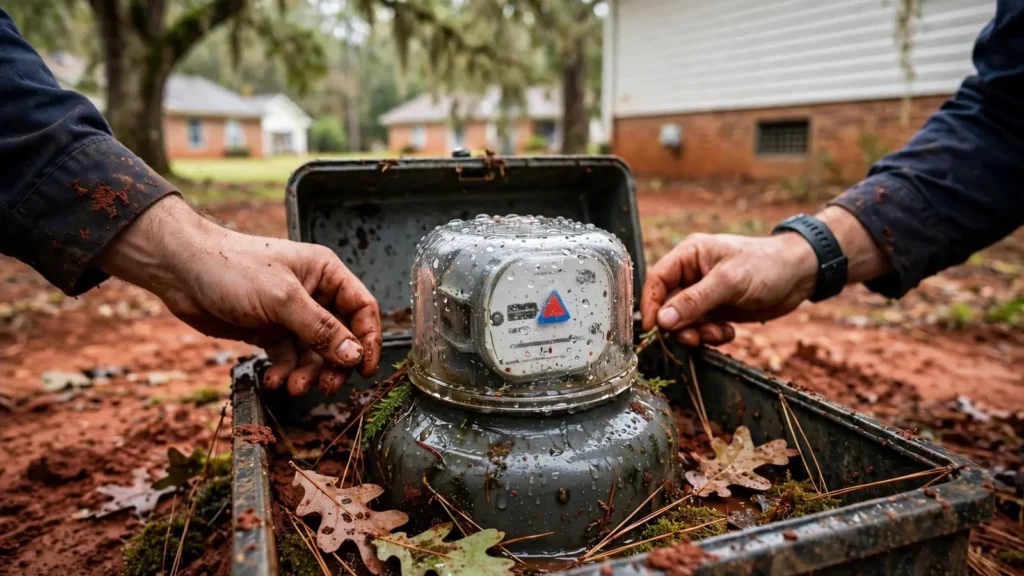
Greenville Water's meters are outside, usually near the street in the right of way. This is the same test the utility recommends, with one extra step that tells you whether the leak is inside or underground.
- Turn everything off. No faucets, toilets, ice maker, washer, dishwasher or irrigation. Make sure no one runs water during the test.
- Open the meter box and read it. Note the position of the sweep hand and the small leak indicator (often a red triangle or star). If the leak indicator is spinning, water is moving.
- Wait at least 15 minutes and read again. EPA suggests two hours for slow leaks, and overnight works even better.
- If it moved, shut the main valve at the house and open a faucet to confirm the water stops. Then go back to the meter.
- Read the result. If the meter still moves with the house valve closed, the leak is in the service line between the meter and the house. If it stops, the leak is inside the house or on something connected to it.
The line from the meter to the house belongs to the homeowner. Greenville Water maintains its side up to the outlet of the meter. Our who-owns guide explains where that line falls, and our water line repair page covers fixing it.
What causes a high water bill in Greenville, SC?
These are the usual suspects, roughly in the order we'd check them.
Toilets
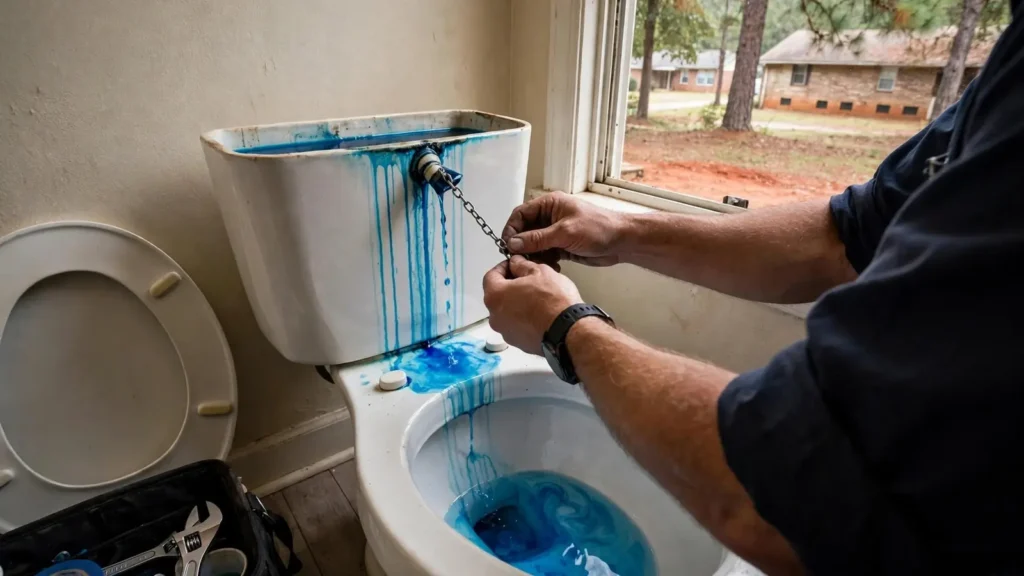
Toilets are the most common cause of a high water bill, and they're easy to rule in or out. Put a few drops of food coloring in each tank, don't flush, and wait. Greenville Water says to wait at least an hour; EPA says color in the bowl after 10 minutes means a leak. Also listen for a tank that refills by itself every so often. Our post on fixing a running toilet shows how to tell a bad flapper from a bad fill valve.
Irrigation systems
Irrigation is the second place to look, especially in spring. EPA says a leak in an irrigation system about 1/32 of an inch across can waste about 6,300 gallons a month. Run each zone and walk it: look for a geyser, a head that won't shut off, or a soggy patch. Check the backflow device too. Greenville Water's rules require a dual check valve or double-check assembly on residential irrigation, and a cracked one can leak at the house end. Note that Greenville Water's rules say no leak adjustments are made for irrigation systems.
The water heater relief valve
A temperature and pressure relief valve that drips or runs into a drain line can leak for months without anyone seeing it, especially if the discharge pipe goes outside or into a floor drain. Feel the end of the pipe and check for a damp drain pan. Our water heater leaking guide covers why these valves open.
Outdoor faucets, hoses and fixtures
A hose left on a timer, a leaking hose bib in the crawlspace, or a faucet that drips once a second all add up. EPA puts a once-a-second drip at more than 3,000 gallons a year.
Hidden leaks: slabs and walls
If the meter runs with every fixture off, the toilets pass the dye test, and the service line checks out, the leak may be under a slab or inside a wall. Warm spots on the floor, the sound of running water, or a damp patch in the garage are clues. That's a job for electronic leak detection; see our leak detection guide.
Meter still spinning? Call a local plumber
What a leak costs at Greenville rates
Most Greenville Water bills carry more than water. Greenville Water bills on behalf of ReWa, MetroConnects, and the City of Greenville, Mauldin, Simpsonville and Fountain Inn. Here are the 2026 residential charges we could confirm from each provider:
| Charge | Monthly base | Per 1,000 gallons |
|---|---|---|
| Greenville Water, inside City of Greenville (5/8" meter) | $5.97 | $1.93 |
| Greenville Water, outside City of Greenville (5/8" meter) | $8.23 | $2.68 |
| MetroConnects sewer collection (most of unincorporated county) | $11.72 | $2.32 |
| ReWa trunk and treatment (5/8" or 3/4" meter) | $12.75 | $7.09 |
For a home outside city limits on MetroConnects sewer, every 1,000 gallons through the meter costs $2.68 + $2.32 + $7.09, or $12.09. ReWa's charge is the biggest piece. ReWa has also announced a 4% rate adjustment starting January 2027.
Worked example: a running toilet
Take a household outside Greenville city limits using 4,000 gallons a month, which MetroConnects calls average. Its usage charges come to about $81 a month: $18.95 water, $21.00 MetroConnects and $41.11 ReWa, base charges included. Now add a toilet that runs nonstop. EPA's figure for that is up to 200 gallons a day, or about 6,000 gallons a month.
| Leak | Extra gallons a month | Extra water | Extra MetroConnects | Extra ReWa | Extra total |
|---|---|---|---|---|---|
| Toilet running nonstop (200 gal/day) | 6,000 | $16.08 | $13.92 | $42.54 | $72.54 |
| Slow flapper leak (30 gal/day, example) | 900 | $2.41 | $2.09 | $6.38 | $10.88 |
So the average bill above goes from about $81 to about $154. Over a year, the nonstop toilet costs about $870. The fix is usually a flapper or fill valve that costs a few dollars.
Why a winter leak can hurt twice
ReWa runs a Six-Month Savings Program that every residential account from participating water agencies, including Greenville Water, gets automatically. It averages your use over the winter (from the October meter read to the April read) and uses that as the most you'll be charged for ReWa treatment during the summer months. The idea is to avoid charging sewer treatment on lawn watering.
The catch: a leak during the winter is billed at full sewer rates, and it also raises your winter average. A higher average means a higher summer ceiling. Fix winter leaks fast. A summer-only leak, on the other hand, mostly costs you the water and any charges not covered by the cap. Greer CPW customers have a fixed 5,000-gallon winter-average maximum for the ReWa portion, according to ReWa.
Can Greenville Water adjust a leak bill?
Sometimes. Greenville Water's posted Rules and Regulations say it isn't obligated to adjust bills except for meter-reading, billing or meter-accuracy errors. When high usage comes from broken or leaking water pipes on your property that you didn't know about, Greenville Water may, at its option, adjust the bill after the repair is made, with proof of repair. The rules set these limits:
- No more than one adjustment in any 12-month period.
- The adjustment covers part of the usage above your normal use under similar conditions, as Greenville Water determines it.
- No adjustments for irrigation systems.
Keep the plumber's invoice showing what was repaired and when. Call customer service at 864-241-6000 and ask how the adjustment would apply to the sewer charges on your bill, since those belong to the partner agencies. A running toilet isn't a broken pipe, so don't count on it qualifying.
Asking for a meter test
If the meter test shows no leak and your usage still looks wrong, you can ask Greenville Water to test the meter. Its rules call a meter accurate if it registers within 3%. If the test finds the meter accurate, you pay a $60 testing charge. If not, Greenville Water covers the test, and a fast meter means a refund of the overcharge for up to 12 months back. A slow meter can work the other way: the rules let Greenville Water bill for water a slow meter missed. Do the leak checks first, since they cost nothing.
If you're a Greer CPW customer
Greer CPW uses a tiered water rate. Inside Greer city limits, the first 4,000 gallons cost $1.41 per 1,000 and use above that costs $1.72. Outside the city it's $2.12 and $2.82, on top of a monthly facility charge ($10.09 inside, $14.45 outside for a 3/4" meter). A leak pushes you into the higher tier faster. Greer CPW has been installing advanced meters that give customers near real-time usage data through its customer portal, which makes a leak easier to spot. The meter test and dye test work the same way. Greer CPW's after-hours line is 864-848-5500.
When it's time to call a plumber
- The meter moves with the house valve closed (service line leak).
- The meter moves with every fixture off and every toilet passes the dye test.
- You hear water running in a wall or under the floor.
- The bill is high enough that you'll want a repair invoice for an adjustment request.
For typical prices on leak detection and line repair, see our Greenville plumber cost guide. If you also notice weak flow at the taps, a service line leak can cause both; our low water pressure guide explains how to tell.
High bill and no obvious leak? Call a local plumber
High water bill questions
How much water does a typical Greenville household use?
MetroConnects says its average residential customer uses about 4,000 gallons a month, and Greenville Water used a 3,000-gallon household as its example for the 2026 rate change. Your own 12-month history on the bill is the best yardstick.
Why was my bill high if the meter isn't moving now?
The leak may be intermittent. Irrigation zones, a toilet that refills every so often, an ice maker line, or a relief valve that opens when the water heater runs can all stop during a short test. Repeat the meter reading overnight, with the irrigation controller switched off.
Does a Greenville Water leak adjustment cover the sewer charges?
The rules don't spell that out for each partner agency. Sewer charges on the bill belong to ReWa, MetroConnects or your city. Ask Greenville Water customer service how an approved adjustment carries over to those charges.
Does filling a pool in summer raise my sewer bill?
For the ReWa treatment portion, usually less than you'd expect. ReWa's Six-Month Savings Program caps residential treatment charges between the April and October reads at your winter average. Other sewer charges on the bill may not have the same cap.
Can I get more time to pay a big leak bill?
Greenville Water's contact form includes time extension requests, and its site has a financial assistance page. Call 864-241-6000 during business hours before the due date; the late fee is $7.50 or 5% of the bill, whichever is greater.
Sources
- Greenville Water, 2026 Greenville Water Rates and Fees (effective January 1, 2026) and 2026 rate change notice.
- Greenville Water, Rules and Regulations (2020 revision, as posted): Section 4.50 Testing Meters, Section 4.80.4 Adjustment of Bills, Section 5.60 Residential Irrigation Systems.
- Greenville Water, Customer Service FAQs (leak checks, meter location, $60 meter test, estimated bills, service line responsibility).
- Greenville Water, "Getting to Know Your Greenville Water Bill" (partner agency charges, delinquent fee).
- MetroConnects, "How Will I Be Billed?" and January 2026 Rate Change notice.
- ReWa, Rates, Fees and Charges page (trunk and treatment rates; 4% adjustment January 2027), and Six-Month Savings Program fact sheet.
- Greer Commission of Public Works, Water rates (residential codes 100 and 200), FAQ (AMI, after-hours service).
- US EPA WaterSense, Fix a Leak Week: checking for leaks, toilet dye test, faucet and irrigation leak figures, 12,000-gallon winter benchmark.
- US EPA WaterSense, Fix a Leak Week family fact sheet (2017): running toilet waste of up to 200 gallons a day.