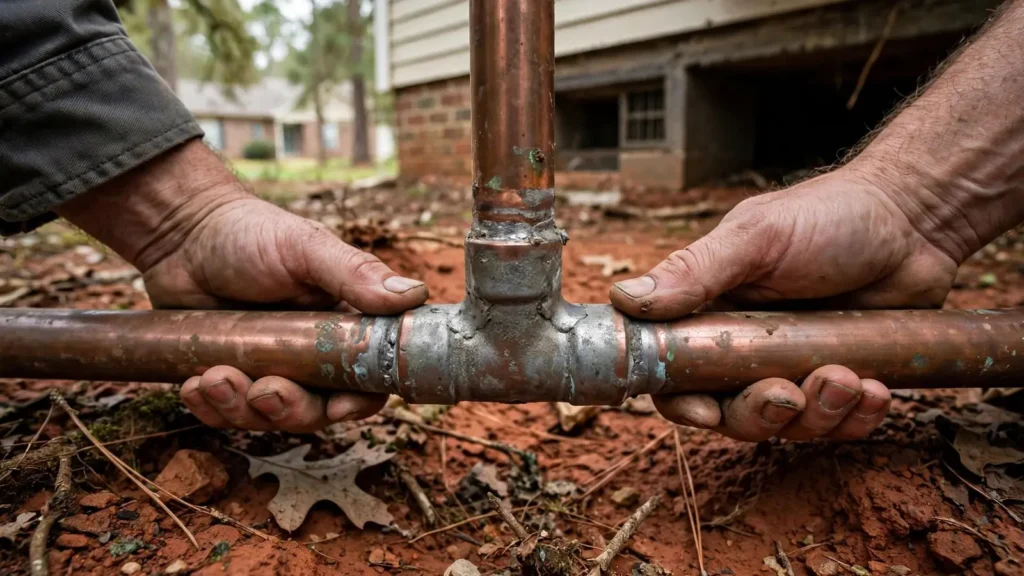
Search for lead pipes in Greenville SC and you'll mostly find national news about cities with tens of thousands of lead service lines to dig up. Greenville County isn't one of them, according to the two utilities that serve most of it. That's good news, and it's worth understanding exactly what it does and doesn't cover, because the utilities' findings stop at the edge of your property, and the rules about lead in household plumbing changed in 1986.
This guide covers what the federal service line inventory requirement was, what Greenville Water and Greer CPW actually published, where lead can still hide in an older Upstate house, how to check your own pipes, and how to get the water tested.
What the service line inventory requirement was
A service line is the pipe that carries water from the main in the street to your house. In older cities, many of those were lead. EPA's Lead and Copper Rule Revisions required every community water system to prepare an inventory of its service line materials, on both the utility side and the customer side, and to have it done by October 16, 2024. Each line had to be classified as lead, galvanized requiring replacement, non-lead, or lead status unknown.
"Galvanized requiring replacement" is a specific category: galvanized steel pipe that is, or ever was, downstream of a lead service line, or is downstream of a line whose material is unknown. Galvanized pipe can absorb lead from upstream and release it later. A galvanized line with no lead ever ahead of it doesn't fall in that category, even though it may still be old and corroded.
The Lead and Copper Rule Improvements
In October 2024, EPA finalized the Lead and Copper Rule Improvements (LCRI). The headline requirements:
- Water systems must replace lead and galvanized-requiring-replacement service lines under their control, generally within 10 years, regardless of tap sample results. A small number of systems may qualify for a deferred deadline with state approval.
- The lead action level drops from 15 parts per billion to 10.
- Systems must make their service line inventories and replacement plans publicly available and keep updating them.
- The compliance date for most requirements is November 1, 2027.
Water utility groups have challenged the LCRI in federal court, and that case was still pending as of this writing. For Greenville County homeowners on Greenville Water or Greer CPW, the practical effect is small either way, because neither utility reports any lead service lines to replace.
Lead pipes in Greenville, SC: what Greenville Water says
Greenville Water's water quality page states that after an extensive review of its records and physical examination, it has determined there are no lead service lines in the Greenville Water distribution system. It says the same for the West Pelzer system it now operates. Its 2025 water quality report repeats the finding, based on a record search, field investigation and modeling.
Its tap sampling backs that up. In the lead and copper samples taken at customers' kitchen taps in 2024 (reported in the 2025 report), the 90th percentile lead level was 0 ppb against the 15 ppb action level then in force. One household exceeded the action level, and a repeat sample at that site came back below it. Greenville Water also adds an ortho/polyphosphate blend during treatment to protect pipes from corrosion, which reduces how much metal water picks up from household plumbing.
What Greer CPW says
Greer CPW's water page says it has published a service line inventory map so customers can see the material used for their service line. It lists the materials in its system as copper, galvanized iron, PEX and PVC, and states that it does not have any known lead service lines. Its 2025 water quality report shows a 90th percentile lead level of 0 ppb, a range of 0 to 4 ppb, and no sample sites over the action level. The next round of lead and copper sampling is due in summer 2028.
Greer CPW invites customers who are concerned about lead to contact it about testing at 864-848-5500 or its lead and copper email listed in the report.
| Greenville Water | Greer CPW | |
|---|---|---|
| Lead service lines reported | None | None known |
| Inventory published | Yes (Greenville Water and West Pelzer systems) | Yes, as a map |
| Most recent lead 90th percentile | 0 ppb (2024 samples) | 0 ppb (2025 report) |
| Corrosion control mentioned | Ortho/polyphosphate blend | See its annual report |
| Who to ask about testing | Laboratory, 864-241-7838 | 864-848-5500 |
If you're on another system, such as Blue Ridge Rural Water, Marietta or Laurens County Water and Sewer, check that utility's own report. Our Greenville County water providers guide explains how to tell which one serves you.
Questions about the pipes in an older house? Call a local plumber
Where lead can still be: inside the house
Both utilities say the same thing in their reports: they're responsible for the water they deliver, but they can't control the materials used in your home's plumbing. That's where the remaining lead risk sits.
Lead solder before 1986
Congress amended the Safe Drinking Water Act in 1986 to require "lead free" pipe, solder and flux in any plumbing that carries drinking water. Solder and flux could contain no more than 0.2% lead, and pipe no more than 8%. The ban applied to installations and repairs made after June 19, 1986. Copper plumbing installed before then was commonly joined with tin-lead solder. That covers a large share of Greenville County's housing: the brick ranches of the 1950s through the 1970s around Wade Hampton, Taylors and Mauldin, and the early 1980s subdivisions that followed.
Solder joints in pipes that have carried water for 40 years or more usually have a mineral layer inside, and corrosion control at the treatment plant helps keep it there. The risk isn't zero, though, and it's higher where water sits in the pipes for long stretches.
Old brass faucets and valves
Brass and bronze fittings were allowed to contain up to 8% lead until a 2011 federal law cut that to a weighted average of 0.25%, effective January 4, 2014. Faucets, stop valves and meter-side fittings installed before 2014 may contain more lead than today's parts. Replacing an old kitchen faucet is one of the cheaper ways to reduce exposure at the tap you drink from.
Galvanized pipe
Older homes in Greenville's mill villages and pre-1960 neighborhoods often still have galvanized supply pipe. Without lead upstream, galvanized isn't in EPA's replacement category, but it rusts, restricts flow and can release sediment. Our older Greenville homes guide and Piedmont plumbing page cover what to do about it.
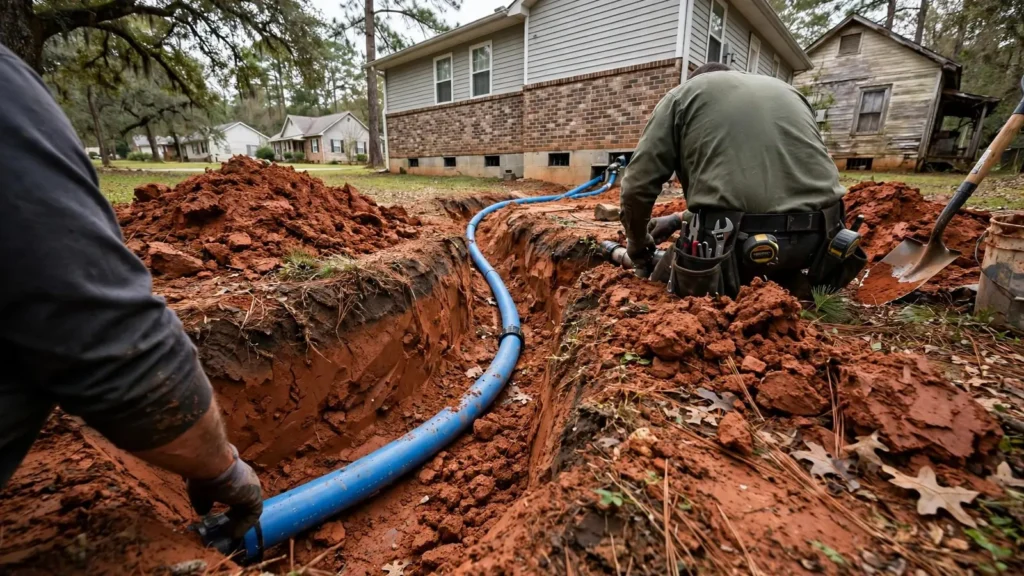
How to check your own pipes
- Find where the water line enters the house. Usually a crawlspace, basement wall, garage or utility closet, near the main shutoff.
- Look at the pipe coming in. Copper is the color of a penny. Plastic is white, gray, blue or black. Galvanized is gray steel with threaded joints. Lead pipe is dull gray and soft.
- Scratch test, gently. EPA's guidance for identifying lead pipe: scratch the surface with a key or coin. Lead shows shiny silver and is soft. A strong magnet won't stick to lead; it will stick to galvanized steel.
- Check the solder. Look at copper joints near the water heater and under sinks. Lead and lead-free solder look much alike, so the home's plumbing date matters more than appearance. Lead test swabs sold for paint can react to lead solder, but treat a result as a hint, not proof.
- Check the inventory. Greer CPW customers can look up their service line on its published map. Greenville Water customers can rely on its statement that the system has none.
If you're replacing old pipe anyway, our repiping guide covers materials, and water line repair covers the service line from the meter to the house. That line is the homeowner's responsibility on Greenville Water; see who owns the water line.
How to test your water for lead
- Use a state-certified laboratory. Greer CPW lists certified labs for drinking water analysis on its water page, and both utilities will answer questions about testing.
- Take a "first draw" sample: water that has sat in the pipes for at least six hours, usually first thing in the morning, from the kitchen tap you drink from.
- On a private well, the SC DES minerals and metals analysis includes lead. Clemson's Home & Garden Information Center lists it at $50; the kit comes from a DES regional office or health department.
- Store-bought test strips are a rough screen at best. If the result matters to you, use a lab.
Simple ways to cut exposure meanwhile
- Run the cold tap before drinking when water has sat for several hours. Greenville Water suggests 30 seconds to two minutes; showering or running a load of laundry first also flushes the lines.
- Use cold water for drinking, cooking and mixing baby formula. Hot water picks up more metal.
- Don't rely on boiling. It doesn't remove lead.
- If you want a filter, look for one certified to NSF/ANSI 53 for lead reduction, and change the cartridge on schedule.
- Clean faucet aerators. Particles of solder or brass can collect there.
Do repairs on old copper need lead-free materials?
Yes. Any repair or new work on drinking water plumbing must use lead-free solder, flux and fittings under the 1986 and 2011 federal rules. A licensed plumber will use lead-free materials by default. If a handyman is soldering copper in your house, ask what solder they're using. Our guide to checking a plumber's license in SC shows how to verify who you're hiring.
Want your older plumbing looked at? Call a local plumber
Lead and service line questions
Do I have to replace a galvanized service line under the new rule?
Only lines classified as "galvanized requiring replacement," meaning galvanized that is or was downstream of lead or of an unknown line, fall under EPA's replacement requirement. Greenville Water and Greer CPW report no lead service lines. An old galvanized line may still be worth replacing for flow and leak reasons.
Where can I see Greer CPW's service line inventory?
Greer CPW links its service line inventory map from the water quality section of its water service page, alongside its annual water quality reports in English and Spanish.
Does boiling water get rid of lead?
No. Boiling kills germs but doesn't remove lead, and as water evaporates the lead that's left becomes slightly more concentrated. Use cold, flushed or filtered water instead.
Can a home inspector tell me if my house has lead solder?
Not with certainty. Inspectors can identify pipe materials and estimate the plumbing's age, but lead and lead-free solder look alike. A first-draw lab test of your tap water is the reliable check.
My house is on a well. Who tests it for lead?
You do. No utility samples a private well. The SC DES minerals and metals analysis includes lead, or you can use a state-certified commercial lab.
Sources
- US EPA, Lead and Copper Rule Revisions (service line inventory due October 16, 2024).
- US EPA, Lead and Copper Rule Improvements final rule and fact sheet, October 2024; Federal Register, October 30, 2024 (10-year replacement, 10 ppb action level, November 1, 2027 compliance date).
- US EPA, Use of Lead Free Pipes, Fittings, Fixtures, Solder and Flux for Drinking Water (1986 SDWA amendments; Reduction of Lead in Drinking Water Act, effective January 4, 2014).
- US EPA, guidance on identifying lead service lines (scratch and magnet tests).
- Greenville Water, Water Quality web page (Lead Service Line Inventory statements for Greenville Water and West Pelzer).
- Greenville Water, 2025 Water Quality Report (lead and copper results, corrosion control, flushing guidance).
- Greer Commission of Public Works, Water service page (service line inventory and materials) and 2025 Annual Drinking Water Quality Report.
- Clemson Cooperative Extension, Home & Garden Information Center, "Testing Drinking Water"; SC DES private well testing program.
- American Water Works Association v. EPA, challenge to the LCRI (pending as of October 2026).