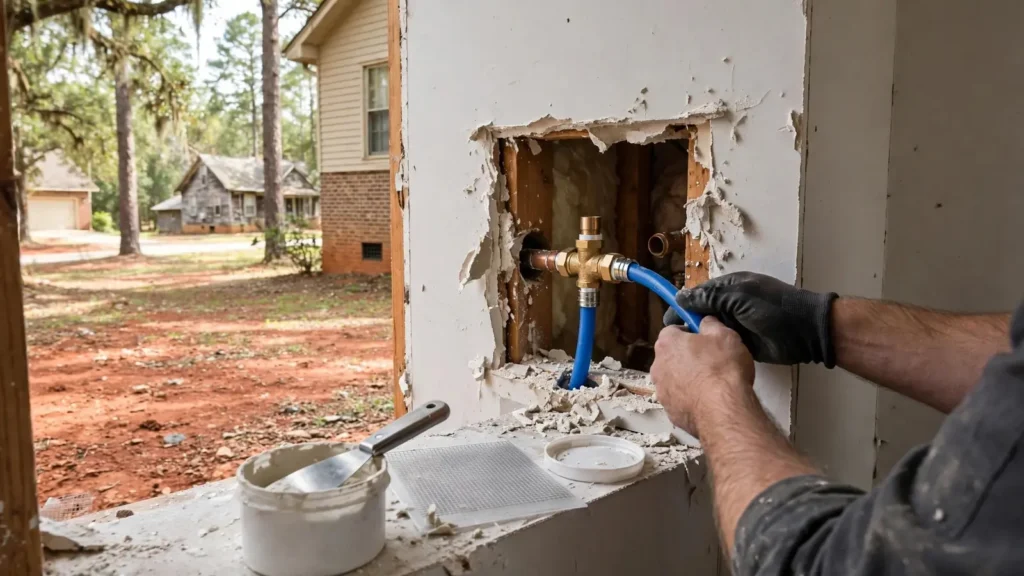
A cosmetic bathroom refresh (paint, a new vanity top, a mirror, new towel bars) doesn't need a permit anywhere in Greenville County. The line gets crossed when the plumbing itself changes, and in a real remodel it almost always does. Moving the toilet six inches, turning a tub into a walk-in shower, or swapping an old two-handle shower valve for a new one all count.
The confusing part locally is that the permit office depends on your address, not your mailing city. A "Greenville" or "Simpsonville" address can sit in unincorporated county land, and parts of Greer and Fountain Inn reach into neighboring counties.
Who issues a bathroom remodel permit in Greenville, SC
Start by finding out whether your property is inside city limits. The county's property records or your tax bill will tell you. Then call the office that matches.
| If your home is in | Permits come from | Phone | Worth knowing |
|---|---|---|---|
| Unincorporated Greenville County (Taylors, Berea, Five Forks, Wade Hampton, Piedmont's Greenville County side and more) | Greenville County Building Safety | (864) 467-7060 | The county's permit page says plumbing, sewer, electrical, gas and HVAC work require a permit. Fees went up 20 percent on July 1, 2025 |
| City of Greenville | City Building and Permit Center | (864) 232-2273 (232-CARE) | The city's plumbing permit form covers all plumbing work in residential and commercial buildings, and it has a homeowner exemption request form |
| City of Mauldin | Business and Development Services | (864) 234-3475 | A permit is required before adding, altering or replacing any plumbing or fuel gas system, or any water heater. Fees double if work starts first |
| City of Simpsonville | City building department, at City Hall | (864) 967-9526 (City Hall) | The building permit application is filed in person, and contractors need a city business license first |
| City of Greer | Planning and Development, Building Division | (864) 968-7029 (inspections) | The city says the contractor pulls the permit and that it checks license, insurance and bond before releasing it. Applications go through eTRAKiT |
| City of Fountain Inn | Planning and Development | (864) 531-0644 | Permits are applied for through the city's iWorQ portal |
If you hire a licensed plumber, the plumber normally pulls the plumbing permit and schedules the inspections. Ask whether the permit fee is in the quote. A price far below the others sometimes means the permit isn't, and in Mauldin starting without one doubles the fee. Our Mauldin plumbing page covers that city's rules in more detail.
Which plumbing changes need a permit
South Carolina builds its residential code on the International Residential Code. The IRC's short list of plumbing work that doesn't need a permit (Section R105.2) is narrow: stopping a leak in a drain or supply pipe without replacing pipe, clearing a stoppage, repairing a leak in a pipe, valve or fixture, and pulling and resetting a toilet, as long as none of it replaces or rearranges valves, pipes or fixtures. Everything past that is permit territory, though cities and the county can and do set their own practices for simple swaps. Mauldin, for one, writes "replacing" right into its rule.
| Bathroom change | Plumbing permit likely? | Why |
|---|---|---|
| Paint, mirror, towel bars, cabinet doors | No | No plumbing involved |
| Fixing a leaky faucet cartridge or a running toilet | No | A repair without replacing pipes, valves or fixtures |
| Same-spot faucet or toilet swap | Depends on the office | It replaces a fixture; ask your permit office |
| Moving the toilet, sink or shower drain | Yes | Rearranges drain and vent piping |
| Tub-to-shower conversion | Yes | New drain location, new valve, shower pan |
| Replacing the shower or tub valve in the wall | Yes | Replaces a valve; the new one must meet the anti-scald rule |
| Adding a second sink, a bidet or a new bathroom | Yes | New fixture, new drain and supply lines |
| New supply lines or a PEX repipe of the bathroom | Yes | New piping |
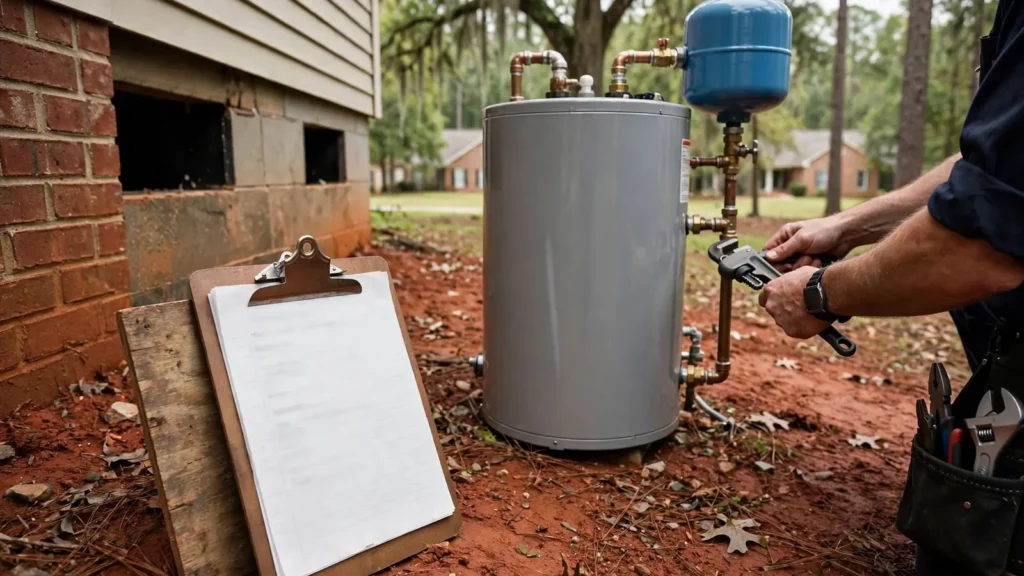
| Water heater replacement or relocation | Yes | The county's residential plumbing permit form lists water heaters; Mauldin requires a permit for any water heater |
| Gas line for a heater or fireplace | Yes, often a separate gas or mechanical permit | Fuel gas work needs its own inspection and pressure test (see our gas leak guide for why) |
If the remodel is part of a bigger plumbing job, our repiping page explains what a repipe involves and how long it takes.
Can a homeowner pull the permit?
Yes, in South Carolina, with conditions. Section 40-59-260 of the state code lets an owner improve their own residential property without a contractor's license, doing the work personally or with licensed contractors, as long as it's for the owner's own use and occupancy and not for sale or rent. A few strings come with it:
- The owner has to personally appear and sign the permit application.
- Selling or renting the property within two years of finishing is treated as evidence it was built for sale or rent, which breaks the exemption.
- The owner has to file a notice with the register of deeds stating the work was done as an unlicensed owner-builder. Not filing it revokes the exemption.
- You can't hire an unlicensed person to do the plumbing for you. Anyone you pay has to hold the license the work requires.
Greenville County asks owner-builders for a notarized, recorded Owner Builder Disclosure Statement and says the property must be held by an individual and not be for sale, lease or rent. The City of Greenville has its own homeowner exemption request form. Other towns handle it their own way, so ask before you start.
Honestly, for plumbing, most homeowners shouldn't. Drain slope, venting and the shower pan are where DIY bathrooms fail inspection, and a leak under new tile is an expensive lesson. Doing the demo and tile yourself while a licensed plumber handles the rough-in and the permit is a common middle ground.
Planning a bathroom remodel? Call a local plumber
What gets inspected, and when
A bathroom remodel with plumbing changes usually sees the inspector at least twice.
- Rough-in, with the walls and floor still open. The inspector looks at drain size and slope, vents, how pipes are supported and protected where they pass through framing, and the new supply lines. Drain and supply piping are typically tested for leaks at this stage, so the plumber will have plugs and a test gauge on site.
- Final, after fixtures are set. The inspector checks the fixtures, the valve, and that everything drains and has no leaks. Under South Carolina's current rules the shower liner test is done at the final plumbing inspection. From January 1, 2027, the builder may choose to do it at rough-in instead.
Greenville County Building Safety has announced that starting November 1, 2026, the separate trade rough-ins on residential new construction and alteration permits will be handled as one combined rough-in inspection. If your project is in the unincorporated county, ask the office how that affects your scheduling, because the electrician, plumber and HVAC contractor now need to be ready at the same time.
Two practical notes. First, don't close a wall until the rough-in passes. An inspector can make you open it. Second, county residential plumbing permits become invalid if work doesn't start, or stops, for six months, so a remodel that stalls can need a new permit.
Shower pan basics: the test that catches the costly mistake
A tiled shower floor isn't waterproof by itself. Underneath is a liner (or a waterproofing membrane) that catches water that soaks through the grout and steers it into the drain. When the liner leaks, you find out months later through a stained ceiling, a soft subfloor or rot at the sill.
South Carolina's version of the residential code spells out the test. Where the shower floor is made watertight by a liner, the completed liner gets tested by filling it to the lesser of the threshold depth or 2 inches, holding it for at least 15 minutes with no sign of leakage. Under the current rules the test is done at the final plumbing inspection; under the 2024 code South Carolina adopts on January 1, 2027, the builder can choose rough-in or final. The drain is plugged during the test. Our guide to the 2027 code changes covers the rest.
- Ask your installer what waterproofing system they use and whether they'll flood test it themselves before tile goes on. Many do it overnight, which is stricter than the code minimum.
- Take photos of the liner or membrane before tile. They're useful later if anything goes wrong.
- Prefab shower bases with their own built-in drain flange are a different animal; follow the maker's installation steps.
Anti-scald shower valves: what the code requires
If you replace the shower or tub-shower valve, the new one has to be a pressure-balancing, thermostatic or combination valve that meets the ASSE 1016 or ASME A112.18.1 standard, and it must have a way to limit the maximum setting to 120°F, adjusted in the field per the maker's instructions. That's the South Carolina modification of the code's shower valve section.
In plain terms, the valve keeps a toilet flush or a running dishwasher from suddenly sending scalding water at you, and it has a limit stop that keeps the handle from turning all the way to hot. Old two-handle valves in 1950s and 60s bathrooms don't do either, which is one reason a "simple" valve swap becomes a permit job. The limit stop matters more than people think in houses with kids or older adults. If your hot water seems weak after the swap, the stop may be set low, and it's adjustable. Our no hot water guide covers the other causes.
Hiring for the plumbing part
South Carolina licenses residential plumbing work through SC LLR's Residential Builders Commission. The state's definition of a residential specialty contractor covers jobs over $500 (raised from $200 in 2022), so almost any bathroom plumbing job you pay for falls under it. Check the license before you sign anything; our guide to checking a plumber's license in SC takes about two minutes. For tips on comparing bids, see how to choose a plumber in Greenville.
When you collect quotes, ask each company to list the permit, the inspections, any water heater or gas work, and patching. The gap between two bathroom quotes is often in those lines. For typical prices, our Greenville plumber cost guide has the ranges we could source.
Need the rough-in done and inspected? Call a local plumber
Bathroom remodel permit questions
Do I need a permit to replace a toilet in Greenville County?
Pulling and resetting the same toilet, for example to replace the wax ring, is on the code's list of exempt work. Swapping in a new toilet in the same spot is treated differently by different offices, so call yours. Moving the toilet needs a permit.
Can a homeowner pull a plumbing permit in Greenville County?
Yes, under South Carolina's owner-builder exemption, for your own home and your own use. The county requires a notarized, recorded Owner Builder Disclosure Statement, and you have to sign the application in person.
How many inspections does a bathroom remodel need?
Usually at least two for the plumbing: a rough-in with the walls open and a final once fixtures are set. Electrical and framing work can add more. In the unincorporated county, trade rough-ins are being combined into one visit starting November 1, 2026.
What is a shower pan test?
The drain is plugged and the shower floor is filled with water to the lesser of the threshold height or 2 inches, then held for at least 15 minutes to check for leaks. In South Carolina it happens at the final plumbing inspection.
What happens if I remodel a bathroom without a permit?
If it's caught, you may have to get a permit after the fact, pay a higher fee (Mauldin doubles it), and open walls so an inspector can see the work. Unpermitted work can also come up when you sell.
Sources
- Greenville County Building Safety: Permits page (work requiring permits, owner-builder requirements, July 2025 fee increase), Residential Plumbing Permit application, Owner Builder Disclosure Statement, and Resources page notice on combined residential rough-in inspections beginning November 1, 2026.
- City of Greenville Building and Permit Center: permit applications list (plumbing permit, homeowner builder/contractor license exemption request).
- City of Mauldin Business and Development Services: permit requirements and fee schedule.
- City of Simpsonville: Forms and Permits page and contact page; City of Greer Planning and Development: Permits, Building Division and Inspections pages; City of Fountain Inn: Residential Building Permits page.
- South Carolina Code of Laws, Sections 40-59-20 and 40-59-260 (residential specialty contractor definition; owner-builder exemption).
- South Carolina Code of Regulations, Sections 8-1239 (IRC P2503.6 shower liner test) and 8-1243 (IRC P2708.4 shower control valves); Reg. Doc. 5417, Section 8-1248 (2024 IRC P2503.6, effective January 1, 2027).
- International Code Council, International Residential Code, Section R105.2 (work exempt from permit).