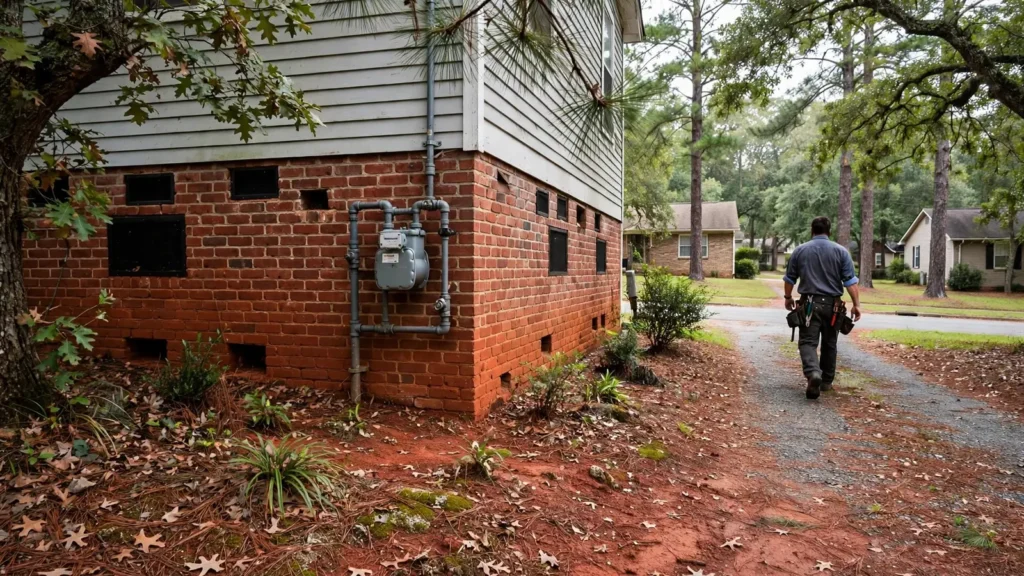
Natural gas has no smell of its own. The rotten-egg odor comes from an odorant the utility adds so a leak gets noticed. That's why any smell of gas in a house deserves to be taken seriously, even a faint one. Piedmont Natural Gas lists three ways to notice a leak: you smell it, you hear a hiss near a gas line or meter, or you see signs outside like bubbling water, blowing dirt or dead plants over a buried line.
Our emergency plumber page has the one-line version. This guide goes further: who supplies gas where in Greenville County, how to tell gas from the smells that fool people, how carbon monoxide differs, who repairs what, and what a proper repair and pressure test look like.
If you smell gas in the house: the first two minutes
- Get everyone out, pets included. Don't stop to find the leak or gather belongings. Piedmont specifically says not to try to find the source.
- Don't create a spark. Leave light switches as they are, on or off. Don't use a cell phone or cordless phone inside, don't light a match or lighter, and don't use the garage door opener or start a car in an attached garage.
- Don't touch the meter or any gas valves. Piedmont warns that operating valves yourself can make things worse.
- Move well away, to a neighbor's house or down the street, upwind if you can tell.
- Call 911, then the gas company. Piedmont: 800-752-7504. Greer CPW: (864) 848-5500, answered around the clock for gas emergencies. If you use propane, call your propane supplier; the name and number are usually on the tank.
- Stay out until the utility or emergency crew tells you it's safe, and wait for them before relighting any pilot light.
Who supplies gas in Greenville County
Most of the county is Piedmont Natural Gas territory. In April 2026 Piedmont said it serves about 170,000 customers in Anderson, Spartanburg, Greenville and Cherokee counties in South Carolina. Greer CPW runs its own gas system, though, and it reaches well beyond the Greer city limits.
| Supplier | Where | Leak number |
|---|---|---|
| Piedmont Natural Gas | Most of Greenville County outside Greer CPW's territory | 800-752-7504, plus 911 |
| Greer CPW | Greer and surrounding areas. Its stated service area runs west to the Enoree River (including the Taylors area), north toward Landrum, Tigerville Road and Gowensville, east to Wellford and south to Crescent near Woodruff | (864) 848-5500, plus 911 |
| Fort Hill Natural Gas Authority | Created by the legislature to serve Anderson, Oconee and Pickens counties. It isn't a Greenville County supplier, but check your bill if you live right at the Pickens County line | Listed on your Fort Hill bill |
| Propane companies | Rural homes without a gas main, common in the northern county and outer edges | Your supplier's number, on the tank or bill |
Taylors is the one that trips people up: many Taylors homes have Greer CPW gas even though their water comes from Greenville Water. Our Greer plumbing guide explains the overlap. Put your utility's number in your phone today, under a name you'll find in a hurry.
How bad is it? Reading the signs
We'd rather you make an unnecessary call than talk yourself out of a necessary one. Utilities would rather come out for nothing, too. Still, here's how the common situations usually play out:
- A strong smell anywhere inside, a hissing sound, or a smell that gets stronger near an appliance or the basement or crawlspace door: leave and call now.
- A faint smell that comes and goes near the range or water heater: still a call. Leave while you make it, and let the utility test with its instruments.
- Dead grass in a strip across the yard, bubbles in a puddle, or dirt blowing near a buried line: call the utility from a distance.
- Someone feels dizzy, sick or has a headache and there's no gas smell: think carbon monoxide (see the next sections). Get out and call 911.
Piedmont also points out that strong cooking or chemical smells can hide the odorant, which is why it suggests a gas detector as a backup.
Rotten-egg smells that aren't gas
A few household smells get mistaken for a gas leak. It helps to know them, but if the smell is anywhere near a gas appliance or you can't tell, treat it as gas.
| Where you smell it | Likely cause | What to do |
|---|---|---|
| Only when hot water runs | Sulfur smell from a reaction with the water heater's anode rod | A plumbing call, not an emergency. See our water heater repair guide |
| Near a floor drain, an unused shower or basement sink | A dry drain trap letting sewer gas in | Run water into the drain for a minute |
| Around a toilet base or in a crawlspace | A failed wax seal or cracked drain line | A plumbing repair |
| Near the range, water heater, furnace, dryer, gas logs or meter | Assume gas | Leave and call |
Utility found a leak in your house piping? Call a local plumber
Carbon monoxide is a different danger
People mix these up, and the difference matters. Natural gas in the house means fuel is escaping before it burns. Carbon monoxide comes from fuel that burned badly, usually in a furnace, water heater, range, fireplace, generator or car. The CDC describes CO as an odorless, colorless gas, so you won't smell it at all, and a gas leak smell tells you nothing about CO.
| Natural gas leak | Carbon monoxide | |
|---|---|---|
| Smell | Rotten eggs (added odorant) | None |
| Where it comes from | A leak in piping, a connector or an appliance valve | Poor combustion or a blocked vent on a fuel-burning appliance |
| How you find out | Your nose, a hiss, or a gas detector | A CO alarm, or symptoms |
| Symptoms | Usually none at first; the danger is fire or explosion | Headache, dizziness, weakness, upset stomach, vomiting, chest pain, confusion (CDC) |
| What to do | Leave, then call 911 and the gas company | Leave, then call 911 |
The CDC recommends battery-powered or battery-backup CO detectors near every sleeping area, checking the batteries when the clocks change, and replacing detectors on the maker's schedule or every five years. Greer CPW also advises getting immediate medical attention for anyone with burns or CO symptoms.
One more difference worth knowing: natural gas is lighter than air and tends to rise, while propane is heavier and settles low, in basements and crawlspaces. If you use a detector, mount it where the maker says for your fuel.
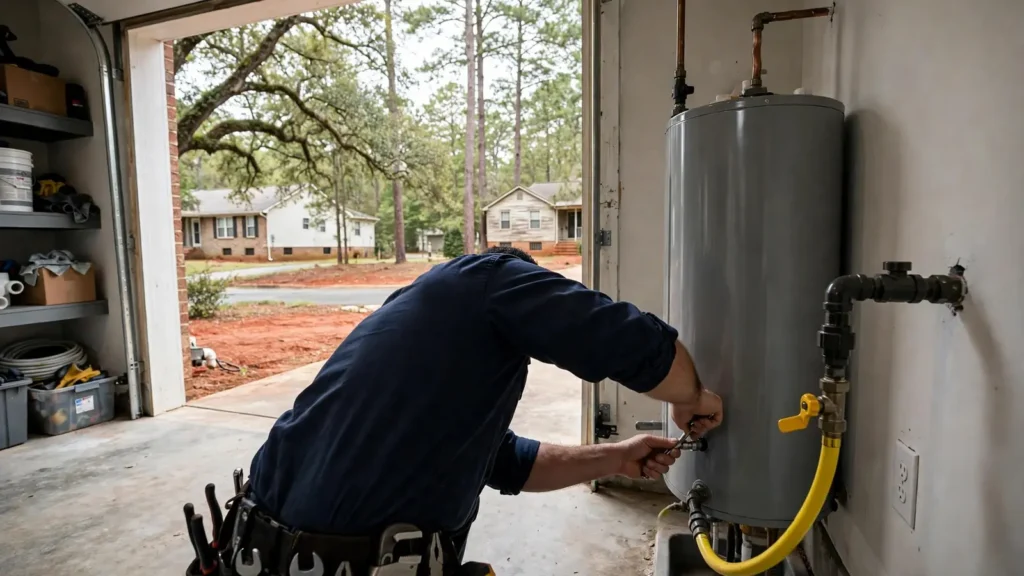
Who repairs what: the utility or a licensed contractor
The meter is the dividing line. The gas company owns and maintains the main, the service line to your house and the meter. Everything on the house side (the piping through the walls, crawlspace and attic, the connectors to each appliance, and any buried line out to a pool heater, grill or detached garage) belongs to the property owner.
- The utility responds to the emergency, finds whether the leak is on its side or yours, fixes its own pipe, and may shut off and lock the meter if the leak is in your piping. Piedmont also says excess flow valves on service lines are installed by Piedmont or its approved contractors, not by plumbers.
- A licensed plumber or HVAC contractor fixes house piping and appliance connections. Not every plumber does gas work, so ask. Check the company's license on SC LLR; our license lookup guide shows how.
- Buried customer piping is the part owners forget. Federal pipeline rules require gas operators that don't maintain customers' buried piping to tell customers that they're responsible for it and that it can corrode and leak. If you have a buried line to an outbuilding, have it checked periodically and call 811 before you dig near it. Greer CPW says the 811 call should be made at least three business days ahead, and marking is free.
Renting? Gas piping and appliances the landlord supplies are the landlord's duty under South Carolina's Landlord and Tenant Act. Our renter repairs guide covers notice and what to do next.
The repair, the pressure test and getting gas back on
A gas repair isn't finished when the joint is tightened. Here's what a proper job looks like:
- Find the leak precisely. The contractor uses a combustible gas detector and leak-detection solution on fittings, valves and connectors.
- Repair or replace. Old flexible appliance connectors and corroded fittings usually get replaced, not patched. Moving a range or dryer is a common time for a connector to crack.
- Pull a permit when the work calls for it. New or altered gas piping generally needs one. Mauldin, for example, requires a permit before altering any fuel gas system; see our Mauldin page. Our post on remodel permits in Greenville lists the county and city offices.
- Pressure test the piping. The fuel gas code requires new and repaired piping to be tested before it goes into service: the system is capped, pressurized with air above its normal working pressure, and a gauge has to hold steady for the required time. On permitted work the inspector may want to see it.
- Restore service and relight. The utility or contractor turns the gas back on, purges air from the lines, relights pilots and checks each appliance connection for leaks.
Expect the gas company to want the problem fixed before it unlocks a meter it shut off. Ask your contractor how that works with your utility, so you're not without heat or hot water longer than needed. For typical prices, our Greenville plumber cost guide covers what we could source; ask for a written price that includes the test and any permit.
Make the next one less likely
- Put CO alarms near the bedrooms and on each level, and a natural gas detector near gas appliances if anyone in the house has a weak sense of smell.
- Have gas appliances installed, serviced and repaired by professionals, as Greer CPW recommends, and keep the area around the water heater and furnace clear.
- Replace old appliance connectors when you replace the appliance.
- Know where your meter is, but in an emergency leave it alone and let the utility handle it.
- Call 811 before any digging project, even a fence post.
Need gas piping repaired and tested? Call a local plumber
Gas smell questions
Is a faint gas smell an emergency?
Treat it as one. Leave the house and call the utility from outside. A faint smell can be a small leak or a pilot problem, but only the utility's instruments can tell you which.
Should I open windows if I smell gas?
Don't stay inside to do it. The priority is getting everyone out quickly without creating a spark. The utility or fire department will ventilate the house when they arrive.
Does a carbon monoxide alarm detect a gas leak?
No. A CO alarm detects carbon monoxide from bad combustion, not natural gas. If you want both, buy a combination unit labeled for both, or one of each.
Who pays to fix a gas leak inside my house?
The property owner. The utility handles its main, service line and meter; piping and connectors on the house side are the owner's to repair through a licensed contractor. In a rental, that's usually the landlord.
Why does my house smell like rotten eggs when there's no gas leak?
Common causes are a dry drain trap letting in sewer gas, or a sulfur smell from the water heater's anode rod that shows up only in hot water. If the smell is near any gas appliance, call the gas company first.
Sources
- Piedmont Natural Gas: Public Awareness and Safety and Natural Gas Safety pages (signs of a leak, what not to do, 800-752-7504); Excess Flow Valves FAQ.
- Piedmont Natural Gas, announcement of its South Carolina base rate application, April 2026 (customer count and counties served).
- Greer Commission of Public Works: Natural Gas page (service area, gas leak safety, 811) and FAQ (24/7 emergency line).
- South Carolina House of Representatives, 2022 resolution recognizing Fort Hill Natural Gas Authority (established 1952 to serve Anderson, Oconee and Pickens counties).
- U.S. Centers for Disease Control and Prevention, About Carbon Monoxide Poisoning.
- U.S. Pipeline and Hazardous Materials Safety Administration, 49 CFR 192.16 (customer notification of buried piping responsibility).
- City of Mauldin permit requirements (fuel gas systems).