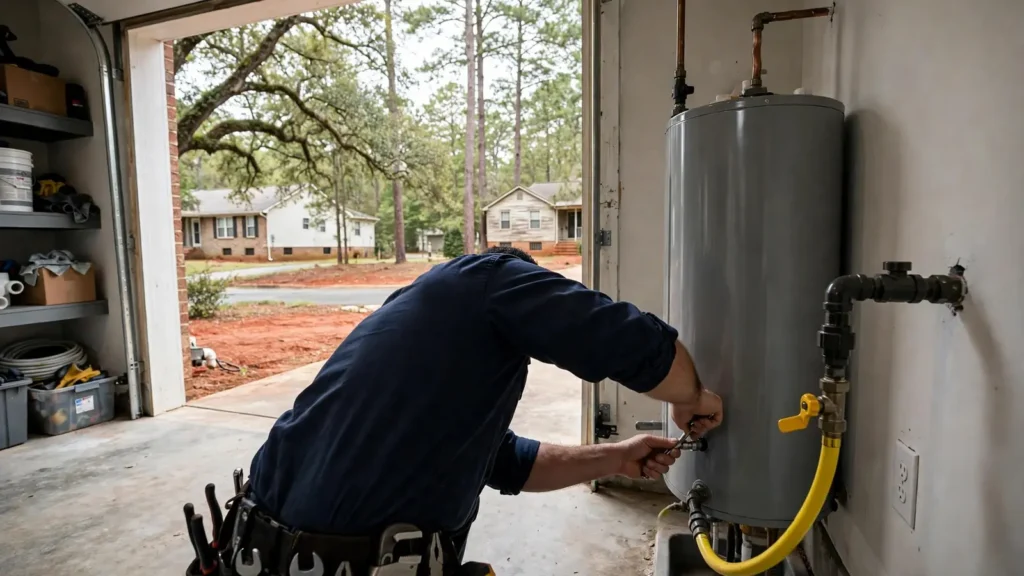
The gas vs electric water heater question comes up most at replacement time, usually when the old tank is already leaking and nobody has time to research. So we did the research with the rates people in Greenville County actually pay: Duke Energy's South Carolina residential rate for electricity and the price South Carolina households pay for natural gas. We show the math so you can plug in your own numbers.
One thing up front. If you already have a gas water heater, replacing it with gas is almost always the easy, cheaper swap, and the same goes for electric to electric. Switching fuels costs real money in piping, venting or wiring. The comparison below matters most for new builds, additions, and owners who already have gas at the house for a furnace or range.
Operating cost: the math with local rates
The rates we used
- For electricity, Duke Energy Carolinas' South Carolina residential tariff (Schedule RS) has a basic charge of $11.96 a month and an energy charge a little under 14¢ per kWh for the first 1,000 kWh after the March 2026 rate change. We used 14¢ to cover small riders. Usage over 1,000 kWh in a month is billed slightly higher.
- For natural gas, the U.S. Energy Information Administration puts South Carolina's average residential gas price at $15.91 per thousand cubic feet in January 2026. That works out to about $1.53 per therm, all charges included. Piedmont Natural Gas, which serves about 170,000 customers in Greenville, Anderson, Spartanburg and Cherokee counties, filed a rate case in April 2026 with new rates expected around October 1, 2026, so check your own bill for the current figure.
- For hot water use, 41,045 Btu of heat a day, the Department of Energy's standard figure for estimating water heater costs (roughly a three-person household).
The formula
Yearly heat needed: 41,045 Btu × 365 days = about 14.98 million Btu. Divide that by the heater's efficiency rating (its Uniform Energy Factor, or UEF, printed on the yellow EnergyGuide label). Then convert to your fuel's units: 3,412 Btu per kWh for electricity, 100,000 Btu per therm for gas. Multiply by your price.
- Electric tank (UEF 0.93): 14.98 million ÷ 0.93 ÷ 3,412 = about 4,720 kWh × $0.14 = about $660 a year.
- Gas tank (UEF 0.64): 14.98 million ÷ 0.64 ÷ 100,000 = about 234 therms × $1.53 = about $360 a year.
- Heat pump water heater (UEF 3.75): 14.98 million ÷ 3.75 ÷ 3,412 = about 1,170 kWh × $0.14 = about $165 a year.
| Water heater | Typical UEF | Energy used per year | Cost per year |
|---|---|---|---|
| Standard electric tank | 0.93 | About 4,720 kWh | About $660 |
| Standard gas tank | 0.64 | About 234 therms | About $360 (about $280 at $1.20/therm) |
| Gas tankless (see our tankless guide) | 0.93 | About 161 therms | About $245 |
| Heat pump, rated | 3.75 | About 1,170 kWh | About $165 |
| Heat pump, cool garage in winter | About 3.0 (our assumption) | About 1,460 kWh | About $205 |
The catch: the gas customer charge
That $300 gap assumes you already pay for gas service. Piedmont's South Carolina residential tariff carries a fixed monthly charge (it has run about $8 in summer months and $10 in winter months), and that charge doesn't care how little gas you use. If the water heater would be your only gas appliance, add roughly $100 a year to the gas column, and the savings shrink to about $200 a year before you've paid a dime for the gas line. Put another way: gas water heating pays off best in a house that already has a gas furnace, range or fireplace.
Greer CPW and co-op customers
Not everyone in the county is on Duke. Greer CPW sells electricity as well as gas in its Greer territory, and some rural edges of the county are served by electric cooperatives. Their rates are different, so take the kWh from the table and multiply by the per-kWh figure on your own bill.
Choosing a new water heater? Call a local plumber
Upfront cost: tank, piping, venting, wiring
Operating cost is only half of it. The install price depends mostly on whether you're staying with the same fuel.
| Situation | What the job involves | Relative cost |
|---|---|---|
| Electric to electric | Same 240-volt circuit, same spot | Lowest |
| Gas to gas | Reuse the gas line and vent, check the vent is sound and sized right | Low to moderate; gas tanks cost more than electric |
| Electric to gas, gas already in the house | New gas branch line, a vent through the roof or wall, combustion air, permit | Moderate to high |
| Electric to gas, no gas service | All of the above plus a new service and meter from the gas utility | Highest; rarely worth it for a water heater alone |
| Gas to electric | New 240-volt circuit and breaker if none exists, cap the gas line | Moderate |
Our Greenville plumbing cost guide lists published local ranges for tank replacements, and its gas line section covers new appliance connections. Every one of these jobs needs a permit from your city or from Greenville County Building Safety, and gas work needs a licensed contractor. Our water heater replacement guide has the permit offices by town.
Venting and where the heater can go
Electric tanks don't vent at all, which is why they show up in hall closets, attics and second-floor laundry rooms. Gas tanks do, and venting is where gas installs get expensive or impossible.
- An atmospheric vent is the classic metal flue pipe that rises out of the top of the tank and up through the roof. It relies on hot exhaust rising, so it needs a vertical path and enough combustion air in the room. Common in older Greenville and Taylors ranches with the heater in a carport closet or basement.
- A power vent uses a fan on top to push exhaust sideways through PVC to an outside wall. More placement options, but it needs an electrical outlet and it won't run in a power outage.
- A sealed-combustion or direct-vent heater pulls air from outside and vents outside, so it can go in a tighter space. Usually more expensive.
When a 1970s house had its gas furnace swapped for a heat pump, the old water heater sometimes ends up alone on a chimney or vent that was sized for two appliances. That can cause poor draft and backdrafting. If your gas water heater is the only thing left on an old flue, have the plumber check the vent before putting a new tank on it. Our page on plumbing in older Greenville homes covers more of what turns up in those houses.
Recovery: how fast each one reheats
Recovery is how many gallons the heater can bring up to temperature in an hour. This is where gas tanks earn their reputation.
- A typical electric element is 4,500 watts, about 15,400 Btu an hour. Heating water 90°F takes about 750 Btu per gallon, so an electric tank recovers about 20 gallons an hour.
- A typical residential gas burner is around 40,000 Btu an hour. After flue losses, that's roughly 40 gallons an hour, about double.
- Heat pump water heaters are slower still in heat pump mode, which is why most switch on their backup element when demand is high.
Day to day, the number to compare is the first-hour rating on the EnergyGuide label: how much hot water the tank can deliver in a busy hour, starting full. A family that runs back-to-back showers every morning will notice the difference between gas and electric at the same tank size. A couple usually won't. Incoming water is colder in a Greenville January than in July, so recovery gets slower in winter for every type. If yours suddenly can't keep up, our no hot water guide covers the usual causes.
Which Greenville County homes have gas?
Natural gas isn't everywhere in the county, and it's the first thing to check.
- Piedmont Natural Gas serves most of Greenville County's gas customers, including much of the city of Greenville, Taylors, Mauldin, Simpsonville and Five Forks.
- Greer CPW supplies gas in its Greer territory. See our Greer plumbing page for how to tell whether you're on CPW.
- Fountain Inn Natural Gas is the city's own gas system (more on our Fountain Inn page). It will tell you whether gas is available at your address at (864) 862-0042.
- Rural and northern areas such as the land around Travelers Rest and the county's edges often have no gas main. Propane is the fallback there, and propane pricing is a separate calculation.
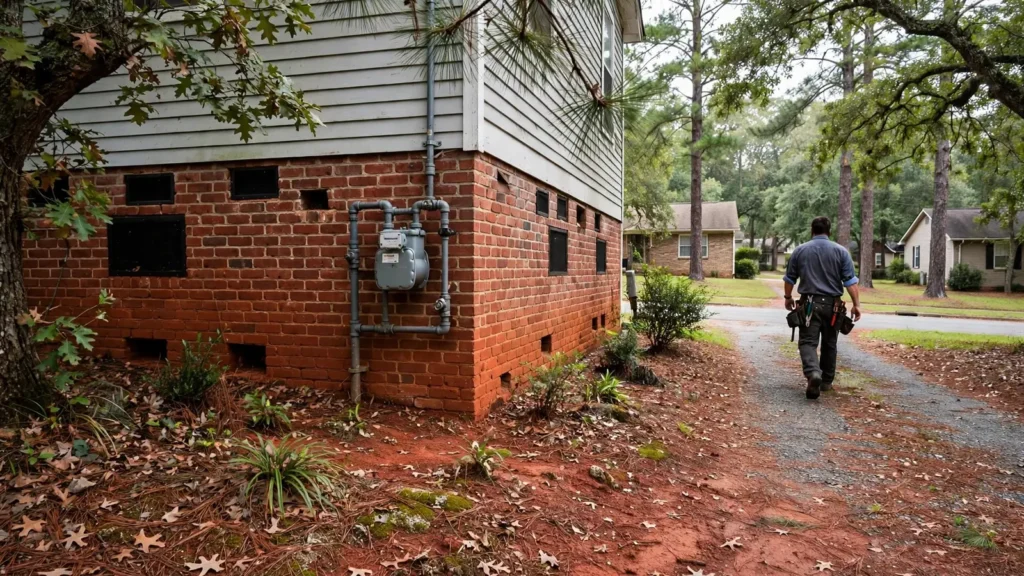
If you see a gas meter on the house, or a capped gas line in the garage, gas may be closer than you think. Call the utility with your address before you price anything.
The third option: heat pump water heaters
If you're on Duke and you have room for it, a heat pump water heater is cheaper to run than either a gas tank or a standard electric one, about $165 to $205 a year in our math. It costs more up front, needs a big enough space (a garage is ideal; a small closet usually isn't), and it's slower to recover. The federal tax credit for these ended for installs after 2025, so the payback has to come from the energy savings and any utility rebate. We worked through that in our heat pump water heater guide for South Carolina.
A simple decision rule
- Replacing a working setup? Stay with the same fuel unless you have a clear reason not to.
- Gas already in the house for heat or cooking? A gas tank (or tankless) gives the lowest running cost of the fuel-burning options and the fastest recovery.
- No gas, and a garage or roomy utility space? Look hard at a heat pump water heater before a plain electric tank.
- No gas, small closet, tight budget? A standard electric tank is still the simplest answer.
Whatever you choose, ask for a written price that names the fuel, the size, the UEF, venting or wiring work, the permit and haul-away. Comparing two quotes is far easier when both list the same items. Whichever you pick, the yearly water heater maintenance checklist keeps it running longer.
Want a gas or electric quote? Call a local plumber
Gas vs electric water heater questions
Is a gas water heater cheaper to run than electric in South Carolina?
Usually, yes. On October 2026 figures, a standard gas tank costs about $360 a year to run against about $660 for a standard electric tank, for a typical household. The gap narrows if the water heater would be your only gas appliance, because of the monthly gas customer charge.
Does a gas water heater work when the power goes out?
A standard atmospheric gas tank with a standing pilot keeps heating without electricity. Power-vent and many newer electronic-ignition models need power and stop working in an outage. Electric and heat pump models stop too.
How do I find my water heater's efficiency rating?
Look for the UEF (Uniform Energy Factor) on the yellow EnergyGuide label or the spec sheet. Older tanks may show an EF (Energy Factor) instead, which is a similar older measure.
Is it worth running a gas line just for a water heater?
Rarely. Between the gas line, venting, permit and the monthly gas customer charge, a heat pump water heater usually makes more sense in a house with no other gas appliances.
How do I calculate my own water heater cost?
Take 14.98 million Btu a year, divide by the heater's UEF, then divide by 3,412 for kWh or 100,000 for therms. Multiply by the price per kWh or therm on your bill.
Sources
- Duke Energy Carolinas, South Carolina Schedule RS residential service tariff (basic customer charge $11.96; energy charges per kWh), with the March 1, 2026 rate change from PSC Docket 2025-172-E; OpenEI Utility Rate Database entry for Duke Energy Carolinas Residential RS (SC).
- U.S. Energy Information Administration, South Carolina Price of Natural Gas Delivered to Residential Consumers, monthly series (January 2026: $15.91 per Mcf).
- Piedmont Natural Gas, news release on South Carolina base rate application, April 1, 2026 (customer count, counties, proposed October 1, 2026 effective date); Piedmont Natural Gas South Carolina Rate 201 residential tariff sheet (monthly charge).
- U.S. Department of Energy, Building Science Education Solution Center, heat pump water heater lecture notes (41,045 Btu/day load, conversion factors, UEF-based cost method).
- ENERGY STAR, heat pump water heater product criteria (UEF).
- City of Fountain Inn, Fountain Inn Natural Gas customer information; Greer CPW service information.
- IRS, Energy Efficient Home Improvement Credit (25C), not allowed for property placed in service after December 31, 2025.