
If the relief valve on your water heater drips after everyone showers, or a toilet starts hissing for no reason in the middle of the night, there's a good chance the problem isn't the water heater or the toilet. It's pressure. In a lot of Greenville County homes, especially the subdivisions built from the 2000s on, the house's plumbing is sealed off from the city main. When the water heater warms a tank of cold water, that water swells, and in a sealed system it has nowhere to go but up in pressure.
This post explains why that happens here, what the code says, how to tell if your expansion tank or PRV has quit, and how to check them yourself. If your relief valve is actively spraying or the tank is leaking, start with our water heater leaking guide instead.
Why your water heater needs an expansion tank: closed systems
Older houses had open systems. When water in the tank expanded, it simply pushed a little water back through the meter into the main. Nobody noticed.
That changed with backflow protection. Greenville Water's Cross Connection Control manual says the utility has required backflow prevention on all service connections since 1971, and that on newly installed meters a residential dual check valve (two spring-loaded check valves in series) is built into the meter setter. Greenville Water replaces the internals of that assembly about once every 30 years. Its manual is blunt about the side effect: an open system "is no longer possible where a backflow preventer is present at the meter."
Two other things close a system:
- A pressure-reducing valve on the main line into the house. Many PRVs block backward flow, which is why the code lists a PRV as its own reason to require expansion control.
- A check valve somewhere else on the main, sometimes installed with a well system, a softener or an irrigation tie-in.
Greer CPW and other water providers have their own meter setups. If you're not sure what's at your meter, ask your provider. Our page on who owns the water and sewer line explains where the utility's part ends and yours begins.
Greenville Water also puts the upkeep on you. Its manual says the customer is responsible for maintaining devices that deal with pressure changes, and names thermal expansion tanks, relief valves and pressure-reducing valves.
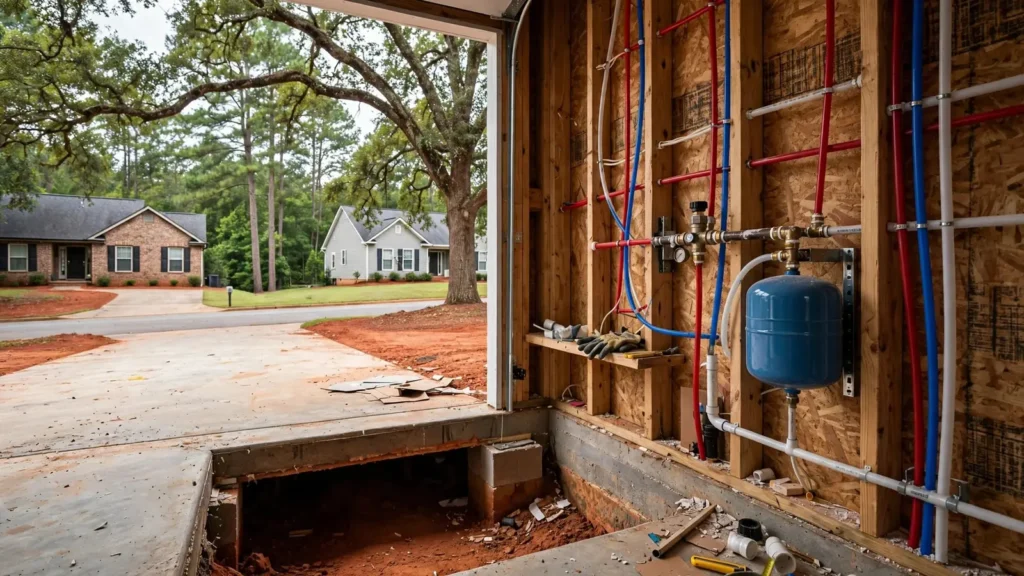
Why newer Simpsonville, Fountain Inn and Greer subdivisions have PRVs
The residential code South Carolina uses caps static water pressure inside a house at 80 psi. Where the pressure coming from the main is higher than that, the code calls for a PRV at the point where the water service enters the house.
Water pressure in a neighborhood depends largely on elevation. Every 2.31 feet of height difference between the water level in the utility's tanks and your faucet is worth about 1 psi. In the rolling ground of southern Greenville County, a house at the bottom of a hill can see much higher pressure than one at the top of the same street. Putting a PRV on every house is a simple way for a builder to stay under the 80 psi limit on a street where pressure varies, and the bell-shaped valve on the main in the garage is a familiar sight in Five Forks, Simpsonville, Fountain Inn and the newer parts of Greer. We don't know of a published pressure map for the county, so the only way to know your number is to measure it, which takes a $10 gauge.
The trouble is that a PRV and a meter dual check together make a very tight closed system. That's the setup where a working expansion tank matters most. Our Fountain Inn and Simpsonville pages cover the other common issues in houses of that age.
Thermal expansion symptoms
Water expands as it heats. Going from about 50°F to 120°F, a 50-gallon tank of water grows by roughly 0.6 gallons. In an open system that small amount drifts back to the main. In a closed system with a dead expansion tank, there's no room for it, so the pressure in the whole house climbs every time the water heater runs. Greenville Water's manual notes that relief valves typically start discharging above about 150 psi.
Signs to look for:
- The T&P relief valve drips or spits after a long shower, a load of laundry or overnight, then stops.
- Toilets refill or hiss on their own, especially at night when nobody is using water.
- A faucet that drips more at certain times of day.
- Pipes that bang or knock when a valve closes; our post on water hammer and banging pipes goes into that one.
- Pressure that reads normal at one moment and much higher later on a gauge.
- Washing machine or dishwasher fill valves and ice maker lines failing sooner than they should.
Relief valve dripping or toilets hissing? Call a local plumber
Does South Carolina code require an expansion tank?
South Carolina adopts the International Codes statewide through the SC Building Codes Council, with state modifications. Right now that means the 2021 International Residential Code and 2021 International Plumbing Code, which local building departments have enforced since January 1, 2023. The Council has adopted the 2024 editions, and local departments must begin enforcing them on January 1, 2027.
In the 2021 IRC, section P2903.4 requires a means of controlling increased pressure from thermal expansion where the code calls for it. P2903.4.1 covers houses with a pressure-reducing valve, and P2903.4.2 says that where a backflow preventer, check valve or similar device is on a system with storage water heating equipment, a device for controlling pressure has to be installed. The IPC's matching section says the control device goes on the water heater's cold supply, downstream of all check valves, PRVs and backflow preventers.
Two details that surprise people:
- The code asks for a pressure control device, not specifically a tank. Greenville Water's manual lists three common methods: a bladder-type expansion tank, a special toilet fill valve with a relief feature, or a separate thermal expansion relief valve. The tank is by far the most common choice because it doesn't waste water.
- The requirement is tied to storage water heating equipment. A tankless heater holds very little water, which is why tankless installs often don't get an expansion tank.
Inspectors here look for expansion control on water heater replacements where the system needs it, and the plumber normally includes it in the price. Your city or Greenville County Building Safety has the final word on what your house needs. Our water heater replacement guide lists the permit offices.
How to test your water pressure
- Buy a hose-bib pressure gauge with a second "lazy" needle that stays at the highest reading. They're sold at most hardware stores.
- Screw it onto an outside faucet or the washing machine's cold valve, open the faucet and read the static pressure with nothing else running.
- Leave it on overnight with the lazy needle set. Run some hot water before bed so the water heater fires.
- Read it in the morning. A static reading between about 40 and 80 psi is normal. If the lazy needle shot well above where it started, thermal expansion is building pressure and the expansion tank isn't absorbing it.
A static reading over 80 psi with a PRV in place usually means the PRV is failing or set too high.
Checking the expansion tank's air charge
A bladder expansion tank has water on one side of a rubber diaphragm and compressed air on the other. Over time the air leaks down or the bladder tears, and the tank fills with water. A waterlogged tank does nothing. Amtrol, one of the larger makers, ships its standard Therm-X-Trol tanks pre-charged to 40 psi and tells installers to set the charge to match the house's incoming water pressure, with the water side drained.
- Tap the tank. The top half should sound hollow and the bottom half duller. A tank that sounds solid all the way up is probably waterlogged.
- Feel the weight. With care, push up on the tank. A healthy one is fairly light; a waterlogged one is heavy and puts strain on the pipe it hangs from.
- Turn off the cold supply to the water heater and open a nearby faucet to take the pressure off the tank's water side.
- Check the air valve on the end of the tank with a tire gauge. It should read close to your house's static pressure.
- If it's low, add air with a bike pump to match your static pressure, then restore the water.
- If water comes out of the air valve, the bladder has failed. The tank needs to be replaced.
Expansion tanks are not expensive, but a full one is heavy and hangs off threaded pipe, so many people have a plumber swap it while they're there for something else. Amtrol also says to replace a tank that is corroded or damaged.
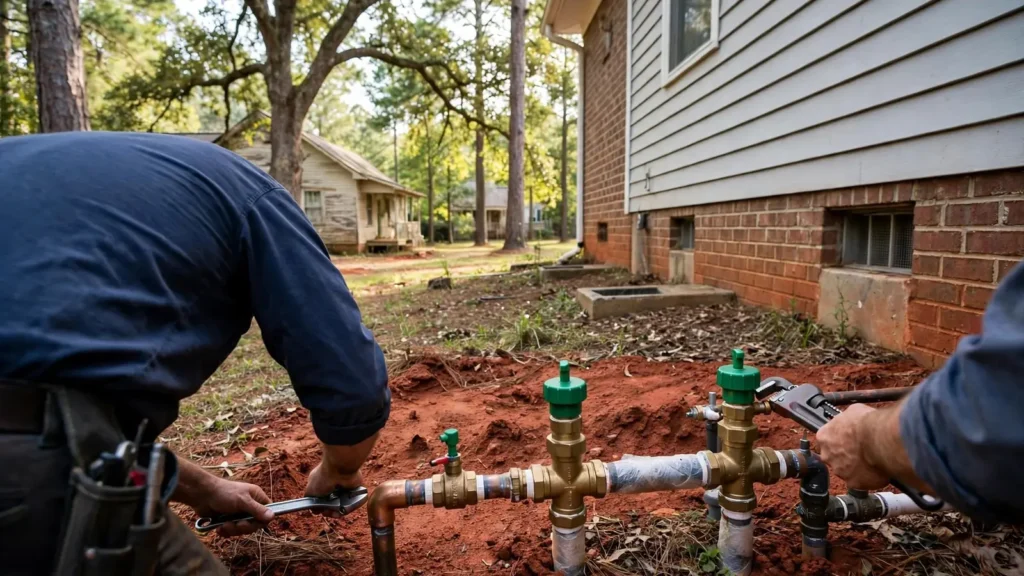
How long PRVs last, and the signs one is failing
There's no fixed lifespan for a pressure-reducing valve. Sediment, the pressure it's holding back and plain wear on the diaphragm and seat all play into it. What we can say is that a lot of PRVs installed with 2000s and 2010s homes are now old enough to drift, and a drifting PRV usually fails toward high pressure.
| What you notice | Likely cause | Usual fix |
|---|---|---|
| Static pressure over 80 psi on a gauge | PRV failing or set too high | Adjust, or replace the PRV |
| Pressure creeps up overnight, T&P drips | Waterlogged or missing expansion tank | Recharge or replace the expansion tank |
| Low pressure throughout the house | PRV stuck partly closed or a clogged strainer | Clean the strainer or replace the PRV |
| Humming, buzzing or chattering at the main | Worn PRV | Replace the PRV |
| Pressure swings when two fixtures run | PRV not regulating well | Replace the PRV |
Most PRVs have an adjusting screw under a cap on top. Small adjustments are fine for a careful homeowner, but if turning it doesn't bring the pressure down, the valve is worn and adjusting it more won't help. Replacing a PRV means shutting off the water supply and cutting into the main line, so it's a plumber's job. When a PRV is replaced, have the expansion tank charge reset to the new house pressure at the same visit.
High pressure is hard on everything downstream, from supply lines to fill valves to the water heater itself. If you've already had a supply line or fitting let go, our leak detection page covers how to look for slower leaks elsewhere. And the yearly water heater maintenance checklist includes the expansion tank check so it doesn't get forgotten.
Need a PRV or expansion tank checked? Call a local plumber
Expansion tank and PRV questions
What water pressure is too high for a house?
The residential code South Carolina uses limits static pressure inside a house to 80 psi. About 40 to 80 psi is the normal range. Above 80 calls for a PRV, or a look at the one you have.
Who pays to fix thermal expansion problems, me or Greenville Water?
You do. Greenville Water's cross connection policy says customers are responsible for maintaining thermal expansion tanks, relief valves and pressure-reducing valves on their side of the meter.
Does a tankless water heater need an expansion tank?
Usually not. The code's thermal expansion requirement is written for storage water heaters, and a tankless unit holds very little water. Ask your installer or building department if you're unsure.
How long does an expansion tank last?
It varies with water conditions and how hard the tank works. Check the air charge every year; the first sign of trouble is a charge that keeps dropping or water coming out of the air valve.
Can I adjust my PRV myself?
Small adjustments with the screw on top are reasonable if you have a gauge to check the result. If adjusting doesn't change the pressure, the valve is worn and needs replacing.
Sources
- Greenville Water, Cross Connection Control Manual, November 2025 (Section 2-4 customer responsibility; Section 5-3 residential dual check valves on meter setters; Section 8 thermal expansion).
- South Carolina Building Codes Council (SC LLR), code adoption notices: 2021 IRC and IPC effective January 1, 2023; 2024 editions adopted August 26, 2025, local implementation January 1, 2027.
- International Code Council, 2021 International Residential Code sections P2903.3.1 (maximum pressure), P2903.4, P2903.4.1 and P2903.4.2 (thermal expansion control); International Plumbing Code section 607.3 (thermal expansion control).
- Amtrol, Therm-X-Trol installation and operating instructions and sizing guide (40 psi factory pre-charge; set pre-charge to incoming pressure).
- SC DHEC (now SC DES) Regulation 61-58.7, residential lawn irrigation cross connection policy (residential dual check).