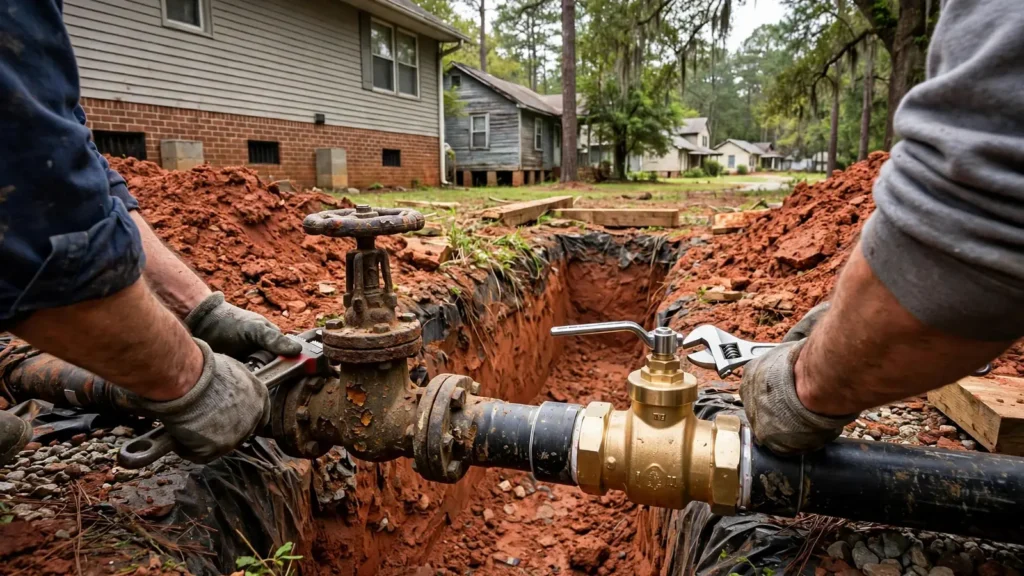
It usually starts as a single thud in the wall when the washing machine finishes filling. Then it's the dishwasher too, and the ice maker at 2 a.m. People tend to ignore water hammer because the pipes don't leak right away. They should take it seriously. Every bang is a pressure spike that travels through the whole system, and the weak points (a crimp fitting, a solder joint, a washer hose, a water heater connector) feel it every time.
The fix depends on the cause, and the cause depends a lot on the house: a 1960s crawlspace ranch in Taylors bangs for different reasons than a 2015 PEX build in Simpsonville.
What causes water hammer
Water is heavy and it doesn't compress. When it's flowing through a pipe and a valve slams shut, all that moving water has to stop at once. Its momentum turns into a pressure wave that slams back and forth through the pipe until it dies out. The bang is that wave hitting the closed valve, elbows and fittings, and the pipe jumping against whatever it's touching.
How hard it hits depends mostly on how fast the water was moving and how fast the valve closed. A column of water stopping gently over a second or two barely registers. One stopped in a fraction of a second can spike far above your normal house pressure. An engineering column on the Plumbing and Drainage Institute's water hammer standard (PDI-WH 201) gives a rough rule of thumb: the pressure wave is about 60 times the flow velocity in feet per second. Water moving at 5 feet per second, which is common in a small supply line with a valve wide open, works out to a spike in the neighborhood of 300 psi on top of what's already in the line. The pipe and fittings in a house aren't meant to take that over and over.
The usual suspects
- Washing machines. Their fill valves are solenoids, electric valves that close almost instantly. This is the most common trigger by far.
- Dishwashers, for the same reason.
- Refrigerator ice makers and water dispensers, which use small solenoid valves on a thin line.
- Irrigation zone valves, which can send a bang back into the house when a zone shuts off.
- Single-lever faucets slapped shut, especially on a kitchen sink running full blast.
- Toilet fill valves, mostly older ones that close abruptly.
The residential code describes a quick-closing valve as one that closes automatically when released, or one closed by a mechanical device like a solenoid. That covers the washer and dishwasher. Manual quarter-turn ball valves generally aren't counted as quick-closing, though you can still make one bang if you snap it shut on a running line.
Is it water hammer or something else?
Pipes make several different noises, and they have different fixes. Matching the sound to the cause saves money.
| What you hear | When | Likely cause |
|---|---|---|
| One loud bang or thud | Right as an appliance or faucet stops | Water hammer |
| Several knocks that fade out | Right after a valve closes | Water hammer with a loose pipe bouncing in its straps |
| Rattling or chattering | While water is running | Loose pipe, or a worn washer or cartridge in a valve |
| Ticking or creaking | As hot water starts flowing, and as it cools | Hot pipes expanding against straps or framing; not water hammer |
| Humming or a whine | While water runs | High pressure or a worn pressure-reducing valve |
| Banging that starts after a new appliance | When that appliance fills | Its solenoid valve, often on a line that was always a little loose |
High water pressure makes it worse
Higher pressure means faster water when a valve is open, and faster water means a harder hit when it closes. That's why water hammer often shows up, or gets louder, when a home's pressure-reducing valve starts to fail. The residential code South Carolina uses caps static pressure inside a house at 80 psi. Anything above that is a problem in its own right.
Checking is cheap. Screw a hose-bib pressure gauge onto an outside faucet or the washer's cold valve, open it with nothing else running, and read it. Between about 40 and 80 psi is normal. If you have a gauge with a "lazy" second needle, leave it on overnight; a needle that climbs well past your starting number points to thermal expansion from the water heater. Our post on expansion tanks and pressure-reducing valves explains that one, and why so many newer Simpsonville, Fountain Inn and Greer homes have PRVs that are now old enough to drift.
Loose pipes and straps
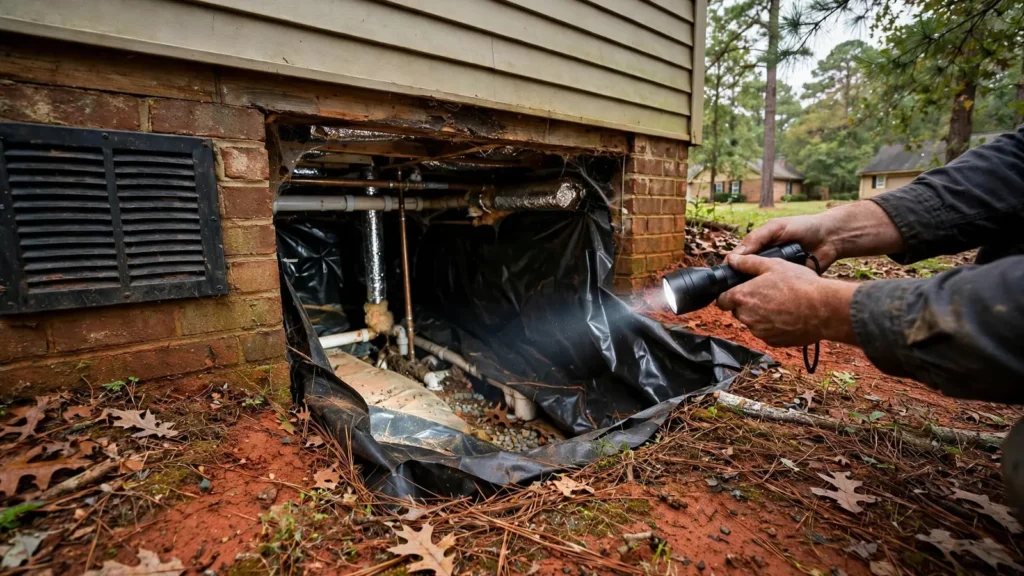
A pressure spike makes the pipe itself move. If the pipe is clamped tight, you might hear a dull thud. If it's hanging loose, it slaps the nearest joist, stud or duct, and the noise can sound like someone hitting the floor with a hammer.
- In crawlspace ranches from the 1950s through the 1970s, common in Taylors, Wade Hampton and Berea, straps rust through, nails back out, and old galvanized or copper runs end up sagging. Our page on plumbing in older Greenville homes covers what else to look for under there.
- In newer homes with PEX, the tubing is flexible and moves more. Runs need support at regular spacing and at every change of direction, and long unsupported runs inside walls can drum against the drywall.
- Where a pipe passes through a hole in a joist or stud, a tight plastic sleeve or a foam cushion can stop the knock.
If you can get to the pipe that bangs, have someone run the washer while you watch. You'll usually see the run that jumps. Adding a few clamps there won't stop the pressure spike, but it can turn a bang into a tap. It works best alongside an arrestor, not instead of one.
Pipes banging every time the washer fills? Call a local plumber
Water hammer arrestors: the real fix
A water hammer arrestor is a small sealed cylinder with a piston or bladder and a pocket of air or gas behind it. When a valve slams shut, the pressure wave pushes the piston into the cushion instead of rattling the pipe. Unlike the old air chambers described below, a sealed arrestor doesn't lose its cushion to the water.
The International Plumbing Code (section 604.9) requires water hammer arrestors where quick-closing valves are used, installed per the maker's instructions and meeting the ASSE 1010 standard, and the residential code carries the same requirement. The mandatory quick-closing-valve wording was out of the residential code for a stretch and was restored in the 2018 code cycle, so a house built in some years may not have arrestors even at the washer.
Where they go
- At the washing machine. Screw-on arrestors thread between the washer valves and the hoses. This is one of the few plumbing fixes most homeowners can do in ten minutes. Many newer washer boxes have arrestors built in.
- Under the kitchen sink on the dishwasher supply.
- On the ice maker line, near the valve.
- On the main or a branch line when the source is irrigation or several fixtures at once. Sizing those is a plumber's call; the PDI standard sizes arrestors by fixture load and pipe length.
The rule is to put the arrestor as close as practical to the valve that's causing the hit. One arrestor in the wrong spot does very little. If the bang persists after you add one at the washer, the source is probably somewhere else.
The old air-chamber drain-down trick, and when it works
Many older homes were built with air chambers: short capped pipes that stick up above the supply to a fixture, hidden in the wall. They hold a pocket of air that works like a cheap arrestor. Over time the air dissolves into the water, the chamber fills, and the banging returns. Draining the house lets air back in.
- Shut off the main. If you're on a well, turn off the breaker to the well pump too.
- Open the highest faucet in the house, then the lowest one (an outside spigot or basement sink) so the lines drain completely.
- Let everything drain until the water stops running at the low faucet.
- Close the low faucet, leave the high one open, and turn the main back on slowly.
- Close the high faucet once it runs steady with no sputtering, then open each other faucet briefly to push out trapped air.
It works when the house actually has air chambers and they've simply waterlogged. It doesn't work in most PEX-plumbed houses from the 2000s on, which usually don't have air chambers at all, or when the cause is high pressure or a loose pipe. In hard-water regions, mineral scale can plug a chamber so it won't drain; on soft Greenville Water that's less likely, so a waterlogged chamber is usually just waterlogged. It also wears off: the air dissolves again over weeks to months. Code interpretations generally don't accept an air chamber as a substitute for a listed arrestor, so if you're going to the trouble of opening a wall, an arrestor is the better part to put there.
Whatever kind of main valve you have, gate or ball, turn it back on slowly after a drain-down, a repair or a frozen pipe scare. Water rushing into empty pipes and slamming into closed faucets can hit harder than any washing machine.
Why it matters: what water hammer breaks
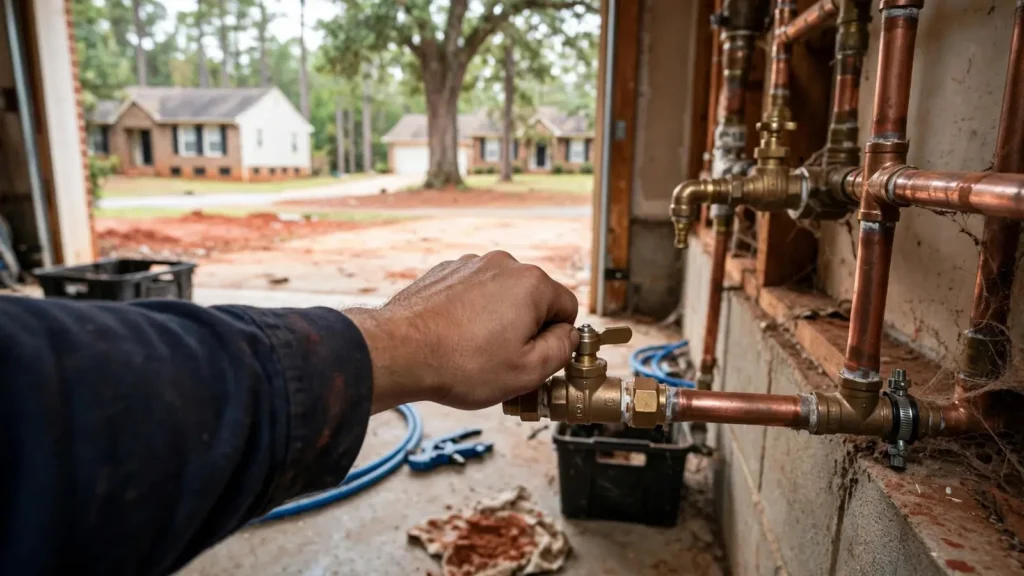
A single bang won't burst a pipe. Thousands of them can wear out the parts that hold the system together. The places we'd look first after a long history of water hammer:
- Washing machine hoses and the threads on the washer valves.
- Braided supply lines under sinks and toilets, and their compression nuts.
- Thin ice maker lines, plastic ones especially.
- Push-fit and crimp fittings, and solder joints on older copper.
- The water heater's connectors and its relief valve.
- Pipe that rubs on a joist or bracket every time it jumps, which can wear a spot thin over the years.
If you've had a supply line or fitting fail already and the house also bangs, fix the banging when you fix the leak. Otherwise the new part is taking the same beating. Our leak detection guide covers how to check for slow leaks you can't see yet, and the burst pipe guide covers what to do if something lets go. For what a plumber visit typically costs here, see our Greenville plumbing cost guide.
Need arrestors installed or pressure checked? Call a local plumber
Water hammer questions
Is water hammer dangerous?
It isn't an emergency, but it isn't harmless. Repeated pressure spikes wear out fittings, hoses and supply lines faster, and a failed washer hose or ice maker line can put a lot of water on the floor. Fix it when you notice it.
Why do my pipes bang only when the washing machine fills?
Washing machine fill valves are solenoid valves that shut almost instantly, which is the classic water hammer trigger. A pair of screw-on arrestors at the washer valves fixes most cases.
Can high water pressure cause banging pipes?
Yes. Higher pressure means faster water and harder stops. If a gauge on a hose bib reads over 80 psi, have the pressure-reducing valve checked or one installed.
Do water hammer arrestors wear out?
Sealed piston arrestors are built to last for years without maintenance, but they can eventually fail. If banging comes back at a spot that has an arrestor, the arrestor is a good first suspect.
Why did my pipes start banging after a new appliance was installed?
The new washer, dishwasher or refrigerator likely has a faster-closing valve than the old one, or it was hooked up without an arrestor. Add one at that appliance's supply valve.
Sources
- International Code Council, International Plumbing Code section 604.9 (water hammer; ASSE 1010 arrestors where quick-closing valves are used) and International Residential Code section P2903.5; 2018 code cycle history restoring the quick-closing valve requirement.
- Plumbing and Drainage Institute, PDI-WH 201 Water Hammer Arresters standard, as discussed in PM Engineer, "Water Cooler Conversation," January 2022 (pressure rise rule of thumb; quick closure definition; quarter-turn valves).
- City of Raymore, Missouri, building code interpretation on IRC water hammer requirements (quick-closing valve definition; air chambers not a substitute for arrestors).
- ASSE International, ASSE 1010 performance requirements for water hammer arresters.
- 2021 International Residential Code section P2903.3.1 (80 psi maximum static pressure), as adopted by the South Carolina Building Codes Council.