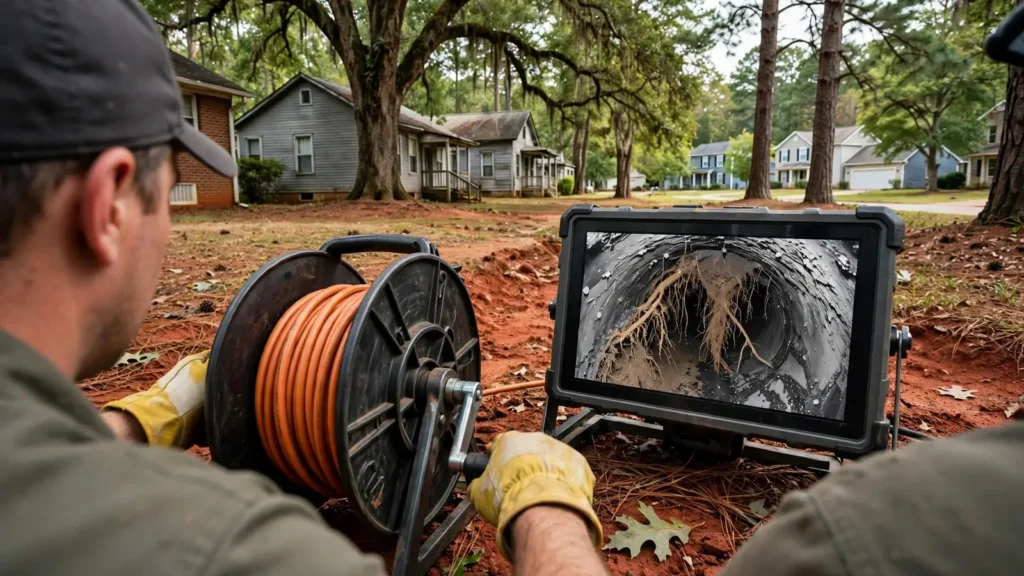
Most buyers in Greenville County get a home inspection, and most should. But a plumbing inspection before buying a house is where a general inspection leaves the biggest gaps, because so much of the system is hidden: supply pipe in the walls, drains under the slab, and a sewer line under the front yard that you'll own the day you close.
This checklist is what we'd look at, what to ask the seller, and how to use what you find. It's written for the housing stock here: postwar ranches in Taylors and Wade Hampton, 1980s and 1990s subdivisions in Mauldin and Simpsonville, newer builds in Fountain Inn, and rural homes on wells and septic.
What a South Carolina home inspection covers, and what it doesn't
In South Carolina, anyone who does home inspections for pay has to be licensed by the Residential Builders Commission, part of the Department of Labor, Licensing and Regulation (LLR). Licenses go to individuals, not companies. State law also requires the inspector to tell you the scope and limitations of the inspection before doing it, and the report has to be on a form the commission approves. Some other licensees, such as residential builders, general contractors and engineers, can inspect under their own licenses.
That disclosed scope is worth reading closely. A typical inspection includes:
- Running faucets, showers and tubs, and flushing toilets.
- Looking at visible supply and drain pipes under sinks, in the crawlspace or basement.
- Checking the water heater's installation, relief valve and venting.
- Noting active leaks, water stains and obvious damage.
What it usually doesn't include:
- The sewer lateral from the house to the street.
- Pipes inside walls, ceilings or under a slab.
- Wells, pumps and septic systems, unless you add them.
- Water quality testing.
- Gas line pressure testing.
If the inspector offers a sewer scope as an add-on, that's fine. Otherwise, hire a plumber to do it.
Why a sewer scope matters on older Greenville County homes
The lateral is the most expensive plumbing surprise in an older house, and it's the one a standard inspection can't see. In MetroConnects areas (most of unincorporated Greenville County), MetroConnects' lateral policy makes the private lateral from the house out to the edge of its easement or right of way the owner's responsibility, plus the connection, and any pipe within 5 feet of the house is always yours. Our who-owns guide explains the split in detail.
Houses built from the 1940s through the early 1970s may have clay tile or Orangeburg fiber pipe to the street. Census estimates put the median home in Wade Hampton at 1973 and in Taylors at 1983, so a lot of the county's resale stock is in that range. A camera shows roots, cracks, offsets, sags and flattened pipe. Ask for the video and the footage of each problem.
For what a sewer camera inspection costs, see the Greenville plumber cost guide. Compared with a lateral replacement, it's cheap.
The plumbing checklist: what to look at
| Item | What to check | Red flags |
|---|---|---|
| Water heater age | Read the serial number on the rating label; most brands encode the year and month | Over about 10 to 12 years old, rust at the base, no drain pan where one is needed |
| Supply pipe material | Look at the main line entry, water heater and under sinks | Gray PB-stamped pipe, galvanized steel, mixed metals with no dielectric fittings |
| Main shutoff | Find it and see if it turns | An old gate valve that's stuck or weeps |
| Water pressure | Put a gauge on a hose bib | Over 80 psi with no pressure-reducing valve |
| PRV and expansion tank | Look near the main line and water heater | A PRV with no expansion tank, or a waterlogged tank |
| Crawlspace | Look with a flashlight or the inspector's photos | Standing water, wet insulation, sagging drain lines, uninsulated pipe near vents |
| Drains | Run several fixtures at once | Gurgling toilets, slow lowest drain, sewage smell |
| Ceilings and walls | Look below bathrooms and around the water heater | Stains, fresh paint patches, soft drywall |
| Water meter | Turn everything off and watch the leak indicator | Any movement |
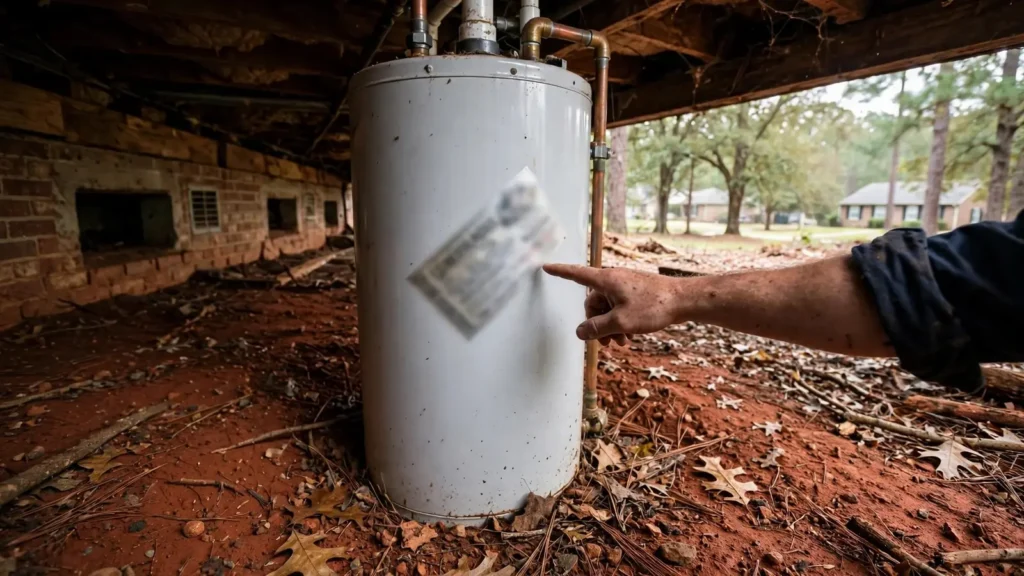
Reading the water heater
The serial number is the quickest way to date it, and the method differs by brand. Our water heater repair guide explains how to decode it and what age means for repair versus replacement. A water heater near the end of its life is fair to bring up in negotiation, but it's not a dealbreaker. It's a known cost.
Pipe material by era
Houses from about 1978 to 1995 may have polybutylene, which some insurers ask about. Read our polybutylene pipe guide before you close on one. Pre-1970 houses may have galvanized steel supply lines and cast-iron drains; our older homes guide covers what to expect. Newer houses usually have PEX, which is good news.
The crawlspace
A lot of Greenville County houses from the 1950s through the 1980s sit on crawlspaces. That makes plumbing easier to inspect and cheaper to fix, but it also means pipes are exposed to the cold. Look for insulation on supply lines, especially near vents and on the north side. Our frozen pipes guide explains why the Upstate's occasional hard freezes cause so many crawlspace bursts.
Need a sewer scope before closing? Call a local plumber
The SC disclosure statement: what the seller has to tell you
South Carolina law (Title 27, Chapter 50) requires most sellers to give the buyer a Residential Property Condition Disclosure Statement. It covers the water supply and sewage system and the plumbing, electrical, heating and cooling systems, among other things. The seller answers each question yes, no or "no representation."
A few things worth knowing:
- The statement is due before you and the seller sign the contract, unless the contract says otherwise.
- "No representation" means the seller isn't claiming knowledge either way. It doesn't excuse hiding something they know.
- A seller who knowingly gives false, incomplete or misleading information can be liable for actual damages.
- If the seller learns something that makes the statement inaccurate before closing, they have to correct it or fix the problem.
- The law keeps the buyer's own duty to inspect. The disclosure isn't a warranty.
Some sales are exempt. The ones buyers run into most are the first sale of a newly built home that's never been lived in, foreclosures and other court-ordered sales, sales by an estate's executor or a trustee, and auctions. On those, your inspection is your only source of information.
Questions to ask the seller
- How old is the water heater, and has it been serviced?
- What is the supply pipe, and has the house been repiped? Ask for the invoice.
- Has the sewer line backed up, been cleaned, or been replaced? When and by whom?
- Have you had any leaks or water damage claims?
- Is the house on public sewer or septic? If septic, when was it last pumped?
- Who provides water and sewer? Greenville Water, Greer CPW, a city system, MetroConnects or a well.
- Where is the main shutoff, and does it work?
- Is there a pressure-reducing valve or backflow device for irrigation?
Rural buyers should also ask for well records and septic permits. SC DES handles septic permits and offers well water testing through its regional offices; its well bacteria test fee was listed at $20 when we checked, but confirm with your office. Our septic pumping guide covers what to check on a septic home.
How to negotiate plumbing repairs
Your best window is the inspection or due diligence period your contract sets. Use it.
- Get a written quote for anything major before you go back to the seller. A specific number carries more weight than "the sewer line looks bad."
- Pick your battles. A 12-year-old water heater is a normal cost of owning a house; a collapsed lateral or a whole-house polybutylene system is a real defect.
- Consider asking for a credit or price reduction instead of a repair. Sellers making repairs on their way out often hire the lowest bidder.
- If the seller does repair it, ask for the invoice, the permit if one was needed, and before-and-after camera video for sewer work.
- Check with your insurer before closing if the house has polybutylene or old galvanized pipe.
When you hire a plumber for any of this, check the license. Our guide to checking a plumber license in SC walks through the LLR lookup.
Got a plumbing item on your inspection report? Call a local plumber
Home buyer plumbing questions
Is a full plumbing inspection part of a standard SC home inspection?
Partly. The inspector checks visible plumbing, fixtures and the water heater. The sewer lateral, hidden pipes, wells and septic are usually outside the scope, which the inspector has to tell you about before the inspection.
Can I hire a plumber instead of a home inspector?
You can hire a plumber for the plumbing, and it's a good idea for a sewer scope. A plumber won't look at the roof, electrical or structure, so most buyers use both.
Does a builder have to give a disclosure statement on a new home?
No. South Carolina exempts the first sale of a dwelling that's never been lived in. Your inspection and the builder's warranty are what you have.
What does it mean if the seller checked "no representation" on plumbing?
The seller isn't claiming to know either way. They still can't hide problems they know about, but you should treat those items as unknown and inspect them.
Who usually pays for a sewer scope when buying a house?
The buyer, as part of their own inspections. If it finds problems, use the video and a written quote to negotiate.
Sources
- South Carolina Code of Laws, Title 40, Chapter 59, Article 5 (Sections 40-59-500 to 40-59-580): home inspector licensing, scope disclosure and report form requirements.
- SC Department of Labor, Licensing and Regulation, Residential Builders Commission: home inspector licensing information.
- South Carolina Code of Laws, Title 27, Chapter 50, Article 1 (Sections 27-50-30, 27-50-40, 27-50-50, 27-50-60, 27-50-65, 27-50-80): Residential Property Condition Disclosure.
- MetroConnects: Lateral Maintenance Policy, adopted July 17, 2023.
- U.S. Census Bureau, American Community Survey 5-year estimates, median year structure built (Wade Hampton and Taylors CDPs), as reported on our older homes guide.
- International Residential Code, Section P2903.3.1 (maximum static pressure).
- SC Department of Environmental Services: well water quality testing services.