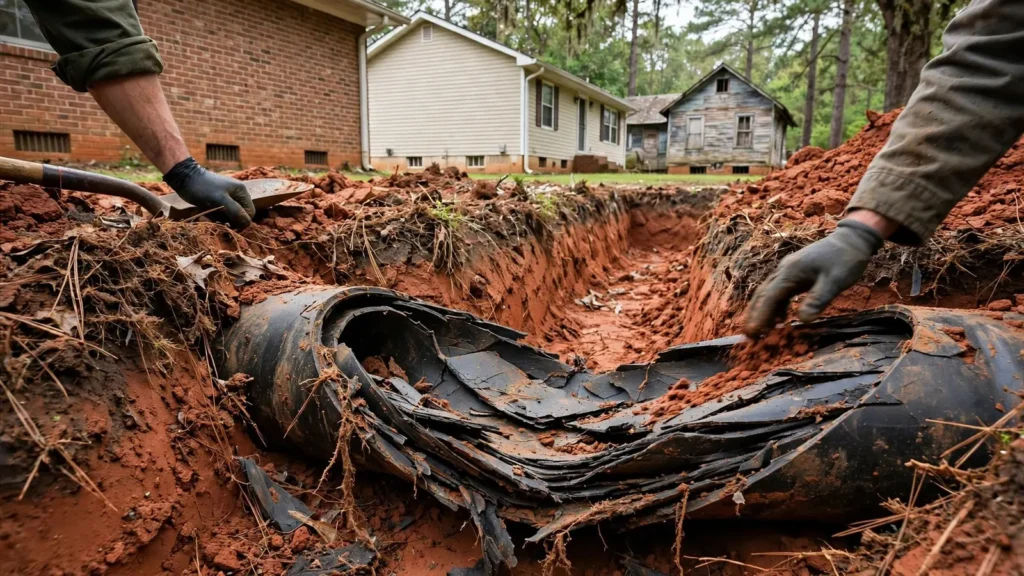
Orangeburg pipe is one of those things most homeowners have never heard of until a plumber pulls a camera out of their cleanout and says the word. It's black, it looks a bit like tar paper rolled into a tube, and in a lot of mid-century neighborhoods it's still carrying everything from the house to the street.
The trouble is that it was never meant to last as long as it has.
What Orangeburg pipe is
Orangeburg is named for Orangeburg, New York, where the Fiber Conduit Company (later the Orangeburg Manufacturing Company) made most of it. The pipe was built up from many layers of wood pulp fiber, pressed together with coal tar pitch between each wrap. A 4-inch sewer pipe could have around 25 layers. One trade writer described it as a toilet paper tube soaked in coal tar, which is not far off.
It started out as electrical and telephone conduit early in the 1900s. After World War II, when materials were short and housing was booming, it became popular for sewer laterals and septic lines: light, cheap, easy to cut and quick to lay. Homes built from roughly 1945 to 1972 are the most likely to have it. PVC took over through the late 1960s, and the Orangeburg plant closed in 1972. Some model codes still allowed bituminous fiber sewer pipe into the early 1980s, so a later house can't be ruled out entirely.
How Orangeburg pipe fails
Orangeburg doesn't crack the way clay or cast iron does. It deforms. The fiber absorbs water over time and softens, and the weight of the soil above slowly squeezes it from round to oval to flat. The usual description is a useful life of up to 50 years, with warping often starting after about 30. Most of the pipe in Greenville County ranch houses went in well over 50 years ago.
What a failing line goes through, roughly in order:
- Ovaling. The pipe flattens at the top. Flow still works, but the opening is smaller.
- Blistering and delamination. Inner layers bubble or peel, catching paper and grease.
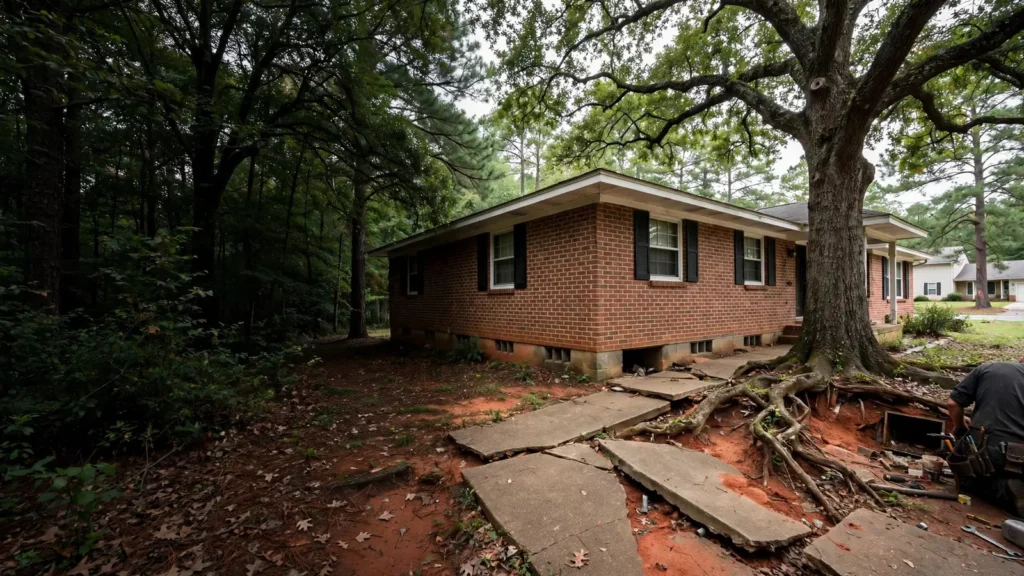
- Root entry. Roots push in at joints and soft spots, and weakened fiber can't stop them.
- Collapse. A section flattens completely or breaks apart, and the house backs up.
Red clay matters here. Upstate clay is dense and holds water, so the pipe sits in damp, heavy soil for much of the year. We haven't found a study that measures how that changes Orangeburg's lifespan, but it's not a gentle setting for a fiber pipe.
Why this matters for 1950s to 1970s Greenville County houses
The unincorporated suburbs east and south of the city grew fast in the postwar years. Census estimates put the median home in Wade Hampton at 1973, with about 60 percent built between 1960 and 1979. In Taylors, about 38 percent of homes are from those two decades, and Berea comes in around 40 percent. Mauldin has its own 1960s and 1970s ranch streets mixed in with newer subdivisions. Those are exactly the years Orangeburg was common. Our older homes guide has the full census table.
That doesn't mean every ranch in Taylors has it. Clay tile and cast iron were also used, plenty of laterals have been replaced already, and a single lateral can be part Orangeburg and part something else after an earlier repair. We haven't found any public record of how much Orangeburg went into the county's laterals, so treat age as a reason to look, not as proof.
The houses most worth checking:
- Brick or frame ranches from about 1950 to 1972, especially on original sewer laterals.
- Houses with large trees between the house and the street. Our Wade Hampton page has more on the mature-oak problem.
- Houses with a history of main-line clogs every year or two.
- Homes that were on septic and later tied into public sewer, since Orangeburg was also used for septic lines.
Main drain keeps backing up? Call a local plumber
Signs you might have a failing Orangeburg lateral
None of these prove Orangeburg on their own. They're the signs of a main line problem, and in a house of the right age they're a reason to put a camera in it.
- Several drains slow at once, especially the lowest tub or shower.
- Toilets gurgle when the washer drains.
- A cleaning clears the line, then it clogs again within months.
- Sewage smell in the yard, or a soft, sunken or extra-green strip between the house and the street.
- A drain cleaner says their cable "hit something soft" or came back with black fiber on it.
For telling a main line clog from a single slow drain, our drain cleaning guide walks through it.
What a camera inspection shows
A sewer camera is the only way to identify Orangeburg without digging. A plumber runs it in from a cleanout (or pulls a toilet if there isn't one) and records the trip to the street. On Orangeburg, look for:
- A dark, almost black pipe wall with a dull, slightly fibrous look rather than glazed clay or rough iron.
- An opening that looks oval or flattened instead of round.
- Bubbles or flaps where inner layers have lifted.
- Roots coming through the pipe wall itself, between joints.
- A spot where the camera simply can't pass.
Ask for the video and for footage marks or a locator reading at each defect, so you know how deep and how far out the bad sections are. That's what any repair quote should be built on.
Repair options: lining, bursting or replacing
This is where Orangeburg differs from other old sewer pipe. Cured-in-place lining (CIPP), where a resin-soaked liner is cured inside the old pipe, takes the shape of the pipe it's in. A liner inside a flattened pipe is a flattened liner. Fairfax, Virginia's lateral program, for example, treats collapsed, back-pitched or fragile pipe as ineligible for lining, and warns that cleaning fragile Orangeburg with a hydro jet before lining can damage it further.
| Method | When it fits Orangeburg | Trade-offs |
|---|---|---|
| Spot repair | One short bad section, rest of the line still round on camera | Cheapest, but the rest of the line is the same age. Often a stopgap. |
| CIPP lining | Rarely; only if the pipe is still round and intact enough to hold its shape | Less digging, but deformed or collapsed sections usually disqualify it |
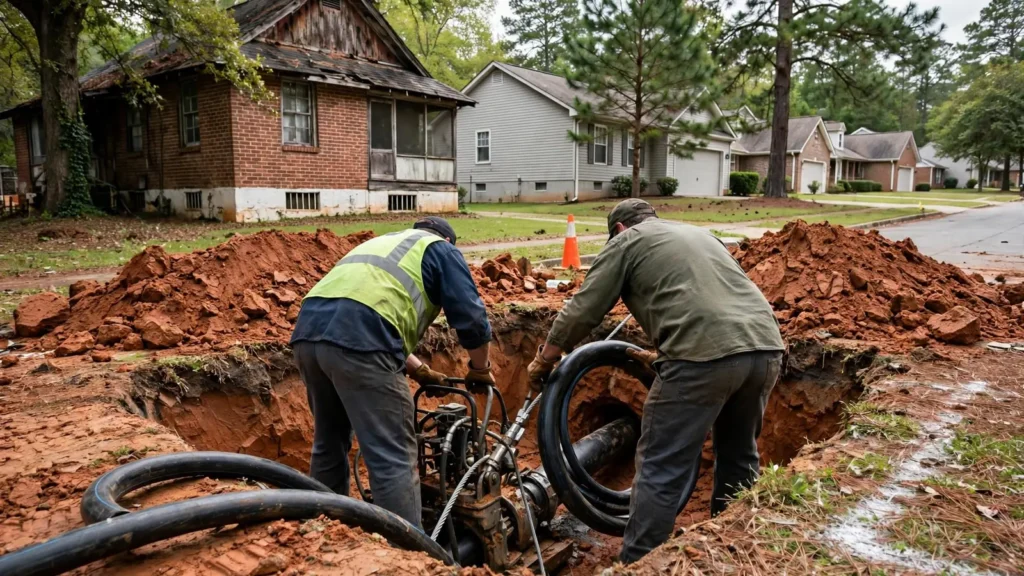
| Pipe bursting | Most deformed laterals with a reasonably straight path | Pits at each end; new HDPE follows the old route and can go up a size |
| Open trench replacement | Collapsed sections, bad slope, shallow lines, or lots of bends | Most digging and yard repair, but you see and fix everything |
For most failing Orangeburg, replacement is the honest answer, either by pipe bursting or a trench. Our sewer line repair guide covers trenchless versus open cut and permits, and the cost guide has price ranges.
Who owns the lateral: MetroConnects, the city or you
In most of unincorporated Greenville County, including Taylors, Wade Hampton and Berea, MetroConnects collects sewer. Its Lateral Maintenance Policy splits each lateral in two. MetroConnects owns the service lateral from its main out to the edge of its easement or the road right of way. You own the private lateral from the house to that point, plus the connection fitting, and any pipe within 5 feet of the house is always yours. Inside Mauldin's city limits, the City of Mauldin handles collection instead, and its rules apply.
Two practical points come out of that:
- A camera often finds that the Orangeburg runs the whole way, including the public section. If a defect is on MetroConnects' side, the policy has a process for that, and its timing rules matter.
- If sewage is backing up, MetroConnects' policy says to call it first at (864) 277-4442, before a plumber. Calling a plumber first can disqualify reimbursement for work in its section. Our sewer backup guide covers the cleanup side.
The full breakdown, including the 30-day reimbursement window, is in our who owns the water and sewer line guide.
What to do if you think you have Orangeburg
- Find your cleanout so a camera can go in without pulling a toilet.
- Get a camera inspection and keep the video.
- Mark where the line runs and where the public section starts.
- Ask for quotes by method, so you can compare bursting and trenching on the same line.
- Plan landscaping and driveway work around it. Don't pour a new driveway over an Orangeburg lateral.
- If you're buying, scope the line before closing. Our plumbing inspection checklist covers what else to check.
Think your sewer line is Orangeburg? Call a local plumber
Orangeburg sewer pipe questions
Is it safe to hydro jet an Orangeburg sewer line?
It can do damage. High-pressure water can tear softened layers loose. Many plumbers will camera the line first and use gentler cleaning, or recommend replacement, if it's Orangeburg in poor shape.
Can Orangeburg pipe be lined instead of replaced?
Only if it's still round and holding together. A liner takes the shape of the pipe it's cured in, so flattened or collapsed Orangeburg usually needs pipe bursting or a trench instead.
Does a standard home inspection check for Orangeburg pipe?
Usually not. Most home inspections look at the visible plumbing and run water through the drains. The lateral is underground, so you need a separate sewer camera inspection to know what it's made of.
Could only part of my sewer line be Orangeburg?
Yes. Earlier repairs often replaced the worst stretch with PVC and left the rest. A camera inspection shows where the material changes.
Why is my Orangeburg pipe black?
The coal tar pitch that bonds the fiber layers is black. On a camera, Orangeburg looks dark and dull, unlike the tan or reddish glaze of clay tile.
Sources
- PHCP Pros (Plumbing and Mechanical), "Everything you wanted to know about Orangeburg pipe but were afraid to ask": construction, years of use, plant closure in 1972, lifespan and deformation.
- InspectAPedia and general histories of the Fiber Conduit Company and Orangeburg Manufacturing Company, Orangeburg, New York.
- City of Fairfax, Virginia: Wastewater Lateral Repair and Replacement Program, CIPP eligibility and Orangeburg cleaning cautions.
- Cleaner magazine (2024): Orangeburg lateral replacement by pipe bursting with HDPE.
- U.S. Census Bureau, American Community Survey 5-year estimates, year structure built (Wade Hampton and Taylors CDPs), as reported on our older homes guide.
- MetroConnects: Lateral Maintenance Policy, adopted July 17, 2023 (service lateral, private lateral, 5-foot rule, call-first and reimbursement rules).
- City of Mauldin: sewer collection within city limits.