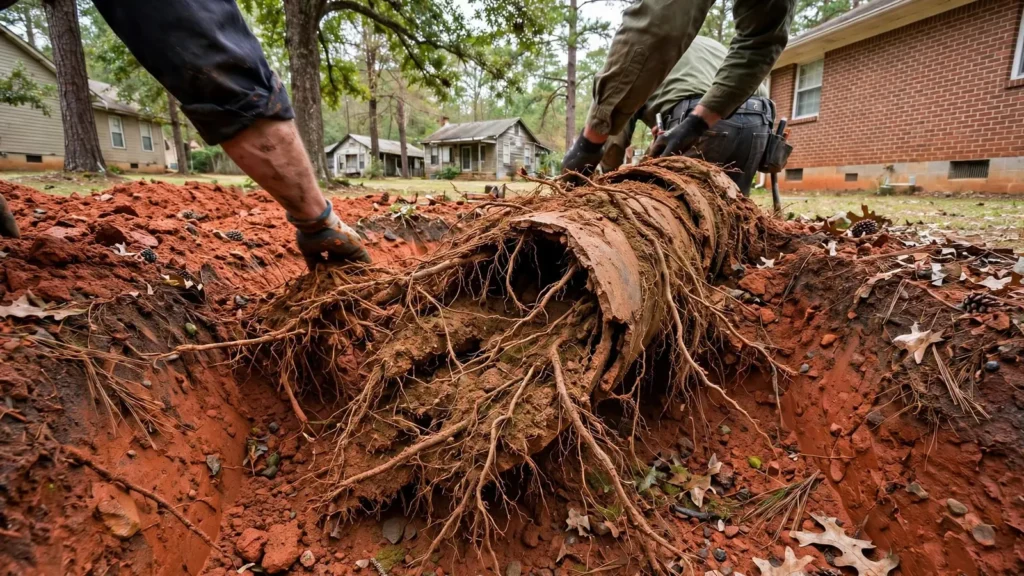
Greenville County is a tree-heavy place. Mid-century neighborhoods in Wade Hampton, Taylors, Augusta Road and around the city have big oaks, maples and pines that were already decades old when the houses went up, or were planted at the same time. Many of those houses still drain through their original sewer lateral, laid in clay or Orangeburg pipe sixty or more years ago. Put the two together and tree roots in the sewer line are one of the most common reasons a main line keeps clogging.
This guide covers why roots get in, which Upstate trees are the usual offenders, what the signs look like, how the fixes compare, who pays in a MetroConnects area, and how far to keep new trees from the line.
Why roots find clay and Orangeburg joints
Roots don't punch through sound pipe. An urban forester with N.C. Cooperative Extension put it plainly in a 2023 article: roots can only exploit existing cracks or gaps, which means a pipe with roots in it was already leaking before they arrived. A leaking joint gives off water, warmth and nutrients, roots near the pipe grow toward it, and a hair-thin root slips into the gap. Inside, it finds a steady supply of water and food, so it branches into a mat that catches toilet paper and grease. As it thickens, it pries the gap wider.
The pipe material decides how many gaps there are:
| Pipe | Where you'll find it | How roots get in |
|---|---|---|
| Vitrified clay | Many laterals from the early 1900s into the 1970s | Clay comes in short sections, so there's a joint every few feet. Older joints were packed with mortar or other materials that crack and shift. |
| Orangeburg (bituminized fiber) | Homes from roughly the late 1940s into the early 1970s | The pipe softens and deforms under soil pressure, flattening into an oval. Roots take advantage of the deformed sections and joints. |
| Cast iron | Common under and near older houses | Joints sealed with oakum and lead loosen over time; rusted-through spots open up. |
| PVC | Most homes built or re-piped since the 1980s | Solvent-welded joints are tight. Roots are rare unless a joint was poorly glued or the pipe cracked. |
If you aren't sure what your lateral is made of, the age of the house is the first clue. Our guides to plumbing in older Greenville homes and plumbing in Wade Hampton cover what's typical in houses of that age.
Upstate trees with aggressive roots
Any tree near a leaking sewer line will send roots into it. A Tennessee municipal advisory publication says flatly that there's no such thing as a sewer-safe tree, only lower-risk ones. Some species are known for it, though. Clemson Extension's Home & Garden Information Center (HGIC) lists willows, red and silver maples, beeches, birches, elms and poplars as trees with very aggressive root systems to keep away from septic drain lines, and its maple factsheet says silver maple's root system will buckle sidewalks and clog drain tiles.
| Tree | What extension sources say | Why it matters here |
|---|---|---|
| Silver maple | Very vigorous roots; clogs drain tiles (Clemson HGIC) | Fast-growing shade tree planted in many older yards |
| Red maple | Aggressive roots; avoid near drain lines (Clemson HGIC) | Common in Upstate yards and subdivisions |
| Willows | Aggressive; known for thriving near wet spots, including sewer lines (Clemson HGIC; UGA Extension) | Often planted near creeks and low, wet yards |
| Elms, poplars, birches, beeches | Aggressive roots; avoid near drain lines (Clemson HGIC) | Less common in yards but present in older neighborhoods |
| Oaks and pines | Not singled out by HGIC, but large and long-lived | The big trees of most older Greenville neighborhoods; their roots will still use any leak they find |
Tree roots also travel farther than people expect. The N.C. Extension forester notes roots can spread two to three times as wide as the tree is tall. A 60-foot oak at the corner of the house can reach a lateral on the other side of the yard.
Signs of tree roots in your sewer line
- Several drains slow at once, especially the lowest ones in the house.
- The toilet gurgles when the washer drains, or a shower drain bubbles when you flush. Our guide to gurgling drains explains why.
- A backup that comes back weeks or months after a drain cleaning. That's the classic root pattern: the cable opened a channel, and the roots regrew.
- Roots, or brown fibrous strands, on the cable when a plumber pulls it out, or visible in the yard cleanout.
- A sewer smell outside along the line, or a soggy, unusually green strip of lawn over it.
- In bad cases, a small sinkhole or depression over the line where soil is washing into a broken pipe.
Problems often get worse in the growing season, when trees are pulling the most water, and after a dry spell, when a leaking sewer joint is the wettest soil around.
Confirm it with a camera before you pay for a fix
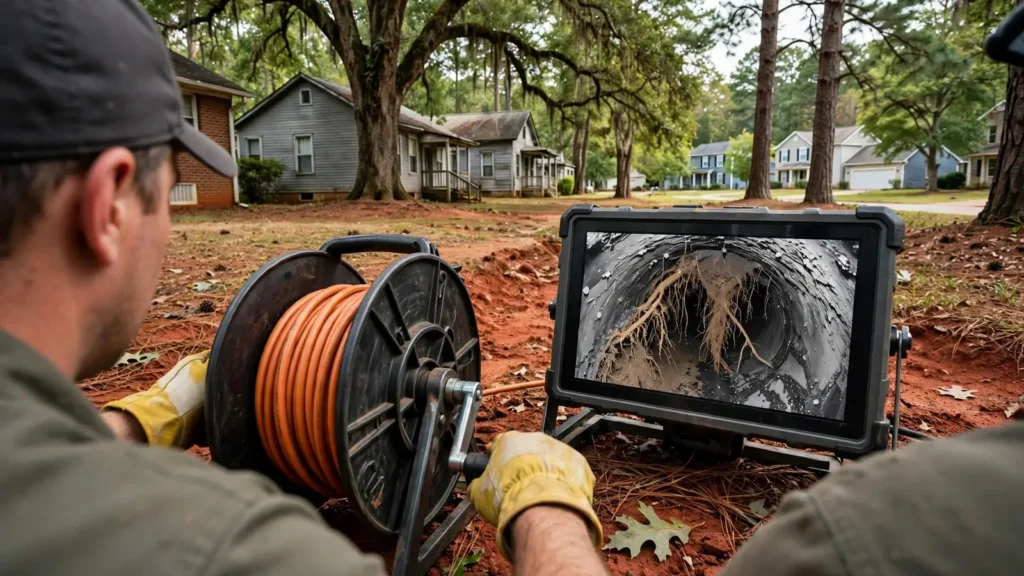
A sewer camera goes in through the cleanout and records the lateral out to the street. For roots, it answers three questions that decide everything else: how many joints have roots, whether the pipe is still round and intact around them, and where along the line they are. That last one matters in MetroConnects areas, because the line is split between you and the utility. Ask for the video and the footage distances from the cleanout. Our sewer line repair guide has a table of what different camera findings usually mean.
Roots back in the line again? Call a local plumber
Root killer vs mechanical cutting vs lining
There are three ways to deal with roots, and they work at very different depths.
| Option | What it does | Good for | Limits |
|---|---|---|---|
| Mechanical cutting (cable with a root-cutting head, or a jetter with a root nozzle) | Cuts roots off at the pipe wall and flushes them out | Getting a blocked line flowing today; light roots in a pipe that's otherwise sound | Roots regrow from the cut ends, often thicker. Expect repeat visits. |
| Foaming root killer (dichlobenil-based products are the common type) | Foams to fill the pipe and kills roots inside it; some labels claim residual control of regrowth | Slowing regrowth after a cleaning; maintenance on a line you're not ready to replace | Treats roots, not the leaking joint. Follow the label exactly. Metam sodium products are restricted-use, for licensed applicators only. |
| Copper sulfate crystals | An older root killer flushed down a toilet | Occasional light root control | Slow, inconsistent results; a label marked "Danger." Not something to keep pouring in. |
| Pipe lining (cured-in-place) | A resin-soaked liner is pulled into the cleaned pipe and cured into a jointless pipe inside the old one | Clay or cast iron with many root joints but still holding its shape | Won't fix a sag or a collapsed section; badly flattened Orangeburg often can't be lined |
| Replacement (open trench or pipe bursting) | New PVC or HDPE pipe with tight joints | Collapsed, flattened or badly broken lines; lines with sags | Highest cost and most disruption; may mean working around tree roots |
Our honest take: if the camera shows light roots at one or two joints in a pipe that's otherwise round and clean, cutting plus a foaming treatment once a year or so is a reasonable holding pattern. If the camera shows roots at joint after joint, or any flattening, you're paying rent on a pipe that's going to fail. Add up a few years of cleanings, compare that to lining or replacing, and decide with real numbers. Our plumber cost guide has published local ranges, and drain cleaning explains cabling versus jetting.
One caution on DIY: don't pour root killer into a line that's already stopped. It needs to reach the roots in the pipe, not sit in a toilet bowl. Clear the line first.
Who pays under the MetroConnects lateral policy
If MetroConnects is your sewer provider (most of unincorporated Greenville County, including Taylors, Wade Hampton, Berea and Five Forks, plus Travelers Rest and Piedmont), its Lateral Maintenance Policy, adopted July 17, 2023, splits your sewer lateral in two:
- The private lateral, from your house out to the edge of MetroConnects' easement or the public right of way, plus the connection fitting there, is yours to maintain and pay for. Any part within 5 feet of the house is always yours.
- The service lateral, from that point to the main, belongs to MetroConnects, which maintains it.
So roots in the part of the line under your yard are usually your bill, even if the tree is the county's or a neighbor's. Roots in MetroConnects' section are MetroConnects' to deal with. In a backup, the policy says to call MetroConnects first at (864) 277-4442, before a plumber, so it can check its side. If a licensed plumber later finds the problem in MetroConnects' section, you can ask for reimbursement within 30 days of the repair, with invoices, proof of payment and photos. Camera footage with distances is the best evidence you can send.
The full breakdown, including what to send and where, is in our guide to who owns the water and sewer line in Greenville. Inside the City of Greenville, Mauldin, Simpsonville, Fountain Inn and Greer CPW's area, the split is set by that provider, so ask it where its responsibility ends before you pay for work near the street.
Planting distances and protecting a new line
If you've just replaced or lined a lateral, or you're planting a new tree, a little planning saves the next owner a lot of money.
- Know where the line runs. It usually goes from the cleanout near the house in a fairly straight line toward the street or the sewer main. 811 doesn't mark private sewer laterals, so ask your plumber to locate it while the camera is in.
- Clemson HGIC's advice for drain lines is to plant trees at least as far from the line as their expected mature root spread, and it calls that distance a bare minimum.
- Over and near the line, choose small, slow-growing trees and shrubs, and skip the species in the table above.
- Root barriers can help near a line, but HGIC says they need to go at least 2 feet deep to work.
- Keep trees off the line for another reason: when the pipe needs digging up, a tree over it may have to come out.
We'd think hard before cutting down a big, healthy tree to save a sewer line. A new PVC lateral with tight joints gives roots nothing to find, and the tree is worth more to the house than the old pipe. Talk to a certified arborist before cutting major roots during any dig, and inside city limits, check local tree rules before removing a large tree.
Need a camera on a root-filled line? Call a local plumber
Tree root and sewer line questions
Will cutting the roots in my sewer line kill the tree?
Not usually. Roots inside a sewer pipe are a small part of a large tree's root system. Cutting roots outside the pipe during a dig is a different matter: severing big roots near the trunk can weaken or kill a tree, so have an arborist weigh in.
How often should a sewer line with roots be cleaned?
It depends on how fast they regrow. Many lines with light roots need attention about once a year. If you're calling every few months, the pipe is the problem, and lining or replacement starts to pay for itself.
Is it safe to flush copper sulfate root killer?
Only as the label directs, and only into a line that's flowing. It's a hazardous product, results are slow, and it doesn't fix the leaking joint that let the roots in.
Does homeowners insurance pay for root damage to a sewer line?
Often not. Many policies exclude wear, tear and root intrusion in pipes, though some cover resulting water damage or offer a service line endorsement. Read your policy or ask your agent before you need it.
Should I take out the tree that's in my sewer line?
Usually it's cheaper to fix the pipe. Roots only get in through gaps, so a lined or replaced lateral with tight joints solves the problem and keeps the tree. Removal makes sense when the tree is unhealthy or sits right on the line's path.
Sources
- Keith O'Herrin, Urban Forester, N.C. Cooperative Extension, Union County Center, "Tree Roots & Sewers," March 7, 2023.
- Clemson Cooperative Extension, Home & Garden Information Center: "Landscaping Over Septic Drain Fields" and "Maple" factsheets.
- University of Georgia Extension, Circular 1030, "Ornamental Plantings on Septic Drainfields."
- University of Tennessee MTAS, "Choosing Sewer Safe Trees."
- U.S. EPA pesticide product labels for sewer root control (dichlobenil foam, EPA Reg. No. 68464-1; copper sulfate root killer; metam sodium restricted-use classification).
- Orangeburg pipe history: PHCP Pros, "Everything you wanted to know about Orangeburg pipe"; City of San Luis Obispo, Sewer Lateral Pipe Material.
- MetroConnects Lateral Maintenance Policy (adopted July 17, 2023), sections on service and private laterals, emergencies and reimbursement.