A sewer smell in the house sends people sniffing around every room with a flashlight. Most of the time the cause is small and cheap. Sometimes it's a cracked cast-iron pipe under the floor or a drain leaking onto the crawlspace vapor barrier, and those don't fix themselves.
In Greenville County homes we see the same patterns again and again: an upstairs bath nobody uses in a Simpsonville or Five Forks two-story, a basement floor drain beside the water heater in an older city house, original cast iron under a 1960s ranch in Taylors or Wade Hampton.
First: is it sewer gas, natural gas or something else?
Sewer gas gets its rotten-egg smell from hydrogen sulfide. Natural gas has no smell of its own, so utilities add an odorant, mercaptan, that also smells like rotten eggs. Your nose can't reliably tell them apart, so where the smell is matters more than what it smells like.
| What you notice | More likely | What to do now |
|---|---|---|
| Rotten eggs near the furnace, gas water heater, range or gas meter | Natural gas | Leave the house. Don't flip switches. Call Piedmont Natural Gas at 800-752-7504 or 911 from outside |
| Rotten eggs or sewage near a sink, tub, shower, toilet or floor drain | Sewer gas from a drain | Run water in that drain and the ones around it, then trace it (below) |
| Sewage smell that's strongest after flushing or near the base of a toilet | Toilet seal (wax ring) | Check whether the toilet rocks; plan a reseat |
| Smell strongest in a hallway or closet with no fixtures | A drain or vent pipe inside the wall or ceiling | Note where; a plumber's smoke test finds it |
| Musty, damp-basement smell | Mold or a wet crawlspace, not sewer gas | Look for water; see our leak detection guide |
| Sweet, rotten-meat smell from one area | Often a dead animal in a wall or crawlspace | A pest or wildlife company, not a plumber |
Is sewer gas dangerous to breathe?
Hydrogen sulfide is a real poison, so it helps to know the numbers.
- People can smell it at very low levels. The CDC's toxic substances agency (ATSDR) puts the odor threshold around 0.5 parts per billion, which is why a little sewer gas seems so strong.
- At low levels it irritates the eyes, nose and throat. Moderate levels can bring on headache, dizziness, nausea and coughing, per ATSDR.
- OSHA's general industry limit is a ceiling of 20 parts per million. NIOSH lists 100 ppm as immediately dangerous to life or health.
- Above about 100 ppm, ATSDR says the sense of smell can shut off within 2 to 15 minutes. That's why sewer workers rely on gas meters, not noses.
- It's slightly heavier than air, so it collects in low, closed spaces.
Those dangerous levels belong to manholes, lift stations and septic tanks. A dried-out trap in a guest bath gives you a nasty smell and maybe a headache, not a life-threatening dose. Sewer gas can also carry flammable methane, though, so a strong, lasting smell isn't something to live with.
How to trace a sewer smell room by room
Do this in one pass, with the windows closed so the smell stays put. Write down where it's strongest.
- Refill every trap. Run water for about 30 seconds in every sink, tub and shower, and flush every toilet, including the ones nobody uses. Pour a gallon or so of water into every floor drain: basement, laundry room, garage, utility closet. Then give it an hour.
- Check the laundry standpipe. The pipe the washer hose drops into has its own trap, and it dries out if the washer sits unused.
- Sniff at the base of every toilet. Kneel and smell where the toilet meets the floor. Try to rock it gently with your knees. Movement or a stain at the base points to the wax ring.
- Open the sink cabinets. Look for a damp trap, a loose slip nut or a small gray valve on a short pipe above the drain (an air admittance valve). Close the door for a minute, then smell inside.
- Check the kitchen. Food packed under a disposal's rubber splash guard smells like sewage. Our garbage disposal guide covers cleaning it.
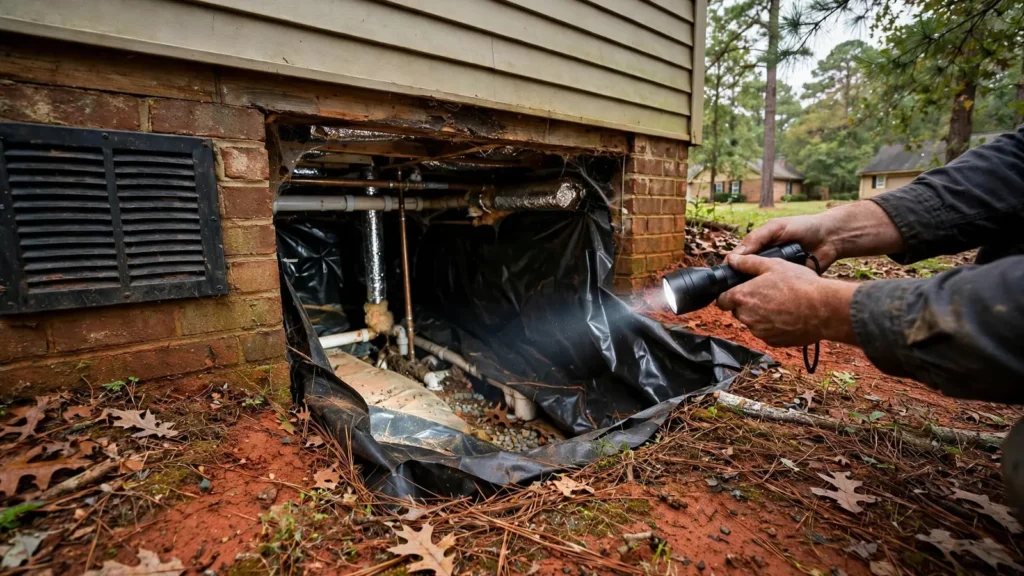
- Go to the crawlspace or basement. With a flashlight, look along the drain lines for wet spots, dark stains on the vapor barrier, white crust on cast iron or a dripping joint. Don't crawl into standing sewage.
- Walk outside. Smell near the yard cleanout and along the sewer line's path to the street. A soggy, extra-green strip of lawn over it is a bad sign.
Gone after step 1? It was a dry trap. Strongest at one toilet? Probably the seal. In a room with no fixtures, or still there after all of the above? Likely a crack in a drain or vent pipe you can't see.
Can't find the source of the smell? Call a local plumber
Dry traps: why the guest bath and floor drain smell first
Every drain in the house has a trap: a bend that holds a small plug of water between the room and the sewer. Plumbing codes require that water seal to be between 2 and 4 inches deep. That's not much water, and it evaporates. A guest bath used twice a year, a basement floor drain that only sees water when the water heater relief valve drips, a shower in a bonus room over the garage: all of them can dry out over a summer.
Run water in rarely used fixtures every couple of weeks. For a floor drain you'll never remember, a plumber can add a trap primer (which tops up the trap automatically) or a trap seal insert that closes when no water is flowing.
A trap that dries out within a day or two isn't evaporation. It's being sucked dry (siphoned) when other fixtures drain, which usually points to a venting problem.
The toilet wax ring
A toilet sits on a wax ring that seals it to the drain flange in the floor. When the toilet rocks, the bolts loosen, or someone resets a toilet without a new ring, the seal breaks. The signs: the smell is strongest at the base of one toilet, the toilet moves when you push it with your knee, the caulk at the base is stained, or there's a stain on the ceiling below an upstairs toilet.
Resetting a toilet on a new wax ring is a modest job for a plumber and a doable one for a careful DIYer. If the floor around it is soft, the seal has been leaking a while and the subfloor needs a look. Don't just caulk heavily around the base; that hides the leak.
Vent problems: when the house can't breathe
Vent pipes run from the drains up through the roof. They let air in so water flows without sucking traps dry, and they carry sewer gas away. A blocked or broken vent either siphons traps (so gas comes in through the drains) or leaks gas inside a wall or attic.
- Blocked roof vents: leaves, pine straw, a bird or wasp nest, or debris from roofing work. Upstate pines drop a lot of straw onto roofs.
- A failed air admittance valve, the one-way valve used under many kitchen islands and in some newer homes instead of a roof vent. Stuck closed, it causes gurgling; stuck open, sewer smell in the cabinet.
- A cracked or disconnected vent in the attic, which shows up as a smell in an upstairs hall or closet, often on hot days.
- Roof vents near a window or attic fan. On still, humid evenings their normal odor can drift in and seem to come from inside.
Gurgling drains and a sewer smell together are a classic vent or main-line sign. Our guide to what gurgling drains mean covers how to tell those apart. Don't climb on the roof to snake a vent yourself.
Cracked pipes and crawlspace leaks
In older Greenville County homes this one is common. Cast-iron drain pipe was standard through the 1960s and into the 1970s. It rusts from the inside, and horizontal runs often split along the bottom. A cracked pipe lets gas out constantly and leaks a little sewage every time water runs.
In a crawlspace house, that sewage lands where nobody sees it, and a wet crawlspace in an Upstate summer smells strong fast. You may notice it most when the HVAC runs, since many air handlers and ducts sit in the crawlspace. Toilet paper on the ground, a pulled-apart joint or rust seams on cast iron are sure signs.
Sewage in a crawlspace needs the pipe fixed and the area cleaned. Our page on plumbing in older Greenville homes covers what original pipe of that age looks like and when a section repair beats replacing the run.
When the smell comes with slow drains or backups
A smell plus slow drains all over the house, water rising in the shower when the toilet flushes, or sewage at the lowest drain means the main line is partly blocked or broken. Check the yard cleanout: if wastewater is standing in it, the problem is between there and the street.
If you're a MetroConnects customer (most of unincorporated Greenville County, plus Travelers Rest and Piedmont) and sewage is backing up, call MetroConnects first at (864) 277-4442. Its lateral policy asks owners to call before a plumber, and the order can affect reimbursement. Our sewer backup guide covers the first hour, and drain cleaning covers clearing the line.
A smell outside along the line, with a wet strip in the yard, usually means the lateral itself is broken, often with roots involved. A camera inspection settles it; our sewer line repair guide explains what the footage shows.
Septic homes are different
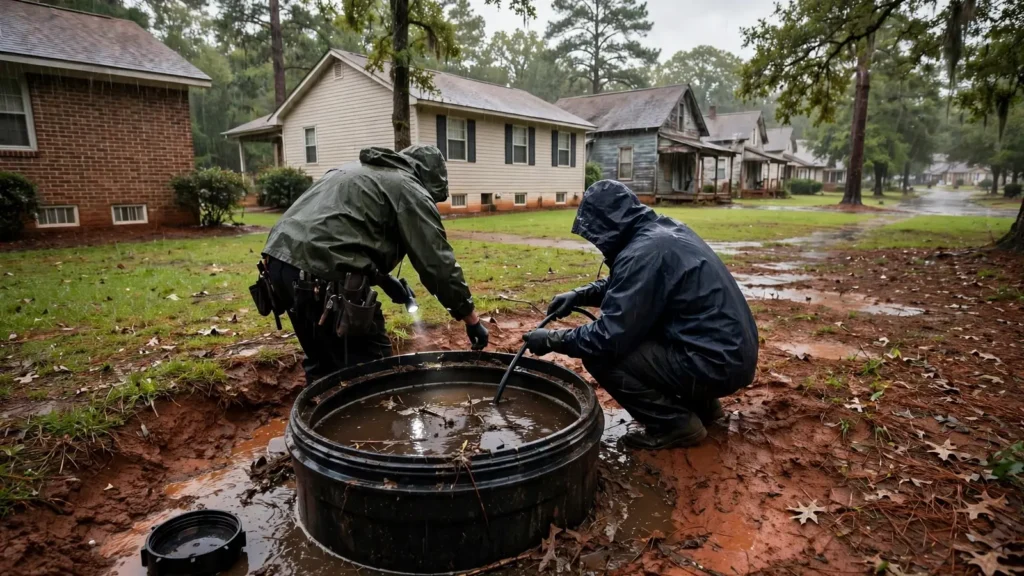
Out toward Travelers Rest, Marietta and the county's rural edges, many homes are on septic. A sewage smell in the yard near the tank or drainfield usually means the tank is full or the drainfield is struggling: a job for a septic company. Indoor smells follow the same rules as above.
How a plumber finds a hidden leak: the smoke test
When the source isn't obvious, a plumber can blow harmless visible smoke into the drain system with the traps full. Wherever it shows up (a baseboard, a ceiling fixture, the base of a toilet, the yard), there's an opening. For the underground lateral, a camera is the better tool. Local prices for both are in our Greenville plumber cost guide.
A good rule: if you've refilled every trap, checked the toilets and looked under the house, and the smell is still there a day later, stop guessing and have it tested.
Sewer smell that won't go away? Call a local plumber
Sewer smell questions
Can a dried-out drain trap make me sick?
The levels from a dry trap are low. Some people get headaches, nausea or a scratchy throat. Refill the trap, air the room, and if anyone feels faint or confused, get everyone outside and call 911.
Why does the sewer smell come and go?
It usually tracks something changing: a trap drying out between uses, a vent problem that shows only when several fixtures drain, wind over the roof vents, or a cracked pipe that leaks only when water runs. Note when it happens; it helps the plumber.
Should I pour bleach down a drain that smells like sewage?
It won't fix a dry trap, a bad seal or a cracked pipe, and mixing bleach with other drain products can release toxic fumes. Plain water refills a trap. A dirty disposal or sink drain is better cleaned by hand.
Does a sewer smell mean I need a new sewer line?
Rarely on its own. Most indoor smells are traps, toilet seals or vents. A smell outside along the line, combined with backups or a wet strip in the yard, is when a camera inspection of the lateral makes sense.
What is a plumbing smoke test?
A plumber fills the drain and vent pipes with harmless visible smoke and watches where it comes out. It finds cracked pipes, broken vents and bad seals behind walls without opening them up first.
Sources
- Agency for Toxic Substances and Disease Registry (CDC), Medical Management Guidelines for Hydrogen Sulfide (odor threshold, olfactory fatigue, health effects, gas density).
- OSHA, Hydrogen Sulfide: Hazards (general industry ceiling limit and effects by concentration).
- NIOSH, Immediately Dangerous to Life or Health (IDLH) value for hydrogen sulfide, 100 ppm.
- Piedmont Natural Gas, Safety information: what to do if you smell natural gas (800-752-7504).
- International Plumbing Code, section 1002.4 trap seals (2 to 4 inch liquid seal); South Carolina Building Codes Council, 2021 code adoptions effective January 1, 2023.
- MetroConnects Lateral Maintenance Policy (adopted July 17, 2023), sewer emergency contact (864) 277-4442.