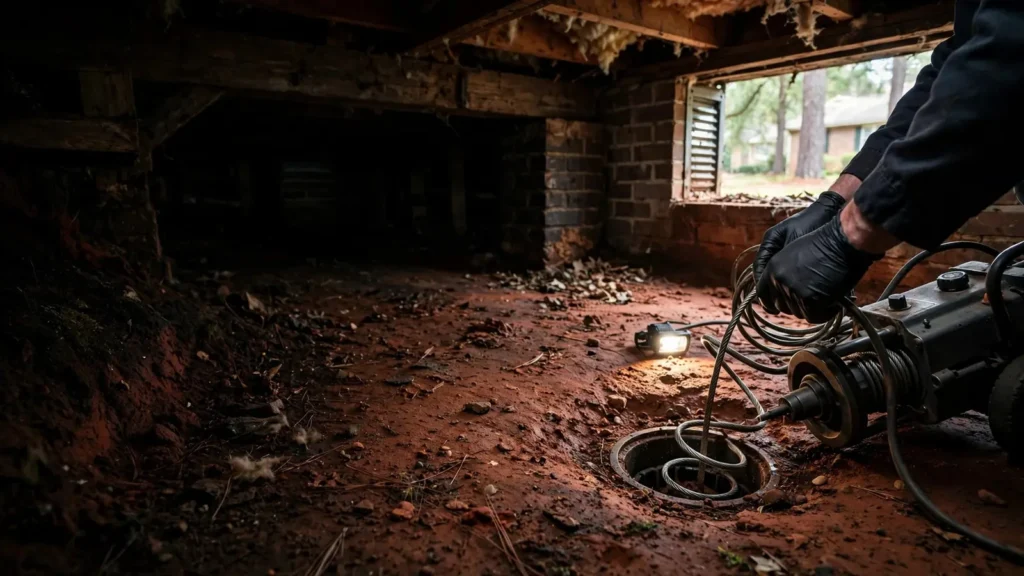
A garbage disposal is a small grinder, not a trash can. It turns soft food scraps into a slurry that has to travel through your kitchen drain, your main line, a sewer lateral in the yard and miles of public pipe to a ReWa treatment plant. Most problems people have with disposals come from forgetting that second half of the trip.
This is the actual list of what not to put in a garbage disposal, with the reasons, plus how to clear a jam with the hex key, what changes if your house is on septic, how to stop the smell, and how to decide whether to repair or replace a disposal that's acting up.
What not to put in a garbage disposal
| Keep out | Why | Instead |
|---|---|---|
| Grease, fat, cooking oil, butter, bacon drippings | It goes down liquid, cools and hardens in the pipe and the sewer. The disposal doesn't change that. | Cool it in a can or jar, then trash it. Large amounts of oil can be recycled (see below). |
| Large bones | Many standard units aren't rated for them; they jam the flywheel. Some higher-end models list chicken and cooked beef bones as fine. | Check your model's manual. When in doubt, trash. |
| Celery, corn husks, artichokes, onion skins, asparagus ends | Fibers wrap around the grinding parts and form mats in the drain. | Trash or compost |
| Lots of potato peels | They grind into a starchy paste that sticks in the trap. | A few are fine; a whole bag of peels is not |
| Pasta, rice, oatmeal, bread | They keep swelling with water after they're ground. | Trash |
| Fruit pits, clam and oyster shells | Too hard; they jam or dull the unit. | Trash |
| Coffee grounds and eggshells in quantity | InSinkErator says neither harms the disposal if you use a strong flow of cold water, because they're sediment-like. In older drain lines, that sediment settles. | Our take: trash or compost them, especially in older homes |
| Non-food: glass, plastic wrap, rubber bands, fruit stickers, twist ties, cigarette butts, matches | None of it grinds. Stickers and plastic go straight to the sewer. | Trash |
| Chemical drain cleaner | InSinkErator lists drain cleaner among things a disposer should never receive. It can damage the unit and splash back at you. | Plunger, trap cleaning or a plumber |
What a disposal handles fine
Soft scraps rinsed off plates: bits of cooked vegetables, fruit, small amounts of meat scraps, bread crusts in small amounts, leftover cereal in small amounts. The disposal is there to catch what slips off during rinsing, not to replace scraping the plate into the trash.
How to run it the way the manufacturer intends:
- Turn on a moderate to strong flow of cold water first.
- Feed scraps in gradually instead of stuffing the chamber.
- Let it run until the grinding sound changes and it's just spinning.
- Keep the water running a few seconds after you switch it off, to carry the slurry past the trap.
Go easy on an older house. Galvanized and cast-iron kitchen lines in homes built before the 1970s narrow with age, and our guide to plumbing in older Greenville homes explains why they catch debris that a newer PVC line would pass.
Use cold water, not hot. InSinkErator advises against hot water when grinding. Cold water keeps any stray fat solid so it gets ground and carried off instead of coating the pipe as a liquid and hardening further down.
Why grease is the big one in Greenville County
The two agencies that run the sewer here say the same thing. ReWa, which treats wastewater for most of Greenville County, says fats, oils and grease (FOG, in utility speak) stick to the inside of sewer lines and harden. Its "Protecting Pipes" page is blunt that garbage disposals don't keep FOG out of the sewer, and that running hot water or adding detergent probably just moves the problem further down the pipe.
MetroConnects, which runs the sewer collection lines in most of unincorporated Greenville County, says grease buildup is behind many of its blockages and that it can cause backups and overflows. Restaurants are covered by a grease control program under ReWa's pretreatment rules; homes aren't regulated the same way, but the pipes don't know the difference.
For a homeowner, the risk is closer than the sewer main. Grease that hardens in your kitchen line or the private lateral in your yard is your problem and your bill, and when it closes a main line off completely, the result is a sewer backup at the lowest drain in the house. ReWa's own home method is simple:
- Wipe pans with a dry paper towel before washing, and throw the towel away.
- Pour leftover grease into an empty can or jar (a soup can, a pickle or mayo jar).
- Let it harden. The freezer speeds it up.
- Toss it in the trash. A grocery bag liner lets you reuse the can.
The holidays are when this matters most. Our post on Thanksgiving grease clogs covers turkey fryer oil, Greenville County's cooking oil recycling, and what to do if the sink backs up mid-dinner.
Disposal jammed or sink backing up? Call a local plumber
Disposal jammed? The hex-key reset
If the disposal hums but doesn't spin, something is wedged between the grinding plate and the ring. If it does nothing at all, the motor's overload protection probably tripped. Both are often fixable in ten minutes. Most units, including InSinkErator models, have a socket for a 1/4-inch hex wrench in the center of the bottom and a red reset button nearby.
- Turn the disposal off at the wall switch. If it's plugged in under the sink, unplug it. Otherwise switch off its breaker.
- Look into the chamber with a flashlight. Pull out anything visible with tongs or pliers. Never put your hand in.
- Fit the hex wrench (the one that came with the unit, or any 1/4-inch Allen wrench) into the socket on the bottom and work it back and forth until it turns a full circle freely.
- Press the red reset button on the bottom. Press it with a finger; don't strike it with a tool.
- Restore power, run cold water and switch it on.
When to stop and call: the reset button trips again right away, the breaker keeps tripping, it still only hums after you've freed it, or it's leaking from the bottom. InSinkErator's own guidance treats repeated resets as a sign of a deeper problem. If it's dead with no hum and the reset doesn't help, check the breaker and any GFCI outlet before assuming the motor is gone.
Garbage disposals on septic
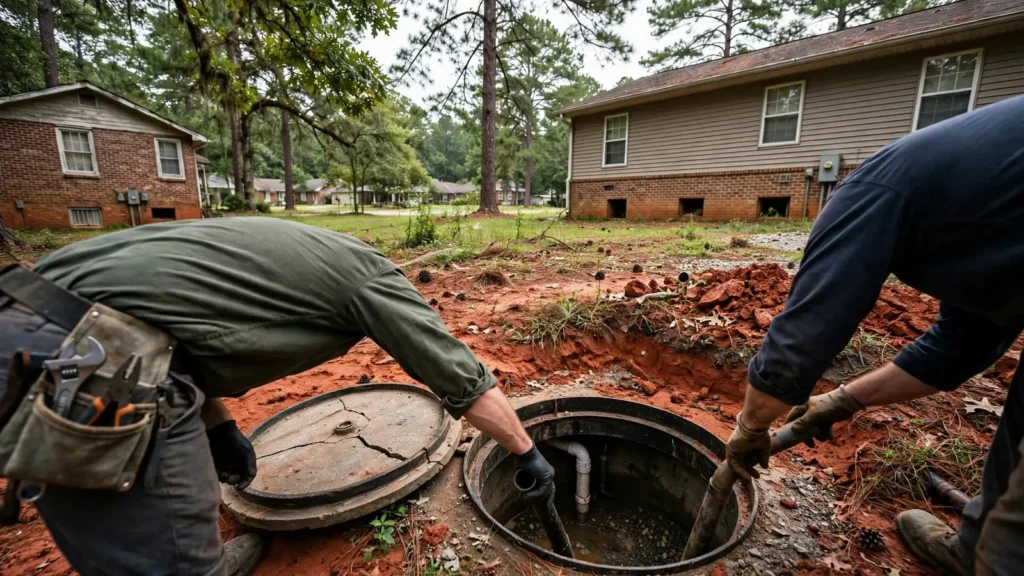
A lot of homes in northern Greenville County, around Travelers Rest, Marietta, Gowensville and the rural edges of the county, are on septic tanks rather than sewer. If yours is, the advice changes.
The EPA's homeowner guidance is direct: eliminate or limit use of a garbage disposal, because it significantly increases the fats, grease and solids entering the tank, and those can clog the drainfield. The EPA also says that if you keep using one, the tank will need pumping more often. Food solids don't break down in a septic tank the way human waste does. They add to the sludge and scum layers, and a drainfield clogged with solids is one of the most expensive repairs a rural homeowner can face.
Manufacturers sell "septic" disposals. InSinkErator's Evolution Septic Assist, for example, injects an enzyme treatment (it calls it Bio-Charge) with each use. That's a manufacturer's feature, and it doesn't change the EPA's advice. Our honest view: on septic, scrape plates into the trash or a compost bin and use the disposal, if at all, only for rinse-off residue. If you're unsure your system was sized for a disposal, ask the septic company at your next pumping. For more on rural systems, see our Travelers Rest plumbing guide.
Why the disposal smells, and how to fix it
A disposal that smells like sewage usually isn't the sewer at all. It's food rotting in places the water doesn't reach.
- The underside of the rubber splash guard. Lift the flaps with a gloved finger or an old toothbrush and scrub; most of the smell lives there.
- Film on the grinding chamber. Grinding a handful of ice cubes with the cold water running knocks loose a lot of residue.
- The dishwasher drain hose, which usually connects to the disposal. If the hose sags with no high loop, dirty water sits in it.
- The sink trap below the disposal, which can hold old grease.
If the smell is strong, hangs around the whole kitchen, and doesn't change after cleaning, it may be a dry trap or vent problem elsewhere. Our guide to tracing a sewer smell in the house goes room by room.
Repair or replace?
| Symptom | Usually means | Usually |
|---|---|---|
| Hums, doesn't spin | Jam | Clear it with the hex key |
| Dead, no hum | Tripped reset, breaker or GFCI; or a failed switch or motor | Reset first; then a plumber or electrician |
| Leak at the top where it meets the sink | Sink flange seal | Reseal the flange; a repair |
| Leak at the side where the dishwasher hose or drain pipe connects | Loose connection or worn gasket | Tighten or replace the gasket; a repair |
| Leak from the bottom of the unit | Internal seal failure, per InSinkErator's troubleshooting guide | Replace the disposal |
| Jams constantly, grinds slowly, rusty housing | Worn unit | Replace |
| Metal-on-metal grinding sound | A spoon, coin or bottle cap inside | Power off, retrieve with tongs |
Replacing a disposal is a common, fairly quick plumbing job, and the price mostly depends on the unit you choose and whether the wiring needs work. For local plumbing rates, see our Greenville plumber cost guide. If you're getting quotes, our guide to choosing a plumber covers what to ask. And if the kitchen sink is draining slowly even when the disposal works, the clog is further down the line; see drain cleaning.
Time for a new disposal? Call a local plumber
Garbage disposal questions
Can I run hot water while the disposal is on?
Use cold. Manufacturers recommend cold water while grinding, so any fat stays solid and gets carried away instead of melting and coating the pipe further down.
Do I need disposal cleaning tablets?
They can freshen the chamber, but scrubbing the underside of the rubber splash guard does more for smell. Skip anything with harsh drain chemicals.
Can a clogged disposal back up into the dishwasher?
Yes. On most kitchens the dishwasher drains through the disposal. If the disposal or the trap below it is clogged, dirty water can sit in the dishwasher. Clear the disposal and trap first.
Is a septic-rated disposal safe to use on a septic tank?
It's a manufacturer's claim, not an EPA one. The EPA still advises limiting or eliminating disposal use on septic and says the tank will need pumping more often if you use one.
Why does my disposal keep tripping the reset button?
Something keeps jamming it, you're feeding it too much at once, or the motor is wearing out. If it trips with an empty chamber and plenty of water, it's time to have it checked or replaced.
Sources
- ReWa (Renewable Water Resources), "Protecting Pipes": FOG guidance, home grease disposal steps, garbage disposals and FOG.
- MetroConnects, "How to Protect Your Sewer System" (FOG and sewer blockages, wipes).
- InSinkErator, "What Can I Grind in a Garbage Disposer?", consumer FAQ, operating instructions and foodservice "never" list; troubleshooting guidance on reset button and leaks from the bottom of the unit.
- Roto-Rooter, "How to Un-Jam a Garbage Disposal" (hex wrench and reset steps).
- U.S. EPA, "How to Care for Your Septic System" and Frequent Questions on Septic Systems (garbage disposals and pumping frequency).
- InSinkErator Evolution Septic Assist specification sheet (Bio-Charge enzyme feature).