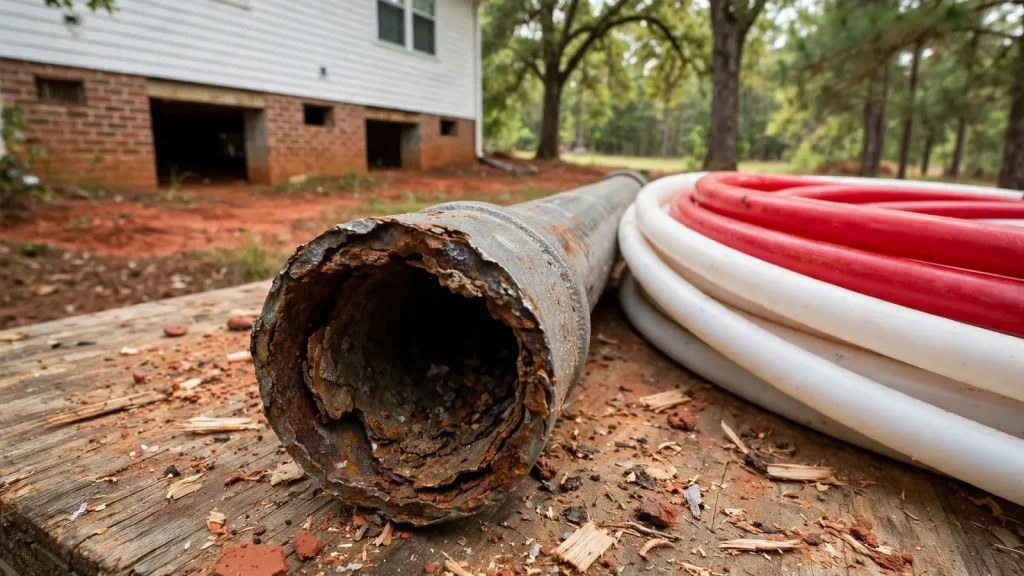
If your house in Greenville County was built in the 1980s or early 1990s, there's a fair chance someone has already said the words "polybutylene pipe" to you, maybe a home inspector, maybe an insurance agent, maybe a neighbor who had a closet flood. It was cheap, quick to install and flexible enough to snake through a crawlspace, which is why builders loved it during a busy stretch of Upstate growth. It also turned out to have a habit of cracking from the inside.
What polybutylene pipe is, and when it went in
Polybutylene (PB) is a plastic resin that was made into water supply tubing and sold for both hot and cold lines. It showed up in US homes in the late 1970s. The national class action settlement over it covered systems installed between January 1, 1978 and July 31, 1995, which is a good working window for when it was used. Public Justice, one of the groups that brought the case, estimated it went into about six million properties.
It was used two ways. Inside the house, it ran from the water heater and main line to each fixture. Outside, some homes got a PB service line from the water meter to the house. Those are two separate problems with two separate fixes, and plenty of houses have one but not the other.
How to identify polybutylene pipe
You can usually tell in ten minutes with a flashlight. Look in the places where pipe is exposed:
- Where the main line comes into the house, often in the crawlspace or a garage wall.
- At the top of the water heater, where the hot and cold lines connect.
- Under sinks, behind the shutoff valves.
- In the meter box at the street, on the house side of the meter.
Indoor PB is usually gray, sometimes silver or black. The service line outside is more often blue, gray or black. Read the printing on the side of the pipe: "PB2110" is the most common code. The pipe may also reference ASTM D3309, the standard for PB hot and cold water tubing. Printing fades, so a missing stamp doesn't clear it.
The fittings tell you as much as the pipe. PB was joined with insert fittings held on by a crimped band of aluminum or copper. Early systems used gray or white plastic (acetal) insert fittings, and those are the ones with the worst reputation. From about 1990 on, metal fittings often replaced the plastic ones, but the tubing itself stayed the same.
| What you see | Likely material | How to tell |
|---|---|---|
| Flexible gray pipe, crimp rings, stamped PB2110 | Polybutylene | The stamp settles it. Plastic insert fittings make it more urgent. |
| Flexible gray, red, blue or white pipe stamped "PEX" | PEX (cross-linked polyethylene) | Gray PEX exists. Read the print before you panic. |
| Rigid cream or tan plastic with glued joints | CPVC | Doesn't bend; joints are solvent-welded, not crimped. |
| Black flexible pipe in the yard, clamped barb fittings | Polyethylene service line | Common for water services; usually stamped PE. |
| Blue pipe at the meter, stamped PB | Polybutylene service line | Yours to replace if it's on the house side of the meter. |
Why polybutylene pipe fails
The explanation that holds up across the litigation record and the plastics research is oxidation. Treated drinking water carries a disinfectant residual so it stays safe all the way to your tap. Over years, those oxidants react with the polybutylene and with the acetal plastic in the early fittings. The material gets brittle, tiny cracks form on the inner wall, and eventually one grows through. Lab work on PEX, a related plastic, shows the same basic pattern: oxidative micro-cracking that ends in a brittle split.
That's why PB failures are so frustrating. The outside of the pipe can look clean and new while the inside is already flaking. A visual inspection tells you what you have, not how much life is left in it.
Installation made things worse in a lot of houses. Crimp rings that were squeezed too hard stressed the fittings. Pipe run close to the water heater, or through a hot attic, aged faster. And the plastic fittings could crack at the barb even when the tubing was fine.
Here's the local piece. Greenville Water disinfects with chloramine (chlorine combined with ammonia), and its 2025 water quality report lists a distribution system average of 2.3 ppm, under the 4 ppm limit. That's normal, safe water, and we found no research showing Upstate water is harder on PB than anyone else's. But every PB system on a treated supply here has had disinfectant moving through it for 30 or 40 years. Time is the problem.
The class action: Cox v. Shell, and where it stands now
The main case was Cox v. Shell Oil Co., a nationwide class action filed on June 13, 1995 in the Chancery Court of Obion County, Tennessee. Shell and Hoechst Celanese, the companies behind the resin and fitting material, agreed to a settlement that started with $950 million for replacing eligible PB plumbing and paying related damages. The cap was later raised to finish the program. Public Justice describes the total as at least $1.103 billion in relief. Claims went through the Consumer Plumbing Recovery Center.
The filing deadline was May 1, 2009, per Public Justice's notice. We found one secondary source citing a later date in 2009, but either way, the program has been closed for more than 15 years.
What that means for you in 2026:
- There is no settlement fund to apply to. If you see an ad or get a call offering to "file your polybutylene claim," be skeptical.
- Replacing PB is now an ordinary home repair, paid for by the owner.
- If a previous owner got a settlement replacement, the house may already be repiped. Ask the seller for paperwork if you're buying.
Found gray PB pipe in your crawlspace? Call a local plumber
Polybutylene, insurance and selling a house
Insurance is where most people feel PB first. Some carriers ask about pipe material on the application or during a home inspection for a new policy. Depending on the company, PB can mean a higher premium, an exclusion for water damage from the pipe, or a declined policy. Rules differ by carrier and change over time, so ask your agent directly: "Do you write policies on homes with polybutylene supply pipe, and on what terms?"
On a sale, South Carolina's Residential Property Condition Disclosure Statement (required under S.C. Code Section 27-50-40 for most resale homes) asks about the plumbing system. The owner answers yes, no or "no representation," but the law still holds an owner liable for knowingly giving false or misleading information. If you know the house has PB, or you've had PB leaks, the safe move is to say so and attach any repair records. Talk to your agent or a real estate attorney if you're unsure how to word it.
From the buyer's side, PB is a fair point to negotiate on. Get a written quote for a whole-house replacement before you go back to the seller, and read our plumbing inspection checklist for buyers for the other things to check while you're in the crawlspace.
Replace all of it, or just part?
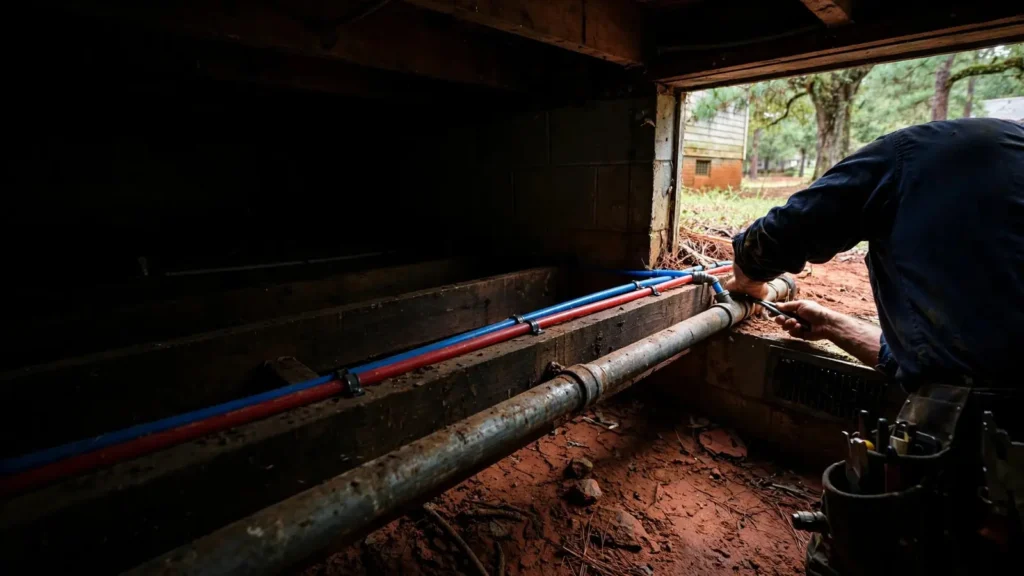
Honestly, if you plan to stay in the house more than a couple of years, full replacement is usually the right call. Patching one PB fitting doesn't change the age or condition of the rest of the system, and the next failure is just as likely to happen behind a wall or above a ceiling. That said, partial work has its place.
| Situation | Reasonable move |
|---|---|
| One leak at an accessible fitting, budget is tight | Repair it with fittings made for PB transitions, then plan a full replacement |
| PB service line from the meter, copper or PEX inside | Replace the service line only; see our water line repair guide |
| PB inside, crawlspace foundation, staying put | Whole-house repipe with PEX, usually the least disruptive kind |
| PB inside, slab foundation or finished basement | Whole-house repipe, routed through the attic or walls; expect more drywall work |
| Selling soon | Get a written replacement quote; decide whether to repipe or credit the buyer |
| Insurer requires removal | Full replacement, with a final invoice that states all PB was removed |
One more detail people miss: the service line and the indoor pipe are separate jobs. Under Greenville Water's rules, the line from the outlet of the meter to your house is yours (our who-owns guide has the details). A blue PB line out there is your cost, and it's usually replaced with polyethylene or PEX in a narrow trench or pulled through with trenchless equipment.
Our repiping guide walks through the job itself, and the Greenville plumber cost guide covers price ranges. House size, foundation and fixture count swing the number a lot.
Which Greenville County homes are likely to have it
We can't give you a list of subdivisions with PB, and you should be wary of anyone who claims to have one. Builders mixed materials, and plenty of houses have been repiped since. What we can say is which eras and areas deserve a look.
- Houses built from the late 1970s through about 1995. Census figures put the median home in Taylors at 1983 and in Piedmont at 1985, which puts a lot of housing stock right in the PB window.
- The 1980s and early 1990s subdivisions that filled in around Taylors, Mauldin, Simpsonville, Five Forks and Greer as the county grew. See our Taylors and Mauldin pages for local water and sewer details.
- Manufactured homes from the same period, which used PB heavily. Our guide to mobile home plumbing in the Upstate covers those separately.
- Older homes with additions from those years, like a 1960s ranch with a bathroom added in 1987.
Houses built after about 1996 are unlikely to have new PB, though a builder using up old stock wasn't impossible. Older houses are more likely to have galvanized or copper; our older homes guide covers those.
If you find polybutylene: a simple plan
- Confirm it. Photograph the pipe stamp and the fittings at the water heater and under a sink.
- Find and test the main shutoff. If it's an old valve that won't turn, have it replaced first.
- Look for active trouble. Damp spots in the crawlspace, stains on ceilings below bathrooms, or a meter that moves with everything off. Our leak detection guide shows the meter test.
- Check your water pressure. Any old plumbing lasts longer at moderate pressure. The plumbing code requires a pressure-reducing valve when static pressure is over 80 psi, and a gauge on a hose bib costs very little.
- Call your insurance agent before they ask you, so you know where you stand.
- Get one or two written repipe quotes, with the permit included and the scope spelled out (service line, indoor lines, or both).
Ready to get rid of polybutylene? Call a local plumber
Polybutylene pipe questions
Is the blue pipe at my water meter polybutylene?
It might be. Blue PB was used for service lines, but blue polyethylene and PEX are also common. Read the printing on the pipe: "PB" means polybutylene, "PE" or "PEX" means it isn't.
Can I still file a claim under the polybutylene settlement?
No. The Cox v. Shell settlement's claim deadline was in 2009 and the program is closed. Treat any offer to file a PB claim for you with suspicion.
Do I have to tell a buyer about polybutylene in South Carolina?
Most SC resales use the Residential Property Condition Disclosure Statement, which asks about the plumbing. You aren't required to inspect, but you can be liable for knowingly giving false or misleading answers. If you know about PB or past PB leaks, disclose it.
Is gray PEX the same thing as polybutylene?
No. Some PEX is gray, which causes a lot of false alarms. PEX is stamped "PEX" along its length. Polybutylene is usually stamped "PB2110."
Can I fix one polybutylene leak with a push-fit fitting?
Some push-fit brands sell fittings or inserts rated for PB, and they can stop a leak. Use only parts the manufacturer lists for polybutylene, and treat it as a stopgap: the rest of the system is the same age.
Sources
- Public Justice (formerly Trial Lawyers for Public Justice): polybutylene settlement notice, including $1.103 billion minimum relief, May 1, 2009 claim deadline, pipe and fitting identification, Consumer Plumbing Recovery Center.
- Tennessee Court of Appeals opinion describing Cox v. Shell Oil Co., filed June 13, 1995, Chancery Court, Obion County, Tennessee.
- U.S. Court of Appeals for the Fifth Circuit, opinion No. 02-41377, describing the Cox settlement and the $950 million initial contribution by Shell and Hoechst Celanese.
- Contractor magazine: reporting on the polybutylene settlement fund and the 1978 to 1995 coverage window.
- Plastics Pipe Institute: Jana Laboratories report on chlorine testing of PEX materials (oxidative failure mechanism).
- Greenville Water: 2025 Water Quality Report (chloramine disinfection, 2.3 ppm average), and customer service line responsibility.
- South Carolina Code of Laws, Title 27, Chapter 50, Article 1 (Sections 27-50-30, 27-50-40, 27-50-65): Residential Property Condition Disclosure.
- U.S. Census Bureau, American Community Survey 5-year estimates, median year structure built (Taylors and Piedmont CDPs), as reported on our older homes guide.
- International Residential Code, Section P2903.3.1 (maximum static pressure of 80 psi).