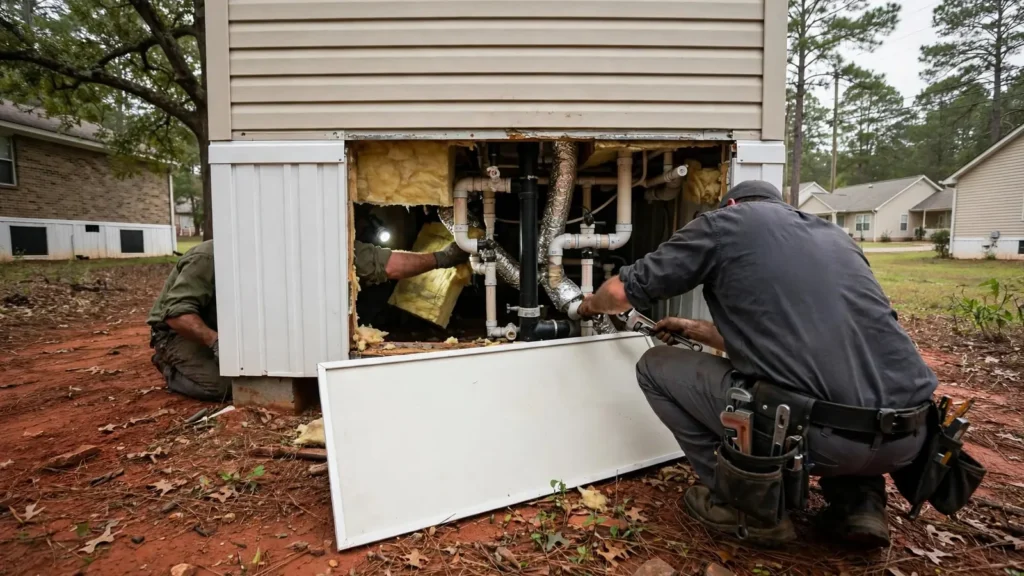
Mobile home plumbing works on the same principles as a site-built house, but the layout is different enough that it catches owners off guard. Everything lives under the floor. Access is through skirting panels and a fabric bottom board. The water heater may be behind an outside door. And on a lot of rural lots in the county, the water comes from your own well and goes to your own septic tank.
Manufactured homes are spread across Greenville County, from communities near Piedmont and Berea to single homes on rural lots in the south end and up toward the mountains past Travelers Rest. The advice below applies on a private lot or in a community, with a few differences we point out along the way.
How mobile home plumbing differs from a site-built house
- Supply and drain lines run in the space between the floor and the bottom board, wrapped in insulation. Leaks don't drip onto the ground. They soak the insulation, and the belly sags.
- The main water line comes up out of the ground in one spot, called the riser, and is exposed to air between the soil and the floor. That short stretch freezes first.
- Drain lines usually join under the home and drop to one sewer or septic connection.
- Fixtures and valves can be sized and placed differently from site-built parts, so a plumber may need parts made for manufactured homes.
- Homes built since June 1976 follow HUD's federal construction code (24 CFR Part 3280) instead of local building codes, and it has its own rules for water heaters.
When you call a plumber, say up front that it's a manufactured home and roughly what year. It changes the parts they bring.
Freeze risk under the skirting
Greenville County doesn't get long deep freezes very often, but it gets enough hard cold nights to burst pipes, and manufactured homes take the hit first. The reason is simple: the riser and any uninsulated pipe near the skirting sit in open air with only vinyl panels between them and the wind. A missing or loose panel, a dog that pushed one out, or a gap where the skirting meets the ground can let cold air straight onto the riser.
What to check every fall:
- Walk the skirting. Replace missing or cracked panels and close gaps at the bottom.
- Look at the riser. It should be wrapped in heat tape and insulated from the ground up to the floor.
- Check the bottom board. Tears, sagging or wet spots mean the insulation underneath may be wet or gone.
- Insulate exposed lines, including the line to any outside spigot.
- Know where your shutoff is, and keep a flashlight near the access panel.
Skirting usually has vents to let moisture out. Don't seal them permanently; in a hard freeze, some owners cover them temporarily and uncover them afterward. Our frozen pipes guide covers the temperatures to watch and what to do if a line has already frozen, and our winter freeze prep checklist lays out the steps to take before a cold snap.
Heat tape: what works and what starts fires
Heat tape (or heat cable) is the standard fix for a mobile home riser, and it works. It also causes fires when it's old, damaged or installed wrong. The U.S. Consumer Product Safety Commission has issued warnings about it for decades, with mobile homes specifically in mind. Its long-standing advice:
- Use heat tape that's listed by a testing lab such as UL, and replace old, uncertified tape.
- Put the tape directly on the pipe, following the maker's instructions.
- Don't overlap the tape on itself unless the instructions allow it.
- Be careful what insulation goes over it. CPSC has warned against putting tape over existing insulation and against flammable insulation on top. Use only what the tape's manufacturer allows.
- Inspect it every fall for cracks, charring or brittle spots.
Self-regulating cable, which turns its heat output up and down with the temperature, is the better type for most homes. It costs more than cheap constant-wattage tape. We'd pay the difference.
A quick check: on a cold morning, the tape should feel warm to the touch. If the riser is cold and the tape is plugged in, the tape has failed, the outlet has tripped, or the thermostat on a plug-in unit isn't switching on. If the outlet keeps tripping, call an electrician, not a plumber.
Mobile home pipes frozen or leaking? Call a local plumber
Polybutylene and gray pipe in older units
Manufactured homes built from the late 1970s into the mid-1990s often have gray polybutylene supply pipe, the same material used in site-built homes in that period, usually joined with crimp rings. It tends to fail at the fittings, often without warning. Look under the sinks and at the water heater for gray pipe stamped "PB2110." Our polybutylene pipe guide explains how to tell it from gray PEX, why it fails and what replacing it involves.
Not every gray pipe is polybutylene. Later homes often have PEX in various colors, and some have rigid CPVC. Read the printing on the pipe.
Replacing supply pipe in a manufactured home is usually easier than in a site-built house, since the lines run under the floor rather than through finished walls. The work involves opening the bottom board, running new PEX, and patching the belly properly with bottom board repair material so rodents and moisture stay out. Our repiping guide covers the process.
Mobile home water heaters: why they're different
This is where people buy the wrong part. HUD's manufactured home code requires every fuel-burning appliance to have complete separation of its combustion system from the air inside the home. That can be done two ways:
- A direct-vent (sealed combustion) water heater, which pulls air from outside and vents outside.
- An enclosure with no door, removable panel or other opening from the inside of the home, usually reached from an outside access door instead.
The code also requires a corrosion-resistant drain pan under every tank water heater, piped to the outside or to a drain, and it requires each appliance to be accessible and removable.
In practice, that's why water heaters sold for manufactured homes exist. They're built and labeled for that use, with the venting and connections laid out for these installations. A standard gas water heater from a home store usually isn't allowed in a manufactured home. Electric units have fewer combustion issues, but you still want one labeled for manufactured home use that fits the space and the existing connections. Ask the supplier or plumber to confirm before you buy.
A few practical notes:
- Check the outside access door. If it's rusted shut or blocked, fix that first, so a plumber can get to the heater.
- Look for the drain pan and its drain line. They're often missing or cracked in older homes.
- Our water heater replacement guide covers sizing and what to expect from the job.
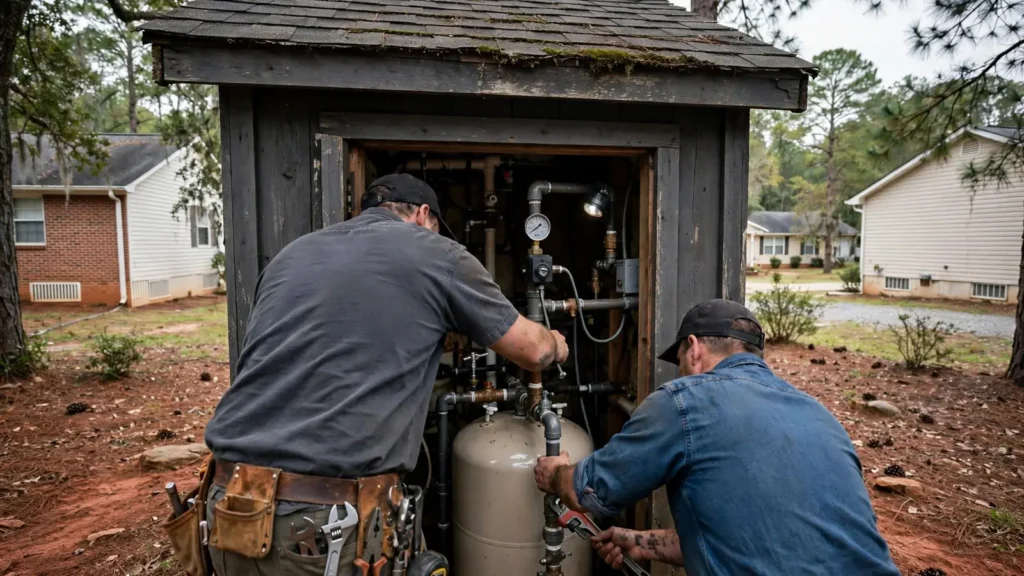
Wells and septic in the Piedmont and rural county
Outside the areas served by Greenville Water and the sewer systems, a lot of manufactured homes sit on private wells and septic tanks. That's especially common in the northern part of the county and in rural pockets around Piedmont and the south end. If that's your setup:
- Test the well. SC DES offers coliform bacteria and metals testing through its regional offices. The bacteria test was listed at $20 when we checked; confirm the current fee. DES runs a private well hotline at 1-888-761-5989.
- Keep the well house or pump insulated. A frozen pressure switch or tank line stops water to the whole house.
- Know where the septic tank and drainfield are. Don't park on them, and keep new skirting or decks off the lid. Our septic pumping guide covers schedules and warning signs on Upstate red clay.
- If you're on public sewer in Piedmont, our Piedmont page lists who handles what.
Who to call for what
| Problem | Who to call |
|---|---|
| Leak, frozen pipe, water heater, drain clog | A licensed plumber who works on manufactured homes |
| Heat tape outlet keeps tripping, wiring issues | A licensed electrician |
| Home not level, piers, tie-downs, structural problems | A manufactured home installer or repairer licensed by the SC Manufactured Housing Board (part of LLR) |
| No water, well pump or pressure switch | A plumber or well contractor; ask if they do well pumps |
| Septic backup or full tank | A septic pumping company first, then a plumber if the line from the home is clogged |
| Water or sewer line in a manufactured home community | Community management first; check your lease for who owns the lines to your lot |
| Leak at the water meter | Your water utility |
Our guide to checking a plumber's license in SC walks through the LLR lookup.
Need a plumber who works on manufactured homes? Call a local plumber
Mobile home plumbing questions
Can I put a regular water heater in a mobile home?
Usually not for gas. HUD's code requires the combustion system to be completely separated from the inside air, which standard gas heaters aren't built for. Buy a unit labeled for manufactured homes, gas or electric.
Is it safe to leave heat tape plugged in all winter?
Listed tape with a built-in thermostat, or self-regulating cable, is designed for that. Old, cracked or uncertified tape isn't. Check it every fall, and replace it if you see damage.
Where is the main water shutoff on a mobile home?
Usually under the home near where the water riser comes up from the ground, behind a skirting panel. Some homes also have a shutoff at the well or meter. Find yours before you need it.
Who fixes the water line in a mobile home park?
It depends on the community. The park often owns the lines up to your lot, and you may own the connection and everything under the home. Check your lease and call management first.
How do I know if my mobile home has polybutylene?
Look for gray flexible pipe stamped "PB2110" with crimp rings, under sinks or at the water heater. Homes built from the late 1970s to the mid-1990s are the most likely to have it.
Sources
- U.S. Department of Housing and Urban Development, Manufactured Home Construction and Safety Standards, 24 CFR Part 3280: Sections 3280.707 (listing, water heater efficiency) and 3280.709(a), (d) and (h) (accessibility, combustion separation, drain pans).
- U.S. Consumer Product Safety Commission: news releases on heat tapes and cables, including mobile home guidance (1989 to 1996).
- SC Department of Environmental Services: well water quality testing services and private well hotline.
- SC Department of Labor, Licensing and Regulation, Manufactured Housing Board: installer, repairer and contractor license classifications (S.C. Code Regs. 79-2).
- Public Justice: polybutylene settlement notice and pipe identification.