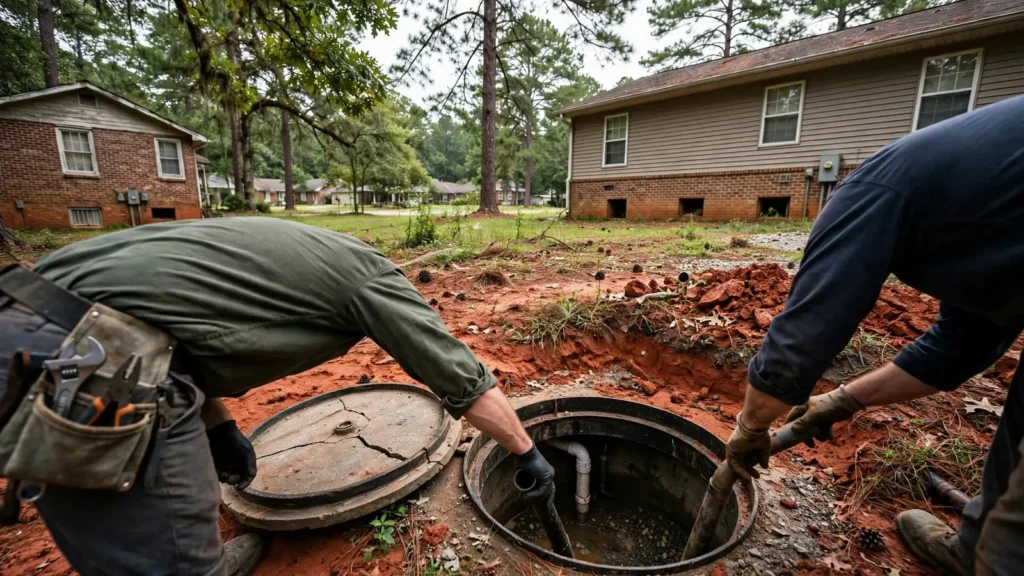
If you live inside Greenville, Mauldin or most of the Eastside, you probably never think about where the toilet goes. Drive north past Travelers Rest toward Tigerville and Marietta, or out to the rural edges near Pelham, Fork Shoals and the far side of Fountain Inn, and the picture changes. A lot of those homes have a septic tank in the yard and a drainfield beyond it. Statewide, SC DES says about 30 percent of South Carolina households rely on septic.
This guide covers septic tank pumping in Greenville, SC from a homeowner's side: how often, what the state requires, what failure looks like on our red clay, and what to ask before you buy a house with a tank.
Where septic is common in Greenville County
MetroConnects runs sewer for most of the unincorporated county, and the cities run or contract their own. Sewer lines follow roads and density, so the farther you get from the Greenville to Greer to Simpsonville core, the more likely a house is on septic. The patterns we see most:
- North of Travelers Rest, along Highway 25 and Highway 276 toward Tigerville, Marietta and Cleveland. Many of these homes are also on private wells. Our Travelers Rest plumbing guide has a side-by-side of city versus well and septic.
- Older rural roads in the northeast county near Gowensville and Lake Robinson, and around the edges of Greer.
- The southern county near Fork Shoals, Pelzer Road and the stretch between Piedmont and Fountain Inn.
Not sure which you have? If your water bill has no sewer charge, or you have no water bill because you're on a well, you're very likely on septic.
Who regulates septic here: SC DES, not the county
In July 2024 South Carolina split the old DHEC in two. The environmental programs, including onsite wastewater (septic), moved to the new SC Department of Environmental Services (SC DES). Older permits and real-estate paperwork still say "DHEC." It's the same program.
A few points that matter for Greenville County owners:
- Septic applications for properties in Greenville County go to SC DES, through its ePermitting portal, using the onsite wastewater application (form D-1740). Greenville County's own building office says it takes no septic applications or payments.
- The governing rule is SC Regulation 61-56, Onsite Wastewater Systems. New systems need a permit to construct and a final approval to operate.
- For a repair, relocation or replacement, SC DES may require a permit even if nothing about the house has changed. The regulation tells owners to contact the department before replacing a system so it can decide.
- If public sewer is available for connection, the state won't allow a failing septic system to be repaired. You'd be connecting to sewer instead.
- Clemson Extension notes that South Carolina requires a licensed contractor to pump and repair systems. Homeowners can look at the drainfield and the cleanout, and that's about it.
How often you need septic tank pumping
The EPA's general guidance is an inspection about every three years for a typical household system and pumping every three to five years. Clemson Extension's "Be Septic Safe" series gives the same three to five year pumping range and suggests an inspection by a licensed professional every one to two years, which can be done on the same visit as the pumping.
Four things move your number:
- Household size. More people means more solids. A couple and a family of six with the same tank are on very different schedules.
- Tank size. Older rural houses often have smaller tanks than a new four-bedroom build. Your permit, if SC DES can find it, lists the size.
- A garbage disposal. Both the EPA and Clemson say to limit or skip it on septic. Ground-up food adds solids that don't break down fast.
- Water use. The EPA puts typical indoor use at about 70 gallons per person per day, and says a single running toilet can waste up to 200 gallons a day. That water flushes through the tank and can push solids out to the drainfield.
The real trigger is what's in the tank. The EPA says to pump when the bottom of the scum layer is within 6 inches of the outlet, when the top of the sludge is within 12 inches of the outlet, or when sludge and scum together fill more than 25 percent of the liquid depth. A pumper or inspector measures this. That's why the inspection matters more than the calendar.
| Your situation | Reasonable starting plan |
|---|---|
| One or two people, no disposal, average tank | Inspect every 2 to 3 years; pump when measured levels call for it, often near the 5-year end |
| Family of four, standard tank | Inspect every 1 to 2 years; plan on pumping around every 3 years |
| Five or more people, or a garbage disposal in daily use | Inspect yearly; expect pumping on the short end of the range |
| Alternative system with pumps, alarms or aerators | Inspect yearly and keep a service contract (EPA) |
| Just bought the house, no records | Pump and inspect now, so you have a baseline |
Signs your septic system is failing
Clemson Extension and the EPA list the same early warnings. Most of them show up in the house before you see anything in the yard:
- Several drains slow at once, or a toilet that gurgles when the washer drains.
- Sewage odor inside, or around the tank and drainfield outside.
- Bright green, fast-growing grass over the drainfield, or the opposite, dead patches.
- Soggy ground or standing water over the field when it hasn't rained.
- Wastewater backing up into the lowest tub or shower.
One slow drain is usually a plain clog. Every drain slow at once points to the tank, the line to it, or the drainfield. If sewage is already in the house, our sewer backup guide covers cleanup; on septic, the first call is a pumper or plumber, not MetroConnects.
Drains slow all over the house? Call a local plumber
Red clay and drainfields: why the Upstate is different
A septic tank only separates solids. The real treatment happens in the drainfield, where the liquid seeps into the soil and the soil does the cleaning. That works best in soil that's somewhat dry, permeable and full of oxygen a few feet down.
Much of Greenville County sits on Piedmont red clay. It holds together well, which is good for foundations, but water moves through it slowly, and it compacts easily. In practice that means:
- Drainfields here tend to be larger, or placed carefully on the better soil of a lot. That's why the SC DES site evaluation comes before any permit.
- Heavy equipment over the field during construction, or parking a truck or a boat on it later, can squeeze the clay shut. SC DES lists soil compacted by heavy equipment as a common cause of problems.
- Long wet spells hit clay drainfields harder. After a week of heavy rain, a field that's been fine for years can go soggy and slow until the ground dries out.
- If solids escape the tank, they clog the trenches. In clay that's hard to undo and expensive. Pumping on schedule is the cheap insurance.
Clemson also warns not to pump during or right after heavy rain: in saturated ground, an empty tank can float. Wait for things to dry unless sewage is backing up.
What not to flush or pour on septic
The EPA's rule is short: flush only human waste and toilet paper. Its "never flush" list includes:
- Wipes, including the ones labeled flushable
- Cooking grease and oil
- Diapers, feminine products, condoms and dental floss
- Paper towels, coffee grounds and cat litter
- Medicines and household chemicals such as paint, thinner, antifreeze and pesticides
Skip chemical drain openers too. The EPA suggests boiling water or a drain snake instead, and our drain cleaning guide covers when a clog needs a professional. Clemson's advice on additives is blunt: products that claim to remove the need for pumping don't, because the bacteria a tank needs already come from human waste.
A few habits help more than any product:
- Fix running toilets fast, and spread laundry over the week instead of doing six loads on Saturday.
- Send gutters, downspouts and any sump pump discharge away from the drainfield. Our sump pump basics post covers where that water should go.
- Keep trees and shrubs off the field, and plant grass over it instead.
Buying or selling a Greenville County home with septic
This is where people get surprised. SC DES says state law does not require existing septic systems to be inspected when a house sells, and the agency itself doesn't do routine inspections. Whether a system gets checked before closing is up to the buyer and the contract.
If you're buying, treat the septic like the roof and have a pro look at it:
- Ask the seller for records. Pumping receipts, repair invoices and the original permit. Clemson recommends every owner keep dated records of all septic work, so a good seller will have them.
- Request the permit from SC DES. For homes built in roughly the last 20 years, SC DES suggests contacting the regional office with the tax map number and original permit holder's name. For older homes you may need a Freedom of Information Act request, and the department doesn't guarantee a record exists.
- Hire a licensed septic contractor to pump and inspect before your due diligence period ends. Pumping lets the inspector see the baffles and the tank walls; a lid-only look doesn't tell you much.
- Walk the drainfield. Wet spots, odor or lush stripes of grass in dry weather are worth asking about.
- Check what's been built. A new patio, pool or addition over the field is a red flag. The EPA says to check with the permitting authority before building on or near a drainfield.
- Ask about sewer. If public sewer runs along the road, a failing system may have to be connected instead of repaired. Call the sewer provider for that address.
If you're selling, a recent pumping and inspection report takes away an easy reason for a buyer to ask for a price cut.
Septic pumper, septic installer or plumber?
These are different trades, and knowing which you need saves a wasted trip fee:
| Problem | Who usually handles it |
|---|---|
| Routine pumping, tank inspection, finding the lid | Licensed septic pumping company |
| Drainfield failure, tank replacement, new system | Licensed septic installer, with an SC DES permit when required |
| Clog in the pipe between the house and the tank | Plumber (with a camera if it keeps coming back) |
| One fixture draining slowly, gurgling vents, broken drain pipe under the house | Plumber |
| Sewage in the house and you don't know why | Start with a plumber or pumper; whoever comes first can tell you if the tank is full |
Whoever you hire, check the license. Our guide to checking a plumber license in SC walks through the LLR lookup, and SC DES lists licensed septic installers and inspectors on its septic pages. For what a plumbing visit costs here, see the Greenville plumber cost guide; we don't publish septic pumping prices because we couldn't find a reliable local source for them.
Backup between the house and the tank? Call a local plumber
Septic pumping questions
Do I need a permit to have my septic tank pumped?
No. Routine pumping doesn't need a permit, but it must be done by a licensed contractor. Repairs, relocations and replacements may need an SC DES permit, so ask the contractor before work starts.
Can I find my septic tank's location from state records?
Sometimes. For homes built in about the last 20 years, SC DES suggests contacting the regional office with the tax map number and original permit holder's name. For older homes, a licensed septic contractor can usually locate the tank with a probe or by following the main drain line.
Should I pump my septic tank after a big rainstorm?
Not unless sewage is backing into the house. Clemson Extension warns that a tank pumped in saturated soil can float. Wait until the ground has dried out.
Do septic additives replace pumping?
No. Clemson Extension says the bacteria a septic tank needs already come from household waste, and no additive removes the need to pump out solids.
Does South Carolina require a septic inspection before a home sale?
SC DES says state law doesn't require it. Buyers can still make an inspection part of the contract, and on a rural Greenville County property we think they should.
Sources
- SC Department of Environmental Services: SepticSmart Week news release (about 30% of SC households on septic; SCDES does not perform routine inspections), September 15, 2025.
- SC DES: Septic Tanks Frequently Asked Questions; How to Locate a Septic Tank; Freedom of Information Act Requests; Backups, Leaks and Odors homeowner page.
- SC DES: Regulation 61-56, Onsite Wastewater Systems (repair, relocation and replacement permitting; repairs not allowed where sewer is accessible).
- SC DES: Onsite Wastewater (Septic System) Application Packet, form D-1740; septic permit pages for residential builders.
- Greenville County Building Safety: notice that septic applications and payments for Greenville County properties go through DES.
- U.S. EPA SepticSmart: How to Care for Your Septic System (inspection and pumping intervals, pumping triggers, water use figures, what not to flush, drainfield care).
- Clemson Cooperative Extension, Home and Garden Information Center: Be Septic Safe series (best practices for maintenance, septic failures, new system users).