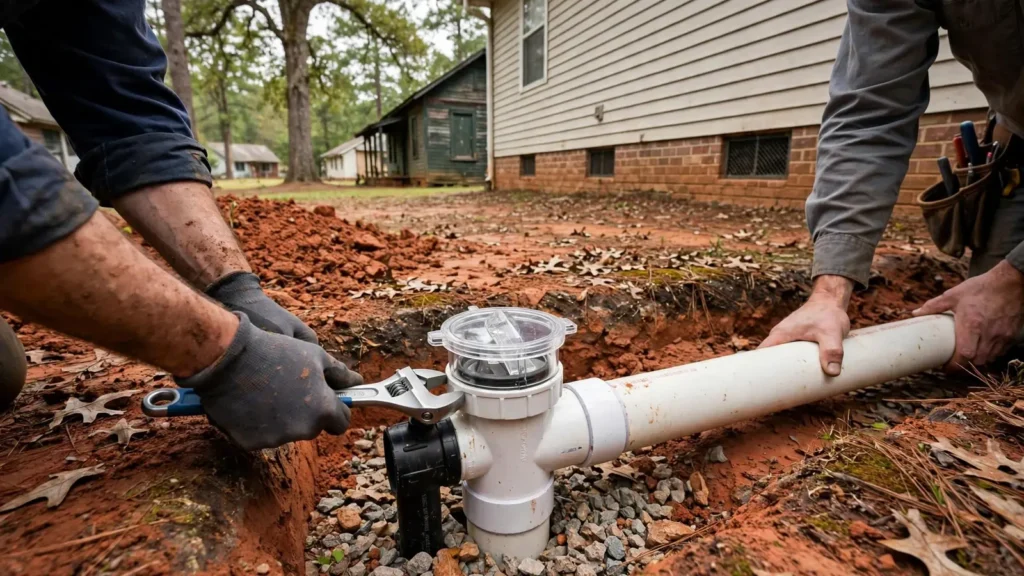
Ask around Greenville and you'll hear two opposite opinions about sump pumps. One neighbor swears every house needs one. Another has lived in the same Taylors ranch for 40 years and has never seen one. They're both partly right, because the answer depends on how the house was built and where the water goes on your lot.
This guide covers when an Upstate home needs a sump pump, the types, battery backups, how to test one, and the local rule people break most: where the water is allowed to go.
Does an Upstate home need a sump pump?
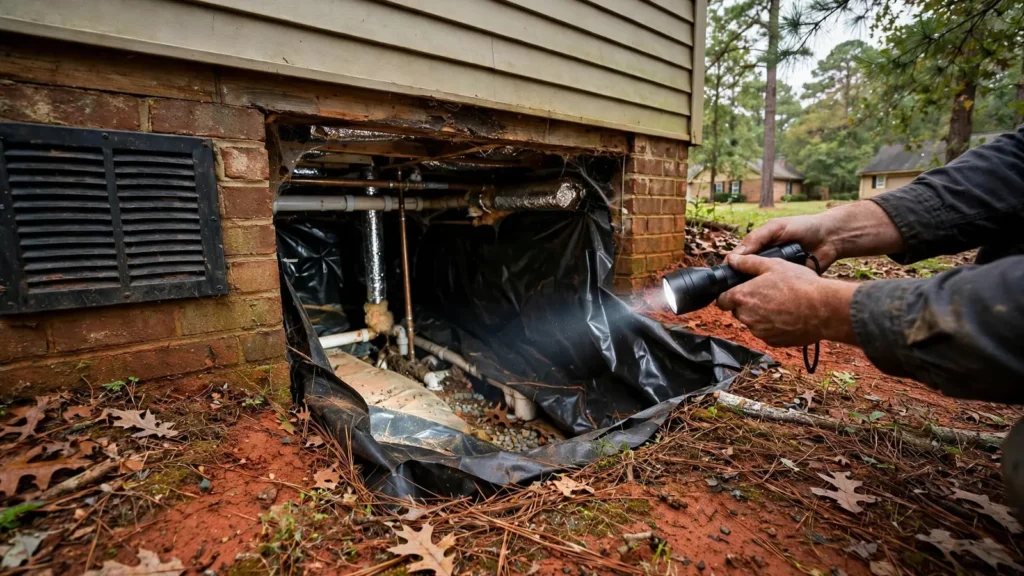
Most homes in Greenville County are built over a crawlspace. Plenty of crawlspaces stay dry their whole lives with nothing more than working gutters, downspout extensions and a yard that slopes away from the house. If yours gets wet only after storms, fix that first. Our guide to water in the crawl space after rain walks through telling a leak from a drainage problem.
A sump pump makes sense when water comes up from below and can't be kept out by grading alone:
- Basements. Full and partial basements are less common here than up north, but you'll find them in older in-town Greenville homes, in houses built into hillsides around Paris Mountain and the northern county, and in some newer custom builds.
- Walk-out lower levels on sloped lots, where the uphill wall sits below the yard.
- Wet lots: low spots, properties near a creek or wetland, or slopes with a seep or spring that runs after rain.
- Crawlspaces that still flood after the gutters and grading are fixed, usually from groundwater rising through the floor. These often get an interior drain feeding a sump pit.
- Encapsulated crawlspaces, where the sealed liner needs somewhere for water to go.
Piedmont red clay makes the decision a bit trickier. Clay drains slowly, so after a long wet spell water can sit in the backfill around a foundation for days and push in from the sides and below. A house that's dry in a normal year can be wet in a tropical-rain year. If you've seen water only once in ten years, a pump may not be worth it. If you see it every spring, it probably is.
How a sump pump system works
A full system has a few parts. Knowing them makes it easier to spot what's wrong:
- The pit (sump basin), a plastic liner set into the lowest point of the floor. Drain pipe around the foundation, if there is any, empties into it.
- The pump, which sits in or over the pit.
- The float switch, which turns the pump on when water rises and off when it drops.
- A check valve on the discharge pipe, so the water in the pipe doesn't fall back into the pit every time the pump stops.
- The discharge line, which carries the water out of the house to a spot in the yard.
- A lid. A sealed lid keeps out debris and kids and, in an encapsulated crawlspace, moisture.
Types of sump pumps
| Type | How it works | Good for | Trade-offs |
|---|---|---|---|
| Submersible | Pump and motor sit in the pit, under water | Most basements and finished spaces; quieter | Harder to service; costs more |
| Pedestal | Motor sits on a column above the pit | Narrow or shallow pits; easy to reach | Louder; motor exposed |
| Battery backup | Second pump on a battery that runs when power fails or the main pump can't keep up | Any home where a flood would be costly | Runs only as long as the battery lasts |
| Water-powered backup | Uses city water pressure to pull water out of the pit, no electricity | Homes on Greenville Water or Greer CPW with good pressure | Useless on a well when power is out; needs a backflow device; uses a lot of water |
| Combination unit | Main pump and battery backup sold as one system | New installs | Both pumps share one pit and discharge |
For pump size, the right answer depends on how much water comes in and how high the pump has to lift it. Ask the installer to explain the pick for your pit and your lift instead of just upsizing. A pump that's too big for a small pit cycles constantly and wears out sooner.
Sump pump running nonstop or not at all? Call a local plumber
Battery backup: worth it here?
We think yes, for any home where the sump protects a finished room or anything you'd cry about losing. The reason is simple. The rain that fills a sump pit usually arrives with wind, and wind takes down power lines. When Helene came through in September 2024, Duke Energy had more than a million customers out across the two Carolinas, and parts of Greenville County went days without power. A main pump without power is a decoration.
A few things to know:
- A battery backup buys time, not forever. Run time depends on the battery and how often the pump has to run.
- Batteries age. Many systems have a test button and an alarm; use them, and replace the battery on the maker's schedule.
- A water-powered backup is a good option on city water, as long as a proper backflow preventer is installed so pit water can't be pulled into the drinking water. It does nothing for a home on a well when the power's out, because the well pump is off too.
- A generator with a transfer switch can run a sump pump. Our post on plumbing after a power outage covers doing that safely.
How to test a sump pump
Test it a few times a year and always before the wet season. It takes five minutes.
- Check the power. The pump should be plugged into a working outlet, ideally its own, not an extension cord. Many pumps have a piggyback plug for the float; both need to be plugged in.
- Lift the lid and look. Clear out debris, gravel or anything that could jam the float or the intake.
- Pour water in slowly with a bucket until the float rises. The pump should start, empty the pit and shut off on its own.
- Go outside while it runs and make sure water is coming out of the discharge, not leaking at a joint or backing up.
- Listen for the check valve. A loud clunk when the pump stops is normal. Water rushing back into the pit is not.
- Test the backup by unplugging the main pump and repeating, or use its test button.
Signs of a failing pump: it runs but the water doesn't drop, it hums without pumping, it cycles on and off every few seconds, or it runs when the pit is empty. Any of those before a big storm is a reason to call; if the pit is already overflowing, see our emergency plumber guide.
Where sump pump water is allowed to go
This is the part people get wrong, sometimes for years. Sump water is groundwater and rainwater. It belongs outside, on the surface or in a storm drainage system, not in the sewer.
Why it matters: in a storm, clean water from sump pumps and downspouts can overload sewer pipes and contribute to backups and overflows, including into other people's homes. In heavy rain, that extra water is a known cause of exactly the kind of trouble our sewer backup guide covers. ReWa's rules apply across its service area, which includes MetroConnects and the city sewer systems that feed ReWa plants. If you're not sure which sewer provider you have, our who-owns guide explains it.
Good discharge habits:
- Run the discharge far enough out that the water can't flow straight back to the foundation. On clay, farther is better.
- Don't aim it at a neighbor's yard, a sidewalk where it will ice up on a cold morning, or a septic drainfield. The EPA says to keep sump pump water away from drainfields, which need dry soil to work.
- Keep the outdoor end clear of mulch, leaves and grass clippings.
- If the line runs underground, ask about a freeze-relief fitting near the house so a frozen or clogged buried line doesn't stop the pump from discharging.
If you bought a house where the sump already drains into a laundry sink or a cleanout, have a plumber reroute it. It's usually a modest job.
Sump pump vs backwater valve
People confuse these because both show up in conversations about water in the basement. They solve different problems:
| Sump pump | Backwater valve | |
|---|---|---|
| Deals with | Groundwater and rain coming up from the soil | Sewage flowing backward from the sewer main into the house |
| Where it goes | A pit at the low point of the floor | On the main drain line, usually near where it leaves the house |
| Needs power | Yes (or a battery or water-powered backup) | No; it's a one-way flap |
| Typical trigger | Heavy rain, high water table, wet lot | Sewer main blockage or overload, often in heavy rain |
| Who installs it | Plumber or waterproofing company | Plumber, usually with a permit |
A house can need both: a sump for groundwater and a backwater valve for a sewer that surcharges in storms. Neither replaces the other.
Who installs sump pumps, and what to ask
Plumbers replace and repair sump pumps, check valves and discharge lines. Waterproofing companies usually install new pits along with interior drains and crawlspace liners. Whoever you hire:
- Check the license. Our guide to checking a plumber license in SC covers the LLR lookup.
- Ask whether the job needs a permit and whether the price includes it. Greenville County Building Safety, or your city's building office, can tell you.
- Ask where the discharge will go, in writing.
- Ask about the outlet. Electrical code changes in recent years call for GFCI protection in many basement and crawlspace locations, and some older sump circuits don't have it. An electrician can sort that out.
For what a plumbing visit costs here, see our Greenville plumber cost guide. We don't list sump pump installation prices because the range depends on whether you're replacing a pump in an existing pit or digging a new one, and we couldn't find a reliable local source.
Need a sump pump replaced or rerouted? Call a local plumber
Sump pump questions
How long does a sump pump last?
It varies with how often it runs and the quality of the pump. A pump that cycles constantly wears out faster. Test it a few times a year and replace it when it struggles, rather than waiting for it to fail in a storm.
Why does my sump pump run when it hasn't rained?
Groundwater can keep flowing into the pit for days after a wet spell, especially on clay. If it runs with the pit empty, the float may be stuck or the check valve may be letting water fall back. Have it checked.
Can I drain my sump pump into the sewer cleanout?
No. ReWa's Sewer Use Regulation prohibits connecting foundation drains and other sources of inflow to the sanitary sewer. Discharge it outside, away from the house, a neighbor's yard and any septic drainfield.
Does a crawlspace need a sump pump?
Most Upstate crawlspaces don't if the gutters, downspouts and grading are right. One makes sense when groundwater still comes up through the floor after those fixes, or in an encapsulated crawlspace.
Is a battery backup sump pump worth it?
For any home where the sump protects a finished room or stored belongings, we think yes. The storms that fill sump pits often knock out power, which is exactly when a main pump stops.
Sources
- Renewable Water Resources (ReWa): Sewer Use Regulation, effective June 6, 1984, as amended January 21, 2025. Section 2.3.3 Connection Not Allowed to Sewer; definition of Inflow; discharge prohibitions including stormwater, surface water and groundwater.
- U.S. EPA SepticSmart: How to Care for Your Septic System (keep sump pumps and roof drains away from the drainfield).
- Duke Energy restoration updates on Hurricane Helene in the Carolinas, September 2024, as reported by WBTV and FOX Carolina.
- Greenville County Building Safety: permit information.
- SC Department of Labor, Licensing and Regulation: contractor and residential builder license lookup.