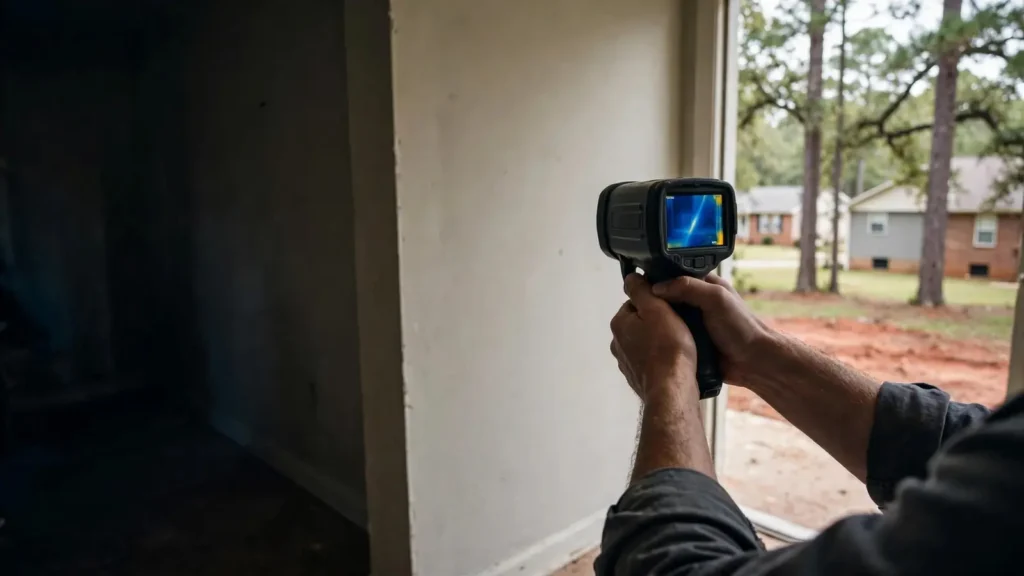
Most houses in Greenville County sit over a crawlspace, not a basement. The 1950s mill houses in Piedmont and Judson, the 1970s brick ranches in Taylors and Wade Hampton, and plenty of 1990s two-stories in Mauldin and Simpsonville all have one. So when a heavy summer storm or a week of tropical rain rolls through, a lot of people open the crawlspace door with a flashlight and find a puddle, or worse, a pond.
Finding water in your crawl space after rain doesn't automatically mean a pipe broke. But it doesn't automatically mean it's "just rain" either, and guessing wrong costs money in both directions. Here's how we'd sort it out.
Water in crawl space after rain: rain or a plumbing leak?
Four checks settle most cases. Do them in this order; the first one takes about 15 minutes and costs nothing.
- Do the meter test. Greenville Water's leak check: turn off every tap and water-using appliance, note the position of the meter's sweep hand (the one that records single gallons), wait at least 15 minutes, and look again. If it moved, water is leaving the pipes somewhere. To narrow it down, shut the house's main valve and check again. If the meter still moves, the leak is between the meter and the house. On a well, watch the pressure gauge instead: if the pump kicks on with nothing running, something's leaking.
- Think about timing. Rainwater shows up during or a few hours after a storm and slowly drains or dries over the next days. A supply leak stays wet in a dry spell, and often gets worse over time. A drain leak shows up after showers, laundry or dishes.
- Look at where the water is. Rain tends to come in along the foundation walls, especially on the uphill side of the lot or under a downspout, and leaves mud lines and silt. A plumbing leak is wettest under a bathroom, kitchen, laundry or water heater, and you can often see drips on a pipe, a wet subfloor or stained insulation above the puddle.
- Smell it. Rainwater smells like wet dirt. A sewage or musty-sour smell near a drain line points to a leaking drain or a sewer problem, and that's a plumber's job.
| Clue | Rain or groundwater | Supply line leak | Drain or sewer leak |
|---|---|---|---|
| Meter or well gauge with taps off | Doesn't move | Moves | Doesn't move |
| When it's wet | After storms | All the time | After fixtures are used |
| Where | Perimeter, low spots, under downspouts | Under a fixture or along a pipe run | Under bathrooms, kitchen, laundry; along the main drain |
| Smell | Earthy | None | Sewage or sour |
| Who to call | Gutter, grading or waterproofing company | Plumber | Plumber |
If the meter is moving and you can't find a wet spot, the leak may be under a slab section, inside a wall or in the yard. That's where a plumber with leak-detection gear earns the fee. If the meter moves with the house valve shut, read our water line repair guide and the who-owns guide to see whose side the leak is on.
Why Upstate crawlspaces flood: clay, slopes and grading
Greenville County sits on Piedmont red clay over rock. Clay soaks up water slowly. In a hard rain, water that can't sink in runs along the surface and goes wherever the ground tilts. If the ground tilts toward your house, it ends up against the foundation, and then under it.
Three local patterns make it worse:
- Sloped lots. Many Upstate homes are built into a hill, with the uphill side of the crawlspace below the yard. That wall takes the runoff.
- Settled backfill. The soil around a foundation was dug out and pushed back during construction. Over years it sinks, and the slope that once ran away from the house can end up running toward it. You see it most in houses 20 or more years old.
- Landscaping. Mulch beds piled high against the brick, edging that traps water, or a patio poured with a slight tilt toward the house.
The International Residential Code, which South Carolina's residential code is based on, says lots should be graded so the ground falls at least 6 inches within the first 10 feet from the foundation. Paved surfaces within 10 feet should slope at least 2 percent away. You can check your own yard with a 10-foot board, a level and a tape measure. If the ground near the house is flat, or tilts in, that's very likely your problem.
Gutters and downspouts: the cheapest fix
A single roof can shed an enormous amount of water in an Upstate downpour, and gutters gather it into a few points. If a downspout drops that water right at the foundation, you've built a small creek that runs straight into the crawlspace.
- Clean the gutters, especially after the fall leaf drop and after pollen season. Overflowing gutters pour water along the whole wall.
- Extend every downspout. For problem soils, the residential code calls for roof water to discharge at least 5 feet from the foundation, and we think that's a good minimum anywhere in clay.
- Watch where it goes. A downspout extension that sends water toward the neighbor, the septic drainfield or back toward the house on a slope doesn't help.
- Check buried downspout drains. Many newer homes run downspouts into corrugated pipe under the yard. Those clog with leaves and roots, back up, and leak at the foundation. Run a hose into one; if it backs up, it needs clearing.
Meter moving and the crawlspace is wet? Call a local plumber
Vapor barriers and crawlspace moisture
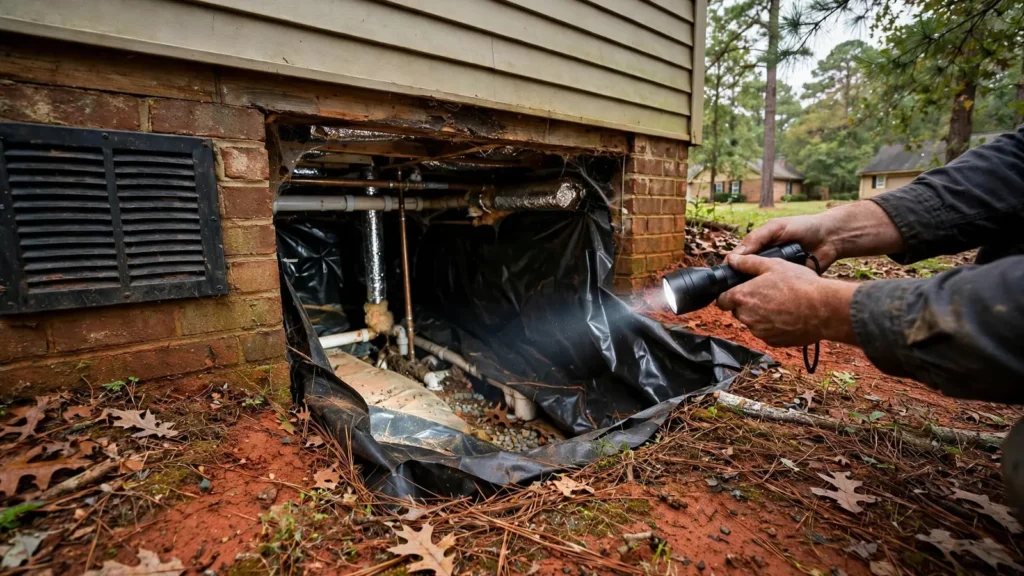
A vapor barrier is the plastic sheeting on the crawlspace floor. Its job is to stop ground moisture from evaporating into the crawlspace air. It isn't meant to stop flowing water, and a barrier with a pond under it or on top of it isn't doing its job.
What to look for:
- Coverage. The whole dirt floor should be covered, with seams overlapped. The residential code's version for a closed (unvented) crawlspace calls for seams overlapped 6 inches and sealed or taped, with the edges run up the walls.
- Water on top of the plastic. After a rain this usually means water ran in over the foundation or through a vent well, then sat on the plastic because it can't soak in. Fix the drainage first, then replace or dry the barrier.
- Torn or missing sections. Plumbers, HVAC techs and pest control crews crawl over the barrier all the time. Gaps let moisture in.
Vented crawlspaces are the traditional Upstate setup: vents in the foundation and a vapor barrier on the floor. Encapsulated crawlspaces (sealed walls, no vents, often a dehumidifier) are common in newer and renovated homes. Either works when the water is managed. Neither works when rain is running in.
One crossover with plumbing: if you're closing up or encapsulating a crawlspace, it's a good time to have the pipes looked at. Galvanized lines, old shutoffs and leaking drain joints are much easier to fix before the walls are sealed. See our guide to plumbing in older Greenville homes.
When a crawlspace sump pump helps
A sump pump in a crawlspace is a low spot with a pit and a pump that pushes collected water out of the house. It's the right tool when water keeps reaching the crawlspace even after you've fixed gutters and grading, usually because groundwater rises up through the floor on a wet lot or a spring-fed slope. A curtain drain or interior perimeter drain often feeds the pit.
It's the wrong first step when the problem is surface water from a downspout. A pump moves water after it gets in. Fixing the slope keeps it out. Our sump pump basics post covers when an Upstate home needs one, battery backups, and where the discharge is allowed to go.
Mold risk and how fast to act
The EPA says that if wet materials are dried within 24 to 48 hours of a leak, in most cases mold won't grow. That's a rule of thumb, not a promise, but it's the number to work from. In an Upstate summer, with warm, humid air in the crawlspace, things get moldy quickly.
- Pump or wet-vac out standing water as soon as the rain stops, if you can do it safely.
- Pull out soaked insulation that has fallen or is sagging. Wet fiberglass between floor joists holds water against the wood.
- Run fans and a dehumidifier until the space is dry. The EPA suggests keeping indoor humidity below 60 percent, ideally 30 to 50 percent.
- If the water smells like sewage, don't dry it with fans first. The EPA says sewage-contaminated water calls for protective gear and containment. Our sewer backup guide covers what to do.
Before you crawl in after a storm, check that the area isn't near wiring, a duct with power to it, or an electric water heater sitting in water. If you're not sure, turn off the power to the crawlspace circuits at the panel first.
Plumber or waterproofing company?
| What you found | Call |
|---|---|
| Meter moves, or the well pump runs with nothing on | Plumber (leak detection) |
| Wet under a bathroom or kitchen, or after showers and laundry | Plumber (drain leak) |
| Sewage smell, or toilets gurgle when it rains | Plumber; MetroConnects or your sewer provider if the main is backing up |
| Water only after storms, along the walls, meter still | Gutter cleaner and a grading or drainage contractor |
| Water rising through the floor on a wet lot, even with good grading | Crawlspace waterproofing company (drain and sump) |
| Sagging floor joists, rot, or heavy mold | Waterproofing or structural contractor, and a mold remediation company |
A note on waterproofing sales: some companies quote a full encapsulation with a sump and dehumidifier for a crawlspace that only needed two downspout extensions and a few wheelbarrows of soil. Do the cheap fixes first, wait for the next big rain, and look again. If it's still wet, then get two written quotes. Our guide to choosing a plumber has questions that work for any contractor.
Not sure if it's a leak or the rain? Call a local plumber
Crawlspace water questions
Is some water in a crawlspace after heavy rain normal?
A little dampness along the walls after a big storm is common in older Upstate homes, but standing water isn't something to live with. It feeds mold and wood rot and draws in pests. Fix gutters and grading first and see if the problem goes away.
How long does it take a crawlspace to dry out?
It depends on how much water got in and the weather. Small puddles may dry in a few days with fans and a dehumidifier. The EPA's guideline is to dry wet materials within 24 to 48 hours to reduce mold, so start right away.
Will homeowners insurance cover crawlspace water from rain?
Usually not for groundwater or surface water seeping in, which most policies exclude and treat as flood or maintenance. Sudden pipe bursts are more often covered. Read your policy or ask your agent.
Should I put a dehumidifier in my crawlspace?
In an encapsulated crawlspace, a dehumidifier is normal and often part of the design. In a vented crawlspace it fights outside air and doesn't help much. Fix any water coming in before buying one.
Can a plumber tell me if the water is from rain?
Yes. A plumber can pressure-test supply lines, run dye or water through drains and camera the main line. If everything tests tight, you have a drainage problem, and you can take that result to a grading or waterproofing contractor.
Sources
- Greenville Water: customer leak-check guidance using the water meter and house shutoff; emergency contacts.
- International Code Council, International Residential Code: R401.3 drainage (6 inches of fall within 10 feet; 2 percent slope for impervious surfaces), R408.3 unvented crawlspace vapor retarder, R801.3 roof drainage on problem soils (discharge at least 5 feet from foundation).
- Renewable Water Resources (ReWa): Sewer Use Regulation, effective June 6, 1984, as amended January 21, 2025, Section 2.3.3 Connection Not Allowed to Sewer.
- U.S. EPA: A Brief Guide to Mold, Moisture and Your Home (24 to 48 hour drying; indoor humidity below 60 percent, ideally 30 to 50 percent); Mold Remediation in Schools and Commercial Buildings, Chapter 4 (sewage-contaminated water).