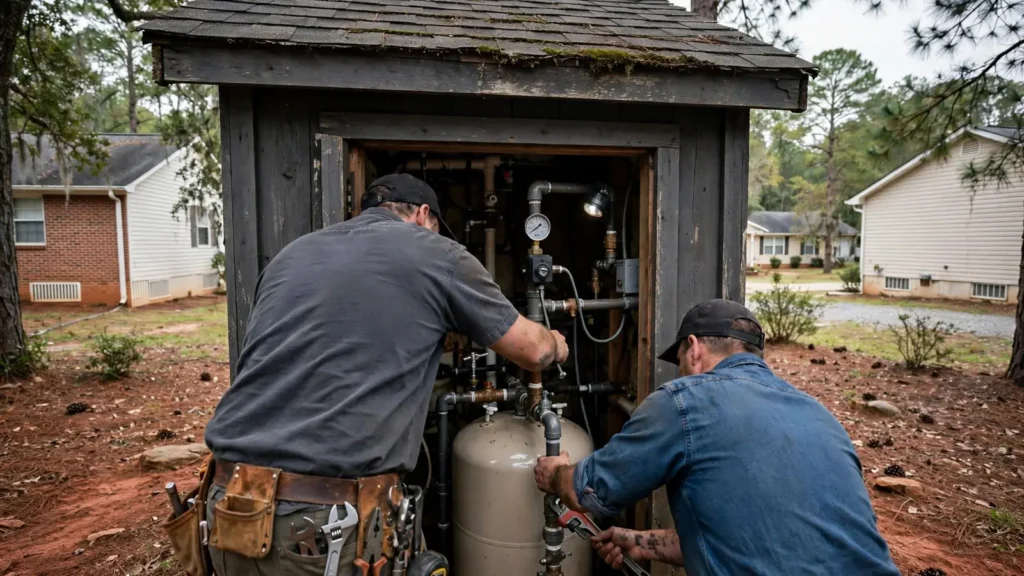
North of Travelers Rest, out toward Tigerville, Marietta and the Glassy Mountain area, and on plenty of rural roads around the edges of Greer, Pelzer and Fountain Inn, the water comes from a private well instead of Greenville Water. That's fine until the morning you turn on the shower and get a cough of air and nothing else.
This guide walks through why a well pump stops working, in the order we'd check it ourselves, and where the line is between a flashlight-and-tire-gauge job and a licensed well contractor.
How a home well system works
Four parts do almost all the work, and almost every problem traces back to one of them:
- The pump, which lifts water out of the ground.
- The pressure tank, a steel tank with an air cushion (usually inside a rubber bladder or diaphragm) that stores water under pressure so the pump doesn't run every time you open a tap.
- The pressure switch, a small gray box on a short pipe near the tank. It turns the pump on when pressure drops to the "cut-in" point and off at the "cut-out" point. Common settings are 30/50 and 40/60 psi.
- The pressure gauge, which tells you what's going on without guessing.
Submersible or jet pump: which do you have?
Look at the well house. If there's a motor-and-pump unit sitting on the floor or a shelf next to the tank, you have a jet pump. If you see only the tank, switch and pipes, and a well cap in the yard with wires running into it, the pump is a submersible, down in the well itself.
| Jet pump | Submersible pump | |
|---|---|---|
| Where it sits | Above ground, in the well house or crawlspace | Down in the well, below the water level |
| Typical use | Shallow wells (shallow-well jets are used when water is less than about 25 feet down) and some older deep-well setups | Most drilled wells, especially deeper ones |
| Common failures | Lost prime, worn impeller, leaking foot valve or check valve, motor | Motor, wiring splice in the well, control box (3-wire pumps), check valve |
| Who fixes it | Many plumbers and well companies | Usually a well contractor with a pump hoist |
Most drilled wells in the Upstate's bedrock use submersibles. Older homes with a shallow dug or bored well are more likely to have a jet pump.
Well pump not working and no water: checks in order
- Check the breaker. Well pumps usually have their own double-pole breaker, often labeled "well" or "pump." If it's tripped, reset it once. If it trips again right away, leave it off. That points to a short in the pump, the wiring or the control box, and resetting it repeatedly can do more damage.
- Look at the pressure gauge. If it reads zero or close to it and the breaker is on, the pump isn't running or isn't moving water.
- Check the pressure switch. Some switches, often Square D models, have a small lever on the side for low-pressure cutoff. If pressure dropped too low (from a power blip or a running hose), the switch shuts off and stays off. Holding the lever up for a few seconds restarts the pump. If you don't know your switch, or there's no lever, don't improvise.
- Listen. With pressure low, you should hear the pump start (a jet pump hums in the well house; a submersible makes a faint click at the switch and maybe a hum at the control box). Silence means no power reaching the motor or a dead switch.
- Check a 3-wire control box, if you have one. It's a small box on the wall near the switch. Some have their own reset button.
If the pump runs but the gauge won't climb, the well may be low (it happens in a dry late summer), a pipe may be broken in the well, or a jet pump may have lost its prime. SC DES has a homeowner page on what to do if a well goes dry, and that's a well contractor's call.
Pressure tank and switch symptoms
A failing pressure tank doesn't usually leave you with no water. It makes the water act strangely. Here's what each symptom usually means:
| What you notice | Most likely cause | What to do |
|---|---|---|
| Pump clicks on and off every few seconds while water runs | Waterlogged tank (lost its air charge or a ruptured bladder) | Check the air charge; a ruptured bladder means a new tank |
| Pressure surges up and down at the shower | Low air charge, or switch contacts sticking | Check the tank, then the switch |
| Faucets spurt and spit air | Air in the lines, a low well, a leaking check valve or a cracked drop pipe | Run a cold tap for a few minutes; if it keeps happening, call |
| Pump runs and runs without shutting off | Leak in the system, low well, worn pump, or switch not cutting out | Turn it off at the breaker; a pump that never stops can burn up |
| Water drips from the air valve on top of the tank | Ruptured bladder | Tank replacement |
| Gauge reads fine, but water is weak at one faucet | Clogged aerator or filter, not the pump | Clean the aerator; check any sediment filter |
Checking the tank's air charge
Amtrol, which makes Well-X-Trol tanks, says the tank's air precharge should be set 2 psi below the pressure switch's cut-in. On a 30/50 switch, that's 28 psi. On 40/60, it's 38 psi. To check it:
- Turn the pump off at the breaker.
- Drain the tank by opening a faucet until the water stops and the gauge reads zero.
- Put a tire gauge on the air valve on top of the tank.
- Compare with your cut-in minus 2. If it's low, add air with a small compressor, then restore power.
Two cautions. If water comes out of the air valve, the bladder is gone and air won't fix it. And Amtrol warns against raising the precharge on a tank that's already in service without checking why the cycle time dropped, because overcharging an old tank can be a rupture risk. When in doubt, have it looked at.
Well pump not working and the breaker is fine? Call a local plumber
Lightning, power surges and storms
Upstate summers bring a lot of thunderstorms, and well pumps take a beating from them. The pump sits at the end of a long wire run, often hundreds of feet down into the ground, which makes it a good path for a surge from a nearby strike. Common storm damage:
- A burned-out pressure switch, with blackened or welded contacts.
- A failed capacitor or relay in a 3-wire control box.
- A dead pump motor, which is the expensive one.
- Repeated short power blips that leave a low-pressure-cutoff switch tripped.
Many well contractors install a lightning arrester at the switch or control box; if you've lost a pump to a storm before, ask about one. When the power is out for a long time, like it was across much of the county after Helene, the pump just stops. Our post on plumbing lessons from Helene covers storing water, generator transfer switches and restarting a well after a long outage.
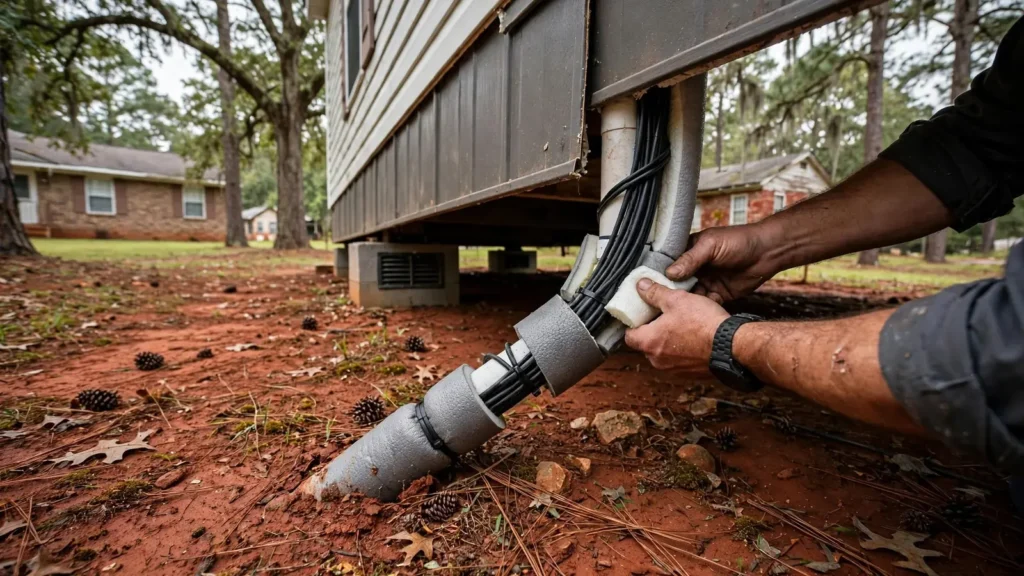
Cold snaps matter too. An uninsulated well house can freeze on a teens night north of Travelers Rest, and a frozen switch tube looks a lot like a dead pump. Our frozen pipes guide covers safe thawing.
Testing your well water
A pump repair, which opens up the system, is a good moment to test the water. The EPA suggests private well owners test at least once a year for total coliform bacteria, nitrates, total dissolved solids and pH, and more often if something changes.
In South Carolina, the main low-cost option is SC DES's private well testing service:
- A coliform bacteria test costs $20, according to SC DES. If coliform is found, the same sample is checked for E. coli. A metals and minerals analysis is also offered.
- Residents over 65 and people on public assistance can get one coliform test and one metals and minerals test a year at no charge. A new well permit holder's first coliform test is free.
- Kits come from an SC DES regional office or local health department. You don't pay at drop-off; the invoice comes with the results, which take about two to three weeks for bacteria.
- SC DES does not regulate the water quality of private wells. Testing and treatment are up to you.
Call the Greenville regional office before you go to confirm kit pickup and sample drop-off days, since samples have to reach the lab fresh. One thing people get wrong: Clemson's Agricultural Service Laboratory tests soil, forage and irrigation water, but not drinking water. Clemson Extension points well owners to SC DES or a certified private lab, and its Home and Garden Information Center has a good fact sheet on testing drinking water.
If the well house flooded or the wellhead was under water, don't drink from it until it's been disinfected and tested. SC DES says to use bottled or boiled water in the meantime and to test 7 to 10 days after disinfection, and Clemson strongly recommends having a licensed well driller shock-chlorinate a well that was submerged.
Plumber or well driller: who to call
South Carolina splits this work. Well drillers are certified by the SC Environmental Certification Board, part of LLR. New residential wells need an SC DES permit and have to be built to the state's well standards. Plumbers are licensed separately, through the LLR residential and contractor boards. Some companies do both; many don't.
| Job | Usually |
|---|---|
| Pressure switch, gauge, tank, piping in the well house | Plumber or well company |
| Jet pump replacement | Plumber or well company |
| Pulling and replacing a submersible pump, drop pipe or well wiring | Well contractor (needs a pump hoist or truck) |
| Well going dry, sediment or a collapsed well, new well or deepening | Certified well driller, with SC DES permit for new wells |
| Leaks, low pressure or no water inside the house only | Plumber |
| Water treatment (sediment filter, UV, softener) after a bad test | Plumber or water treatment company |
Before anyone starts, check the license. Our guide to checking a plumber license in SC covers the LLR lookup, and the same LLR site lists certified well drillers. For what a service call and repairs cost around here, see the Greenville plumber cost guide, and the Travelers Rest plumbing page has more on well and septic homes north of town. If you're on a well, you're probably on septic too, and our septic pumping guide covers that side.
No water from the well? Call a local plumber who works on pumps
Well pump questions
Why does my well pump breaker keep tripping?
A breaker that trips again right after a reset usually means a short or a failing motor, often in the pump, the wire splice down the well, or a 3-wire control box. Leave it off and call. Repeated resets can finish off a pump that might have been repairable.
What pressure should my well pressure tank be set to?
Amtrol, a major tank maker, says to set the air precharge 2 psi below your pressure switch's cut-in, checked with the pump off and the tank drained. That's 28 psi on a 30/50 switch and 38 psi on a 40/60 switch.
Why is my well water spurting air?
A little air after a power outage or repair is normal and clears after running a cold tap. Air that keeps coming back can mean a low water level in the well, a leaking check valve or a cracked pipe in the well. Have it checked before the pump runs dry.
How long do well pumps usually last?
It varies a lot with water quality, how often the pump cycles and power surges. A short-cycling pump from a bad tank wears out much faster than one on a healthy system, which is why fixing the tank early is cheap protection.
Can I get my well water tested for free in South Carolina?
Possibly. SC DES offers one free coliform test and one free metals and minerals test a year to residents over 65 and people on public assistance, and a free first coliform test to new well permit holders. Otherwise the coliform test is $20.
Sources
- SC Department of Environmental Services: Well Water Quality Testing Services (coliform test fee, exemptions, kits, turnaround); Private Drinking Water Wells; What Do I Do If My Well Goes Dry; Private Wells: What to Do After Storms.
- SC DES: Regulation 61-44 (individual residential well permits) and Regulation 61-71 (Well Standards).
- SC Department of Labor, Licensing and Regulation, Environmental Certification Board: well driller certification and renewal pages.
- Amtrol: Well-X-Trol well tank FAQ and installation instructions (precharge 2 psi below cut-in; caution on raising precharge).
- Clemson Cooperative Extension, Home and Garden Information Center: Residential Drinking Water Well series; Testing Drinking Water; How to Prepare Your Well for the Next Flood.
- Clemson Extension Savannah Valley District: residential drinking well testing (Agricultural Service Laboratory does not test potable water).
- U.S. EPA: Private Drinking Water Wells, guidance on annual testing.
- The Driller and manufacturer literature on submersible and jet pump systems (shallow-well jet pumps for water less than 25 feet down).