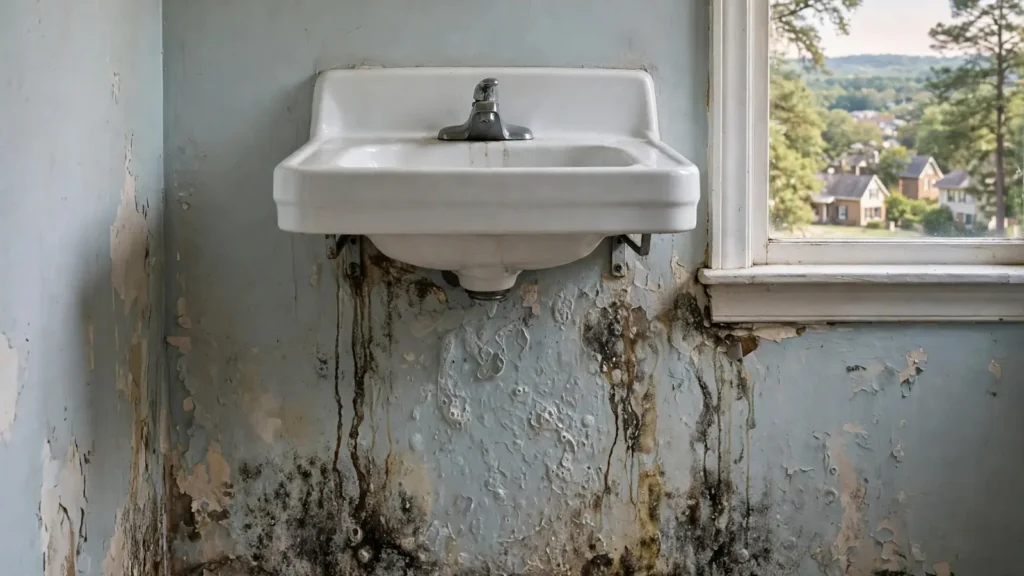
Pinhole leaks in copper pipes are maddening because they don't seem fair. Copper is supposed to last a lifetime, the pipe looks fine from outside, and then a stain appears on the ceiling under the bathroom. You cut out the drywall and find a hole you could barely fit a pin through, spraying a fine mist that's been running for weeks.
The good news is that a single pinhole is a simple fix. The harder question is whether it's a one-off or the first of many, and that depends on why it happened.
What causes pinhole leaks in copper pipes
Copper normally builds a thin, stable film on its inner surface that protects it. A pinhole forms where that film breaks down in one small spot and corrosion digs straight through the wall instead of spreading out. That's called pitting. A few things are known to drive it.
Water chemistry
The best-known research comes from Virginia Tech, where Marc Edwards and his students spent years recreating pinhole outbreaks in the lab, funded in part by the National Science Foundation. They tested hundreds of water recipes. Factors linked to more pitting included higher chlorine levels, aluminum in the water, and less natural organic matter. One counterintuitive finding: raising the pH to about 8.5 to 9 together with high chlorine was especially damaging. In some pits they also found sulfate-reducing bacteria, which points to a biological cause in some cases.
That work also found pinholes could be produced without stray electrical current, lightning or poor plumbing practice. Those things can still contribute, but they aren't required.
Velocity and erosion
Fast-moving water, particularly hot water, can scour the protective film away, usually right after an elbow, tee or burr where the flow turns turbulent. The Copper Development Association's design guidance puts the upper limits around 5 to 8 feet per second for cold water, 4 to 5 feet per second for hot water under 140°F, and 2 to 3 feet per second above 140°F. Undersized pipe and hot water recirculation pumps running too fast are the classic culprits.
Installation
- Pipe ends that weren't reamed after cutting leave a lip that creates turbulence.
- Excess soldering flux left inside the pipe can keep corroding the wall near joints.
- Pipe that was kinked, dented or bent too tightly.
- Copper touching steel or galvanized pipe without a dielectric fitting.
- Pipe that rubs on a joist or strap and vibrates.
Stray current and grounding
People blame electrical grounding a lot, and it can matter, but the Virginia Tech work suggests it's not the usual driver. If you see leaks clustered near where the electrical ground clamps to the water pipe, it's worth having an electrician check the grounding. Otherwise, look at chemistry, speed and installation first.
Is Greenville Water's water aggressive to copper?
Left untreated, Upstate surface water would be. Greenville Water's reports show it as very soft and low in alkalinity, the kind of water that tends to be corrosive to metal pipe. The utility has run a corrosion control program since the mid-1970s, and SC DHEC (now SC DES) approved it under the federal Lead and Copper Rule. What the utility does, in its own published numbers:
| Measure | Greenville Water figure | What it tells you |
|---|---|---|
| Total hardness | About 5.7 mg/L (2026 year-to-date average) | Very soft. Its own scale calls anything under 17.1 mg/L soft. |
| Total alkalinity | About 8.8 mg/L | Low buffering, which is why pH control matters |
| pH | About 7.7 | Raised with sodium hydroxide; below the 8.5 to 9 range flagged in the Virginia Tech lab work |
| Corrosion inhibitor | Ortho/polyphosphate blend, orthophosphate about 0.6 mg/L | Forms a protective layer on pipe walls |
| Disinfectant | Chloramine, 2.3 ppm system average (2024) | Normal and under the 4 ppm limit |
| Copper at customer taps | 90th percentile 0.093 ppm (2024 sampling) | Well under the 1.3 ppm action level |
Our read: the treatment is doing its job for general corrosion. Copper at the tap is low across the system. That doesn't rule out pinholes, which are a local, spot-by-spot problem that a tap copper test doesn't measure. We didn't find any Greenville Water statement about pinhole leaks, or any public report of a pinhole outbreak in its service area. If your house gets them, the cause is more likely in the house (velocity, installation, an old recirculation setup) than in the water. If you're on Greer CPW or another provider, its annual water quality report lists the same kind of figures.
Private wells are a different story. Well water isn't treated by anyone but you, and a well with low pH can eat copper from the inside. If you're on a well and getting pinholes, a water test is the first step, before any pipe work.
Found a pinhole leak? Call a local plumber
Signs of a pinhole leak
- A water stain, bubbling paint or soft drywall, often on a ceiling below a bathroom or along a wall near the water heater.
- A musty smell in one room or closet that doesn't go away.
- Green or blue crust on the outside of exposed copper, or a small white or green spot with a damp halo.
- A faint hissing in the wall when the house is quiet.
- A water meter that moves with every faucet off.
- In a slab house, a warm spot on the floor if it's a hot line.
The meter test is the fastest check. Turn off every faucet and appliance and watch the meter's leak indicator for 15 minutes. Our leak detection guide explains how plumbers find leaks behind walls without tearing out everything.
Temporary fixes until a plumber arrives
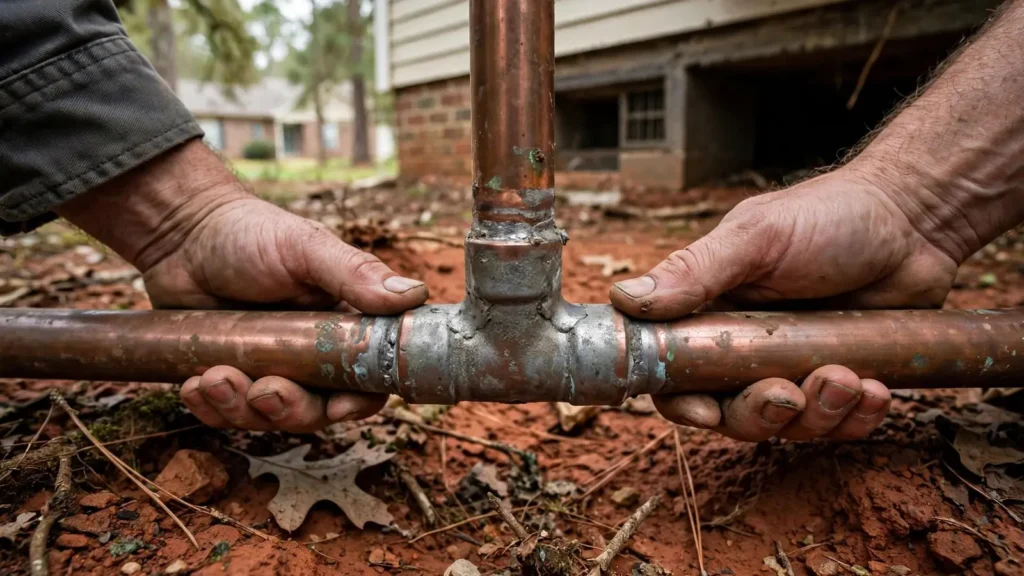
First, shut the water off. If the leak is on a branch you can isolate, close that fixture's valve; otherwise use the main. If it's a hot line, turn off the water heater too. Then, if the pipe is reachable:
- Pipe repair clamp. A rubber-lined clamp sized to the pipe, centered over the hole. It's the most reliable stopgap.
- Epoxy putty rated for plumbing. Dry and sand the pipe first, or it won't stick.
- Self-fusing silicone repair tape, stretched tight and wrapped well past the hole.
- Push-to-connect coupling. Cut out the bad inch of pipe and join the ends. This can be a lasting repair if it's done right and left accessible.
Clamps, putty and tape are meant to buy days or weeks, not years. If the leak sprayed into a wall, dry it out quickly; our burst pipe guide covers water damage cleanup.
When to repair and when to repipe
Here's the decision guide we'd use for a Greenville County house:
| What you're seeing | Reasonable next step |
|---|---|
| One pinhole, no history of leaks | Cut out and replace the bad section. Ask the plumber to look at the pipe nearby. |
| A second pinhole on the same run | Replace that whole run, not just the spot. |
| Leaks only on hot lines, near a recirculation pump | Check pump speed and pipe size; replace the hot side if it's widespread. |
| Three or more pinholes in different parts of the house within a year or two | Get repipe quotes. The pattern is unlikely to stop. |
| Pinholes plus copper under a slab | Consider rerouting overhead instead of chasing leaks in the slab. |
| On a private well with pinholes | Test the water, fix the chemistry, then decide on the pipe. |
When people repipe because of pinholes, PEX is the usual choice. It doesn't pit and handles soft water fine. Some homeowners stick with copper because they like it. That's reasonable if the cause was installation, but if the house has had pinholes all over, we'd go with PEX. Our repiping guide covers the process, and the cost guide covers what drives the price.
A few other things to weigh:
- Insurance. Each water damage claim goes on your record, and several in a row can affect renewal. Ask your agent how they treat repeat leak claims.
- Age. Older houses may have a mix of copper and galvanized. Our older homes guide explains what each era typically has.
- Selling. Repeated leaks are worth disclosing and worth fixing before a buyer's inspector finds the stains. See our home buyer's plumbing checklist for what inspectors look for.
Pinholes aren't the only reason copper or plastic supply pipe fails. If your 1980s house has a gray plastic line mixed in with copper, read our guide to polybutylene pipe too.
Second pinhole this year? Call a local plumber about a repipe
Pinhole leak questions
Why do pinhole leaks show up on hot water lines first?
Hot water speeds up corrosion, and fast-moving hot water can wear away copper's protective film near fittings. That's why the Copper Development Association recommends lower speeds for hot lines than for cold ones.
Are pinhole leaks a sign my drinking water is unsafe?
Not on their own. Greenville Water's 2024 tap sampling showed copper far below the federal action level. If you're worried, especially on a private well, have your water tested.
Is epoxy lining a good fix for pinhole leaks?
Some companies line copper pipes with epoxy instead of replacing them. It's less common than repiping. If you consider it, ask for the product's NSF/ANSI 61 certification for drinking water and a written warranty.
Can a pinhole leak stop on its own?
Sometimes corrosion deposits plug a tiny hole for a while. Don't count on it. The pit is still there, and the leak usually comes back larger.
Should I replace copper with copper or PEX after pinholes?
If the pinholes were caused by poor installation in one area, new copper installed correctly can be fine. If they're spread across the house, PEX avoids the problem because plastic doesn't pit.
Sources
- Science News, "Holey copper pipes": Virginia Tech research led by Marc Edwards on pH, chlorine and pitting, sulfate-reducing bacteria, and cost analyses by Eric Sarver and Ewa Kleczyk.
- National Science Foundation, engineering news (2004): Virginia Tech pinhole leak research findings on chlorine, aluminum, natural organic matter, and stray current.
- Copper Development Association, "What is most important when designing and installing copper piping systems?" (velocity limits).
- Greenville Water: 2025 Water Quality Report (chloramine, ortho/polyphosphate blend, sodium hydroxide pH adjustment, 2024 lead and copper sampling).
- Greenville Water: 2026 Finished Water Quality Report, monthly averages for the Stovall and Adkins plants (hardness, alkalinity, pH, orthophosphate).
- Greenville Water: corrosion control program page.
- NSF International: NSF/ANSI/CAN 61, drinking water system components.