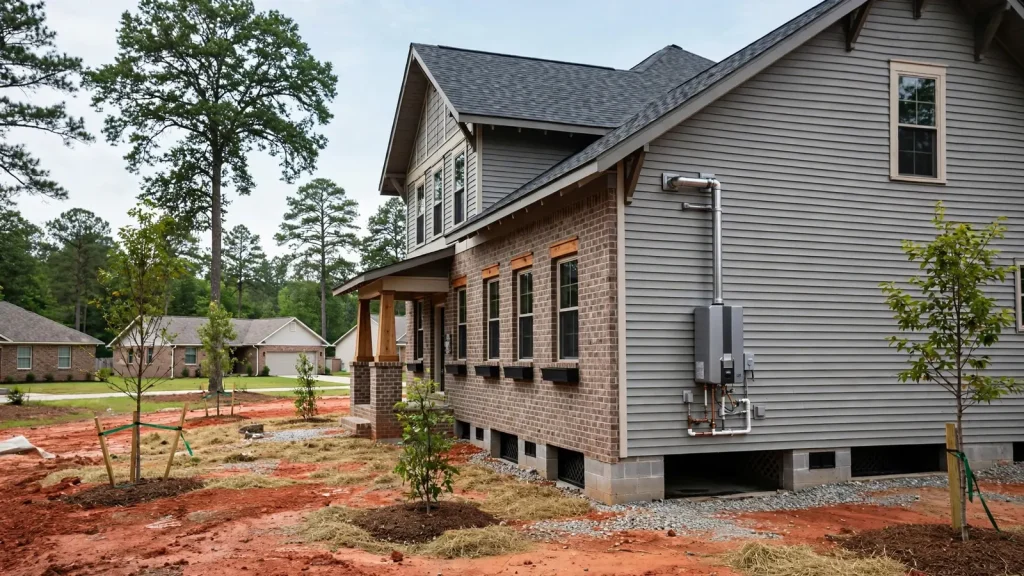
Heat pump water heaters have been around for years, but most Greenville County homeowners still haven't seen one in person. They look like a regular tank with a box on top, and they cost more on the receipt. The reason to care is the power bill: water heating is one of the bigger loads in an all-electric house, and a heat pump model cuts that load by around three-quarters.
This guide covers how they work, where they fit in the kinds of houses we have here, what they sound like, what incentives are actually available in 2026, and a payback example with real Duke Energy numbers. If you're still deciding between fuels, start with our gas vs electric water heater comparison.
How a heat pump water heater works
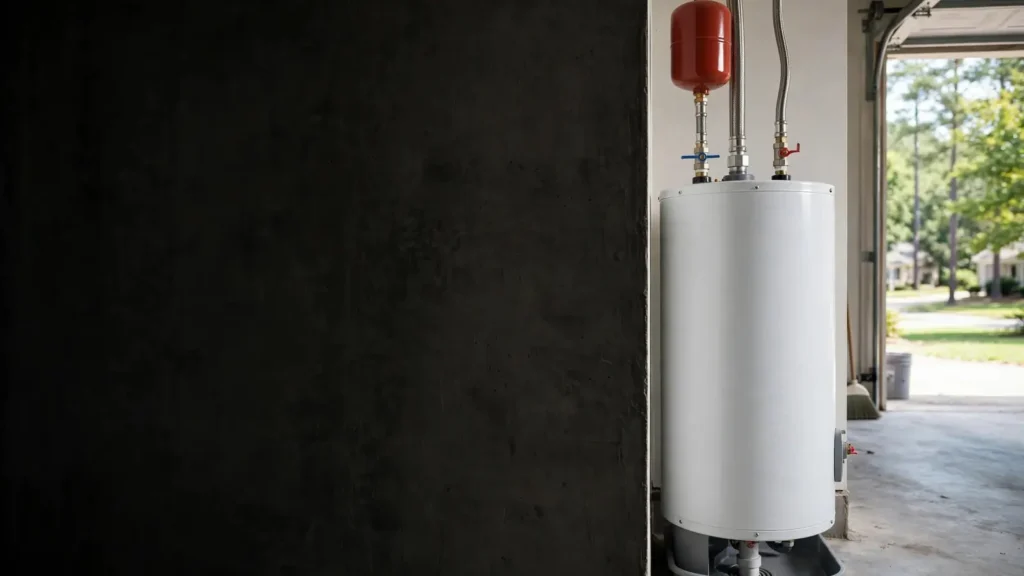
Think of a refrigerator running in reverse. A fan on top pulls room air across a cold coil. Refrigerant in that coil absorbs heat from the air, a compressor squeezes the refrigerant to make it hotter, and that heat moves into the water in the tank. The air that comes out the other side is cooler and drier than what went in.
Moving heat takes far less electricity than making it. That's why the efficiency numbers look so different. A standard electric tank has a Uniform Energy Factor (UEF) around 0.93. ENERGY STAR's current specification requires at least 3.30 for a standard 240-volt heat pump model, and many 50-gallon units are rated near 3.75 or higher.
Most units also have one or two ordinary electric elements as backup. Typical settings are:
- Heat pump only, the cheapest to run and the slowest to recover.
- Hybrid or "energy saver," which runs the heat pump most of the time and the elements when demand spikes.
- Electric only, which makes it a standard electric tank, handy when the space is too cold or for a houseful of guests.
- Vacation, which keeps the tank barely warm.
Most heat pump water heaters need a 240-volt circuit, same as a regular electric tank. There are also 120-volt plug-in models built to drop into an existing gas or electric spot without new wiring. They're less efficient; ENERGY STAR's minimum for them is 2.20.
Where they fit in Upstate homes
Location decides whether a heat pump water heater is a great buy or a frustrating one. ENERGY STAR says these units belong in interior spaces that stay between 40°F and 90°F year-round, with about 1,000 cubic feet of air around them, though its installer guidance and DOE's Building America guide accept smaller rooms (roughly 450 to 750 cubic feet) for some models. Check the manual for the unit you're looking at.
| Location | Fit | Why |
|---|---|---|
| Attached garage, standard in the 2000s to 2020s subdivisions around Simpsonville and Five Forks | Usually the best spot | Lots of air volume. Hot Upstate summers make the heat pump very efficient. Winter nights get cold, so expect some backup-element use in January. |
| Unfinished basement, as in many older Greenville homes | Very good | Stable temperature, and the unit dehumidifies a space that is often damp here. |
| Large utility or laundry room | Good, if it's big enough or vented | Watch the noise if it shares a wall with a bedroom. |
| Hall or laundry closet | Only with a louvered door or ducting | ENERGY STAR guidance calls for at least 240 square inches of net free vent area, with openings high and low. |
| Carport storage closet in a 1960s or 1970s ranch | Poor | Small, and open to winter cold through gaps. The unit spends cold months on its elements. |
| Attic | Avoid | Too hot in summer, cold in winter, heavy, and a condensate or tank leak lands on the ceiling. |
Winter is the question everyone asks. At Greenville-Spartanburg, normal January lows sit right around freezing. An attached garage usually stays well above the outdoor low, but on the coldest stretches it can drop toward 40°F, and below its operating range the unit hands the job to its backup elements. You still get hot water. You just lose some of the savings for those days, which is why we use a lower efficiency figure for garages in the cost math below.
A few practical fit checks before you buy:
- Height: heat pump models are taller than standard tanks of the same size. Measure under any shelves or a low garage ceiling.
- Condensate: the coil drips water, so it needs a drain, a floor drain nearby or a small pump.
- Clearance: the fan needs open space at the intake and exhaust. Don't box it in with storage.
Noise and the cooling effect
There is a compressor and a fan, so you'll hear it. ENERGY STAR says units meeting its current specification run under 55 dBA, about the level of a background conversation, and some models are rated around 45 dBA, closer to a quiet dishwasher. In a garage nobody notices. In a closet next to a bedroom, someone will. ENERGY STAR's own advice is to keep them away from bedrooms and living areas.
The cooling effect is real too. ENERGY STAR notes these units can cool the spaces they're in. In a Greenville summer that's a bonus: a cooler, drier garage or basement. In winter, if the unit sits inside the heated part of the house, it is pulling heat your furnace or heat pump just paid for. That's another reason garages and basements work better here than a closet off the hallway.
Thinking about a heat pump water heater? Call a local plumber
Rebates and tax credits in 2026
Federal 25C tax credit: ended
The Energy Efficient Home Improvement Credit (Section 25C) used to cover 30% of a heat pump water heater, up to $2,000. The 2025 federal budget law (Public Law 119-21, signed July 4, 2025) moved its end date up. The IRS says the credit is not allowed for any property placed in service after December 31, 2025. If your unit was installed and running in 2025, you can still claim it on your 2025 return using Form 5695. A 2026 install gets nothing from 25C, and the separate 25D clean energy credit doesn't cover heat pump water heaters.
Duke Energy
Duke Energy's Smart $aver program lists a rebate for heat pump water heaters for its customers. The amount, and rules such as whether the unit must replace an existing electric water heater, have changed over time, and third-party listings we found disagree with each other. Check Duke's Smart $aver page for South Carolina, or call Duke, before you buy, and keep the receipt and model number. Greer CPW and electric co-op customers should ask their own utility.
South Carolina state rebates
The South Carolina Energy Office runs the state's share of the federal Home Energy Rebates: HEAR (the Home Electrification and Appliance Rebates, aimed at low- and moderate-income households) and HOMES. Its rebates page says rebates are not currently available, with availability anticipated in 2026. As of our October 2026 check, the programs had not opened. If your household income is under about 150% of your county's median, sign up for updates on the Energy Office site; HEAR is the program most likely to cover a heat pump water heater.
A payback example with Duke Energy rates
Here is a worked example for a typical household replacing a 50-gallon electric tank in a garage. We used Duke Energy Carolinas' South Carolina residential energy charge, rounded to 14¢ per kWh, and the Department of Energy's standard hot water load of 41,045 Btu a day.
| Standard electric tank | Heat pump water heater | |
|---|---|---|
| Efficiency (UEF) | 0.93 | 3.75 rated; 3.0 assumed for a garage that gets cold in winter |
| Electricity per year | About 4,720 kWh | About 1,170 to 1,460 kWh |
| Cost per year at 14¢/kWh | About $660 | About $165 to $205 |
| Yearly savings | About $455 to $495 |
Now the upfront side. ENERGY STAR puts heat pump water heaters at about $1,500 to $3,000 for the unit, with contractors reporting $1,000 to $3,000 for installation. Published local figures for a standard tank installed in Greenville run about $1,300 to $2,200 (see our cost guide). So the extra you pay for a heat pump model depends heavily on the unit and on how much work the spot needs.
- If the heat pump install costs $1,800 more than a standard electric tank, at about $475 a year in savings it pays back in under four years.
- If it costs $3,000 more because the location needs a new drain or electrical work, payback is closer to six or seven years.
- A Duke rebate, if your install qualifies, shortens either number.
That lines up with ENERGY STAR's own national estimate of a 3 to 6 year payback against a standard electric tank. Most tanks last longer than that, so for a household on Duke with a decent garage or basement spot, the numbers generally work even without the federal credit.
When a heat pump water heater isn't the right call
- The only spot is a small, closed closet and you can't add louvers or ducting.
- You already have gas for heat or cooking and a working gas water heater; a gas tank is cheaper to run than a standard electric one, and switching fuels adds cost.
- Your household drains the tank every morning and can't tolerate slower recovery, unless you size up or run hybrid mode.
- The tank is failing right now and the right heat pump model would take days to arrive. Installers often need lead time to order one, per ENERGY STAR. In an emergency, a like-for-like tank may be the practical answer; our replacement guide covers that route.
Looking after one
A heat pump water heater gets the same yearly care as any tank: test the relief valve, drain a little sediment and keep an eye on the anode. On top of that, ENERGY STAR notes the air filter may need regular cleaning, and the condensate line has to stay clear. Our water heater maintenance checklist covers the tank side. On soft Greenville Water, scale on the heat exchanger is less of a worry than it would be in hard-water areas, as our repair guide's soft water section explains. Hire a licensed installer who has put in heat pump models before; our guide to choosing a plumber in Greenville lists the questions to ask.
Need a heat pump water heater quote? Call a local plumber
Heat pump water heater questions
Do heat pump water heaters work in a South Carolina winter?
Yes. In a garage or basement the heat pump runs most of the winter, and on the coldest days, when the space drops below the unit's range, it switches to its backup elements. You keep hot water; the bill for those days just looks like a standard electric tank's.
How loud is a heat pump water heater?
ENERGY STAR certified models run under 55 dBA, about background conversation, and some are rated near 45 dBA. Fine for a garage or basement, noticeable in a closet next to a bedroom.
Can a heat pump water heater go in a closet?
Sometimes, with a louvered door or ducting to bring in enough air. ENERGY STAR guidance calls for at least 240 square inches of net free vent area, split between high and low openings. A small closed closet is a poor fit.
Does a heat pump water heater need a drain?
Yes. The coil makes condensate, much like an air conditioner, so it needs a drain line to a floor drain, an outside spot or a condensate pump.
Will a heat pump water heater make my garage cold?
It will cool and dry the air around it somewhat. In summer that's a plus. In winter a garage is usually large enough that you won't feel much difference, but in a small room you may.
Sources
- IRS, Energy Efficient Home Improvement Credit page and FAQs on the modification of Section 25C under Public Law 119-21 (July 4, 2025): not allowed for property placed in service after December 31, 2025; 2025 Instructions for Form 5695.
- ENERGY STAR, Heat Pump Water Heaters product page; Heat Pump Water Heater Design Considerations (noise, closet venting); "What Goes into the Cost of Installing a Heat Pump Water Heater?"; December 2025 program planning information (Version 5.0 UEF criteria).
- U.S. Department of Energy, Better Buildings Residential Network heat pump water heater guidance; Building America Measure Guideline: Heat Pump Water Heaters in New and Existing Homes.
- South Carolina Energy Office, Home Energy Rebates page (rebates not currently available; anticipated 2026), checked October 2026.
- Duke Energy, Smart $aver home improvement rebates (heat pump water heater listed); amount not confirmed from a primary source.
- Duke Energy Carolinas, South Carolina Schedule RS residential tariff; DOE Building Science Education Solution Center heat pump water heater lecture notes (41,045 Btu/day load).
- National Weather Service Greenville-Spartanburg, January daily normals (1991–2020).