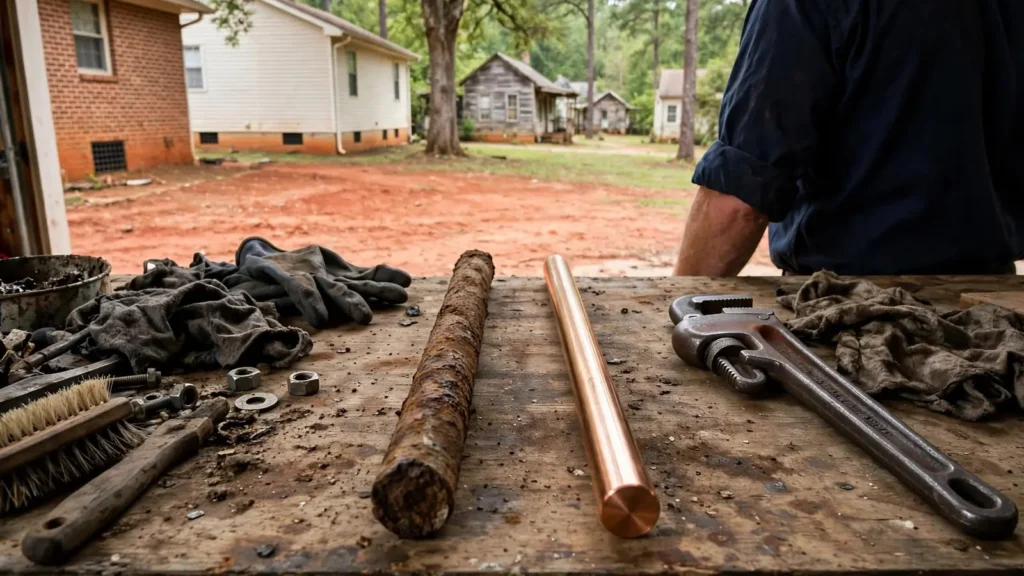
Most tank water heaters in Greenville County never get touched until they quit. A little water heater maintenance once a year won't make a tank last forever, but it pushes it toward the long end of its life, and it catches the one problem that is actually dangerous: a relief valve that no longer works.
This checklist is written for the 40 and 50 gallon gas and electric tanks most homes here have, on Greenville Water or on a well. If your heater is already leaking or not heating, skip ahead to our leaking water heater guide or no hot water guide. Maintenance is for a tank that still works.
The yearly water heater maintenance checklist
Pick one date and stick to it; the fall time change works. Here is the whole list, with how often each job makes sense on the two kinds of water we have in this county.
| Task | Greenville Water or Greer CPW | Private well | DIY or plumber |
|---|---|---|---|
| Look for drips, rust and a wet pan | Every few months | Every few months | DIY |
| Test the T&P relief valve | Once a year | Once a year | DIY, carefully |
| Drain a few gallons from the bottom | Once a year | Every 6 months, more if the water carries sand or iron | DIY |
| Full flush | Only if it rumbles or the drain runs cloudy | Once a year | DIY or plumber |
| Check the anode rod | Around year 3 to 5, then every couple of years | Around year 2 or 3, then yearly | Usually a plumber |
| Check the thermostat with a thermometer | Once a year | Once a year | DIY |
| Gas: look at the flame and the vent | Once a year | Once a year | DIY look, plumber for repairs |
| Expansion tank air charge (if you have one) | Once a year | Once a year | DIY with a tire gauge, or plumber |
How to test the T&P relief valve
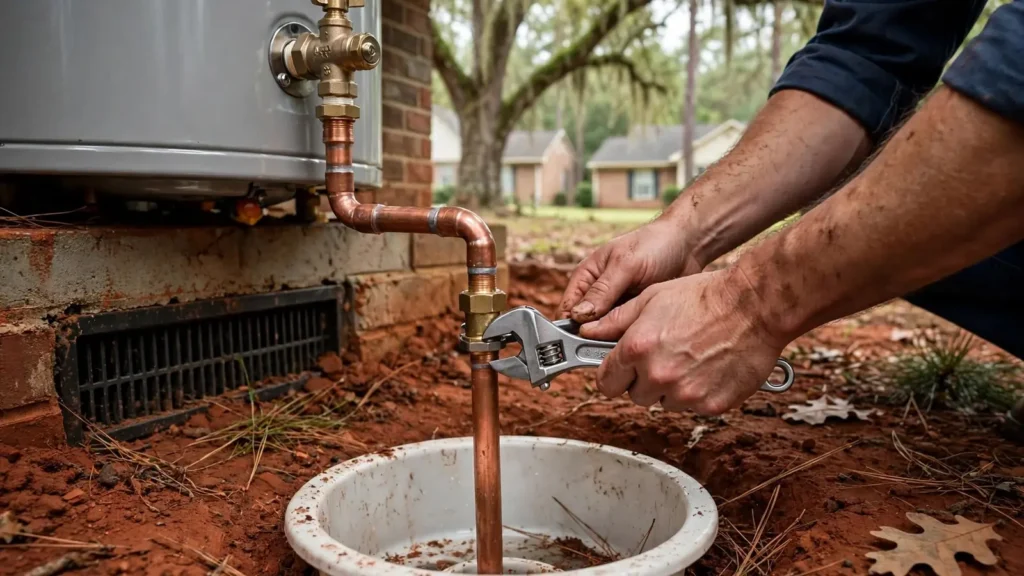
The T&P valve is the brass valve near the top of the tank with a lever and a pipe running toward the floor. If the tank gets too hot or the pressure climbs too high, it's what keeps the tank from bursting. Manufacturer maintenance schedules call for opening it by hand about once a year to make sure it still moves and still reseats.
- Put a bucket under the discharge pipe, or make sure the pipe runs to a drain or outside. The water that comes out is scalding.
- Lift the lever for a few seconds. You should hear a rush and see water flow out of the pipe.
- Let it snap back down. The flow should stop completely within a few seconds.
- Watch the pipe for the next day or two. A slow drip after the test means the seat didn't close cleanly.
If the valve drips on its own, without you touching it, that's a different issue. In a lot of newer Simpsonville, Fountain Inn and Greer homes it's a pressure problem, not a bad valve. Our post on expansion tanks and pressure-reducing valves explains why.
Flushing: how often on Greenville Water vs well water
Sediment settles on the bottom of the tank. On a gas heater it sits right on top of the burner and makes the tank pop and rumble. On an electric tank it can bury the lower element. Flushing pulls it out through the drain valve at the bottom.
On Greenville Water
Greenville Water is very soft. The utility's 2026 monthly reports show total hardness of roughly 5 to 7 mg/L, and its own scale calls anything under 17.1 mg/L soft. That means the hard white scale that wrecks tanks in other parts of the country mostly doesn't happen here. What you do get is a small amount of fine sediment and bits of corroded anode. For most homes on Greenville Water, a yearly mini-flush is plenty: hook a hose to the drain valve, open it, and run a few gallons until the water comes out clear. A full drain-down every year is overkill on soft water.
Greer CPW customers should check CPW's own water quality report, but the same logic applies to any soft surface-water supply.
On a private well
Wells vary a lot from one property to the next. Some pull fine sand or silt, some carry iron or manganese, and some have low pH water that is hard on metal. Clemson Extension's Home & Garden Information Center recommends testing a private well every year for bacteria, nitrates, total dissolved solids and pH, with extra testing if the pH is low. The SC Department of Environmental Services (formerly DHEC) tests private wells for a fee.
On a well, drain a few gallons every six months and do a full flush once a year. If the first bucket comes out orange, black or gritty, flush more often and talk to someone about a sediment filter ahead of the heater. Our Travelers Rest page covers well systems in more detail.
The mini-flush, step by step
- Turn the heater off. Electric: switch off the breaker. Gas: set the control to "pilot" or "vacation."
- Attach a garden hose to the drain valve and run it to a floor drain, the driveway or a bucket.
- Open a hot faucet somewhere in the house so the tank isn't under a vacuum.
- Open the drain valve and let it run until the water looks clear, usually a few gallons.
- Close the drain valve, take off the hose and check the valve for drips.
- Turn the power or gas back on. On an electric tank that you fully drained, make sure the tank is full first (hot faucet running without sputtering) before you flip the breaker.
Relief valve stuck or drain valve leaking? Call a local plumber
Checking the anode rod
Inside every glass-lined steel tank is a metal rod, usually magnesium or aluminum, that corrodes so the tank doesn't. When the rod is used up, the steel starts to go. That makes anode checks the best thing you can do for tank life.
How often depends on your water and your heater. Manufacturer service checklists for some A.O. Smith models call for a yearly anode inspection, and they specifically say softened water needs an annual check, because softened water eats anodes faster. On plain Greenville Water, checking around year three to five and then every couple of years is a sensible pace. On a well, start sooner.
A rod that is still mostly intact is fine. One worn down to bare steel wire for six inches or more is due. The hex nut on top is often seized, and a low ceiling may call for a flexible segmented rod, so many homeowners hand this job to a plumber.
Rotten egg smell in the hot water only? That's common on wells. Sulfate-reducing bacteria in the water react with a magnesium anode and give off hydrogen sulfide gas. Swapping to an aluminum-zinc rod or a powered anode often fixes it. If the cold water smells too, the problem is in the well, not the tank.
Setting the temperature: why 120°F
Both federal agencies that weigh in on this land in the same place. The Department of Energy's Energy Saver guidance says to set the water heater to 120°F, which it calls safe for most people, and points out it saves energy and lowers scald risk. The Consumer Product Safety Commission urges everyone to lower their water heater to 120°F, and its tap-water scald sheet spells out why. Here's how long it takes hot water to cause a third-degree burn in an adult, from that CPSC sheet:
| Water temperature | Time to a third-degree burn (adult) |
|---|---|
| 150°F | About 2 seconds |
| 140°F | About 6 seconds |
| 130°F | About 30 seconds |
| 120°F | About 5 minutes |
A few practical notes:
- Gas dials often say "hot," "warm" and "vacation" instead of degrees. Go by a thermometer at the tap, not the dial. The CPSC suggests checking first thing in the morning, or at least two hours after anyone used hot water.
- Most electric tanks have two thermostats, upper and lower, behind two panels. Both should be set to the same temperature. Turn the breaker off before you open either panel.
- If someone in the house has a weakened immune system, DOE notes some households keep the tank at 140°F to limit bacteria. If you do that, a plumber can add a mixing valve so the taps still deliver about 120°F.
- Running out of hot water? Turning the tank up without a mixing valve is the wrong fix. See our replacement and sizing guide.
Gas vs electric: what changes on the checklist
| Check | Gas tank | Electric tank |
|---|---|---|
| Burner or elements | Look through the sight glass. A steady blue flame is normal; lazy yellow flame or soot means call a plumber. | Nothing to see. A tank that heats slowly or only half the tank is hot usually means a bad element or thermostat. |
| Venting | Make sure the vent pipe on top is attached, sloped up and not rusted through. Scorch marks at the draft hood are a warning sign. | None |
| Clearance | Keep gasoline, paint thinner, mops and laundry away from the base. The burner can ignite vapors. | Keep the access panels clear so a plumber can get to them. |
| Sediment | Rumbling and popping is common and gets louder as sediment builds. | Sediment can bury and burn out the lower element. |
Put a carbon monoxide alarm near any gas appliance. Tankless units have their own routine (mostly descaling and inlet filters), covered in our tankless guide. If you're weighing a fuel switch at replacement time, our post on gas vs electric water heaters in Greenville runs the operating-cost math.
What a homeowner should not do
Most of this is safe for a careful homeowner. These are the exceptions.
- Don't cap, plug or remove the T&P valve or its pipe, even if it drips. A drip is a symptom. Find the cause.
- Don't turn an electric heater back on before the tank is full. An element that fires in air burns out in seconds.
- Don't take the anode out "to stop the smell" and leave it out. The tank will rust through, and it can void the warranty.
- Don't do gas work yourself: the gas connector, the gas valve, the burner assembly or the vent. In South Carolina that's licensed work, and a mistake there can kill someone. Our guide to checking a plumber's license in SC shows how to confirm whoever you hire.
- Don't crank the drain valve open on an older tank with a plastic valve and walk away. Some won't close again.
- Don't ignore a wet drain pan. A slow tank leak usually starts small, and it means the tank is done. Our repair or replace guide helps with the decision.
Want a plumber to check the anode and relief valve? Call a local plumber
Water heater maintenance questions
How long does it take to flush a water heater?
A mini-flush, draining a few gallons until the water runs clear, takes about 15 minutes. A full drain and refill on a 50-gallon tank can take an hour or more, mostly waiting on the tank to empty and then reheat.
Should I flush an old tank that has never been flushed?
Be careful with tanks over about ten years old. Opening a drain valve that hasn't moved in a decade can leave you with a valve that won't close, and stirring up years of sediment can clog it. Have a plumber look at the tank's age and condition first.
Can I check the anode rod myself?
Yes, if you have a large socket, a breaker bar and enough ceiling height to pull the rod straight up. Turn off the heater and the cold supply and relieve the pressure first. If the nut won't budge, stop before you damage the tank fitting and call a plumber.
Should I turn the water heater down when I go on vacation?
For a week or more, yes. Set a gas heater to "vacation" or switch off an electric heater's breaker. It saves standby energy and it's one less thing running while you're away. Turn it back on a few hours before you get home.
Sources
- U.S. Consumer Product Safety Commission, "Avoiding Tap Water Scalds," Publication 5098.
- U.S. Department of Energy, Energy Saver guide (2022) and FEMP Home Energy Checklist and residential water heater purchasing guidance (120°F setting; 140°F with mixing valve option).
- Greenville Water, Finished Water Quality Reports, April and May 2026 (total hardness and hardness scale).
- Clemson Cooperative Extension HGIC, "Residential Drinking Water Wells: Water Quality" and "Testing Drinking Water" factsheets.
- A.O. Smith water heater service and maintenance checklists (T&P valve operation, anode inspection, softened water note), as reproduced in manufacturer maintenance documentation.
- ENERGY STAR, Heat Pump Water Heaters product page (filter maintenance).