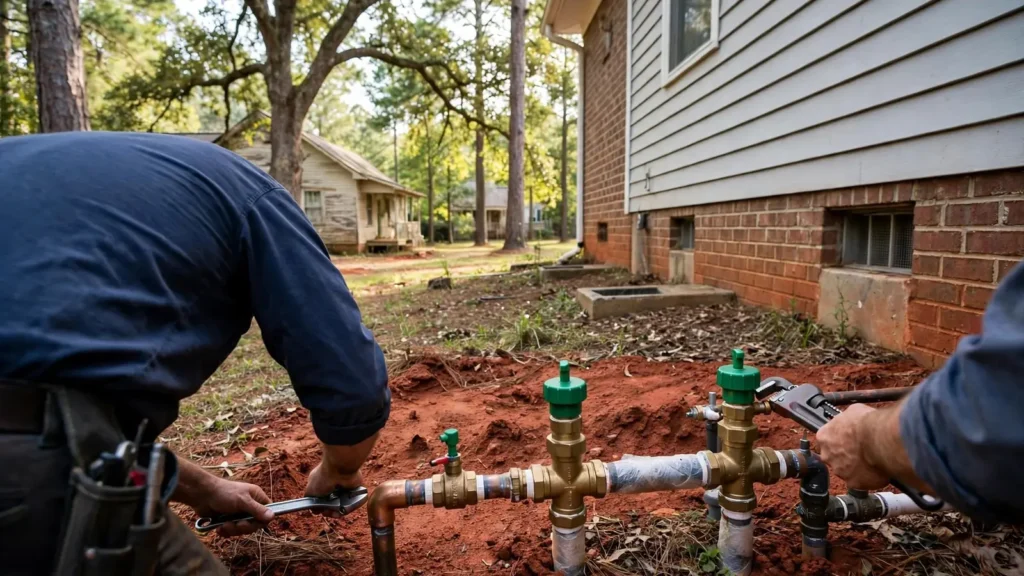
Most people find out about backflow testing in Greenville, SC the same way: a letter from Greenville Water arrives with a due date, a device ID and a warning about fees.
It didn't. Greenville Water has run a cross-connection control program since 1968, and its current manual says it has required backflow prevention on all service connections since 1971. What has changed is how it treats ordinary houses with lawn sprinklers. We read the utility's Cross Connection Control Manual (adopted September 2022), and the answer for a typical Five Forks or Taylors house isn't what most people assume.
What backflow is, and why a sprinkler system counts
Backflow is water running the wrong way, from your property back into the public main. Back-siphonage is suction: a main breaks or fire trucks pull hard from a hydrant, street pressure drops, and water in your pipes gets pulled backward. Backpressure is the reverse, when a pump or pressurized tank on your side pushes harder than the city supply.
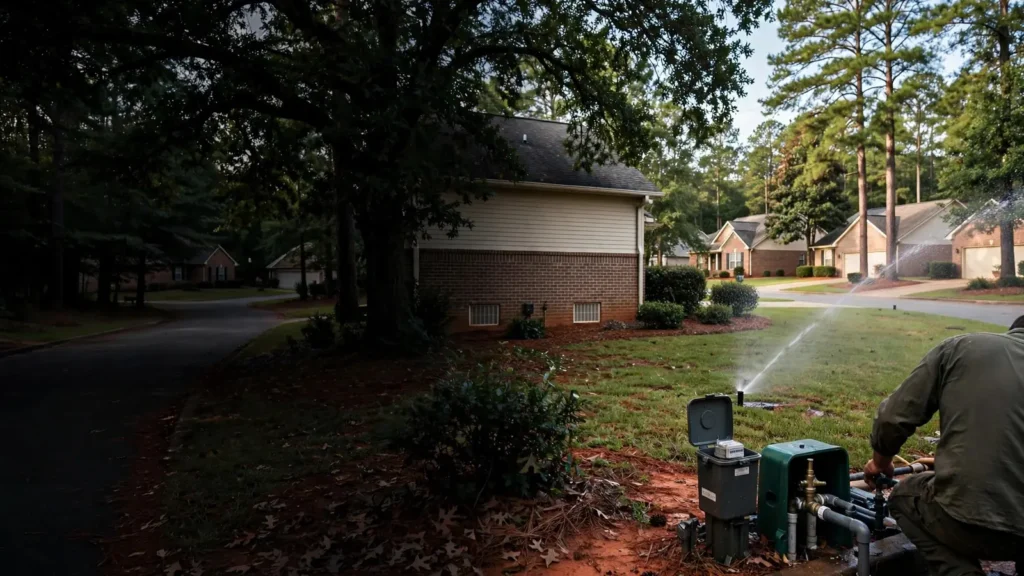
A lawn irrigation system is a textbook cross-connection. The heads sit in wet soil with fertilizer, pesticide, pet waste and puddled water around them. If pressure drops at the wrong moment, whatever is around those heads can get drawn into the pipe. Greenville Water's manual lists irrigation systems right alongside fire sprinkler systems, auxiliary water supplies and industrial processes as cross-connections the customer has to control.
Backflow testing in Greenville, SC: what Greenville Water requires
The manual puts the duty on the customer: you install, maintain and test whatever assembly Greenville Water requires, at your own cost. One line surprises people. The customer is responsible "even if the customer does not own the water system beyond the service connection," which matters for renters and HOAs.
| Your situation | What's usually there | Testing under Greenville Water's manual |
|---|---|---|
| Commercial, industrial or high-hazard connection | Reduced pressure principle assembly (RP or RPZ) or an air gap | At installation, then at least once a year |
| Low-hazard connection, including many fire sprinkler lines | Double check valve assembly (DCVA) | At installation, then at least once a year |
| New residential irrigation meter | Dual check valve built into the meter setter | Not testable. Greenville Water replaces the internal parts once every 30 years |
| Older residential irrigation with a DCVA | A testable double check in a box near the meter | Being phased out. If not swapped for a dual check within 15 years of the policy's effective date, it must be tested then and every 15 years after |
| Any new testable assembly | RP or DCVA | Tested before use; the report must reach Greenville Water within 10 days of starting service |
So if you own a single-family home with a sprinkler system on its own Greenville Water irrigation meter, there's a decent chance you have no yearly utility test at all. If you're getting annual letters, your account has a testable assembly that the utility tracks, and the letters are not optional.
How the notice timeline works
- The first letter goes to the mailing address on the account about 45 days before the test due date.
- You hire a certified tester. Greenville Water doesn't install or test devices itself.
- The tester uploads the result to Greenville Water's Backflow Test Result Portal. You don't mail anything in.
- A 15-day grace period follows the due date, to allow for a passing test or a replacement device and passing test.
- The third notice goes out 15 days after the due date. At that point Greenville Water hires a third-party vendor to test the device, charges a one-time $500 non-compliance fee, and adds the cost of any needed repairs to your account.
- Service can be shut off. Customers who haven't returned a test within the 60-day window are considered out of compliance, and the manual allows discontinuing water service.
Who can test, and what to ask them
Only a state-certified tester can do the test. South Carolina's drinking water rules (R.61-58) make the state the certifying agency, which today means SC DES, the Department of Environmental Services that took over DHEC's environmental programs in July 2024. Greenville Water's manual defines a certified tester as someone who passed the state course and holds a current tester card and approved test equipment. The state also expects test gauges to be calibrated every year.
Plenty of local plumbing companies and irrigation contractors carry the certification. Before you book, ask three things:
- Is your SC tester certification current, and can you send me a photo of the card?
- Will you upload the result to Greenville Water's portal yourself, the same day?
- If it fails, can you repair it on the spot, and what does a retest cost?
Licensing for any repair work beyond the test is a separate question. Our guide to checking a plumber's license in SC walks through the LLR lookup.
Got a backflow test letter? Call a local plumber
RPZ, PVB, DCVA or dual check: what's in your yard
Open the green lid or walk around the side of the house and you'll usually find one of these. Knowing which one you have tells you how worried to be about freezes and whether a test is even possible.
| Device | What it looks like | Where you'll see it | Testable? |
|---|---|---|---|
| Dual check | Nothing visible; it's inside the meter setter | New Greenville Water irrigation meters | No |
| Double check valve assembly (DCVA) | Brass or bronze body with two shutoff valves and four small test cocks, usually in a box | Older irrigation, fire lines, low-hazard commercial | Yes |
| Pressure vacuum breaker (PVB) | Above ground, with a bonnet on top, two test cocks and two ball valves, often by the foundation | Common on irrigation systems where the plumbing code calls for one | Yes |
| Reduced pressure assembly (RP or RPZ) | Longer body with a relief port underneath that can spit water | High-hazard connections, irrigation with chemical injection | Yes |
A PVB has to sit higher than every sprinkler head and pipe downstream of it, usually by at least 12 inches, because it works by letting air in when pressure drops. That's why they stick up out of the shrub bed.
The plumbing code has its own irrigation backflow rules, separate from the utility's. The International Plumbing Code, which South Carolina's plumbing code is built on, has long called for testable assemblies to be tested at installation, after repair, and yearly. If you're adding a system or moving a PVB, ask the permit office for your area.
The side effect nobody mentions: thermal expansion
With a backflow device at your meter, your house is a "closed system." When the water heater warms a tank of cold water, the water expands with nowhere to go, pressure climbs, and the temperature and pressure relief valve on the heater may start dripping. Greenville Water's manual says this directly and lists three fixes: a bladder-type expansion tank, a special toilet fill valve with relief, or a thermal expansion relief valve. If your heater's relief valve drips after a backflow or meter change, read our page on a leaking water heater before you replace anything.
Greer CPW and other water systems
Greer CPW is its own utility with its own rules. It sells separate irrigation taps (its new construction fee table lists 3/4-inch, 1-inch and larger irrigation services), but we couldn't find a published residential backflow test schedule on its website. If your water bill comes from Greer CPW, don't assume the Greenville Water rules above apply. Call Greer CPW at (864) 848-5500 and ask what device your account has and whether it's on a test cycle. Our Greer plumbing guide covers how to tell which utility serves your house.
If you're adding sprinklers: the irrigation meter rules
Greenville Water's irrigation meter policy is worth reading before anyone quotes you a sprinkler system. A separate irrigation meter is billed for water only, with no sewer charge, which adds up over a hot summer. New systems on that meter need a rain sensor and an EPA WaterSense labeled weather-based controller. A split off your existing service line avoids the capacity fee, and Greenville Water's 2026 development fee schedule lists a 5/8-inch irrigation split installation fee of $1,015. Irrigation systems also fall under the utility's drought response plan, so watering limits can apply in a bad year.
Lawn irrigation is everywhere in the newer subdivisions around Simpsonville and Five Forks, which is why our Simpsonville page covers it too.
Protecting a backflow device from Upstate freezes
Above-ground PVBs and RPZs freeze. The brass body or the plastic bonnet cracks on the first night in the teens, and you don't find out until you turn the system on in April and water sprays out of the top. Greenville Water's manual requires testable assemblies to be in an enclosure or building to prevent freeze damage, but a lot of residential PVBs sit out in the open.
Manufacturers publish winterizing steps for each model, and you should follow yours. The usual routine for a PVB looks like this:
- Shut off the irrigation supply at the valve upstream of the device, often in the basement, crawlspace or meter box.
- Open the test cocks with a flat screwdriver to let water drain out of the body.
- Set the two ball valves halfway, at about 45 degrees, so water isn't trapped in the ball.
- Drain or blow out the zones if your system calls for it. Most Upstate systems are drained, not blown out, but ask whoever installed it.
- Cover it with an insulated bag or box made for backflow devices. Don't wrap it in plastic that traps moisture.
In spring, reverse it: close the test cocks, turn the ball valves fully open, then open the supply slowly. Slamming a valve open can crack a weak bonnet. The full startup routine is in our spring plumbing checklist, and the general freeze advice is on our frozen pipes page.
What happens when a backflow test fails
Failures are common and usually fixable: grit on a check seat, a worn rubber disc or a tired spring. A tester can often rebuild the assembly with a manufacturer's repair kit and retest the same day. Greenville Water's manual wants the failed report sent in the same day if parts are on order, and the passing retest sent in the same day as the repair.
If the device is old, cracked from freezing, or no longer on the approved list, replacement may be the better call. Any replacement has to meet the current manual, and the manual suggests calling the Cross Connection Control office before buying one. For prices, our Greenville plumber cost guide has the ranges we could source; testers set their own fees, so ask for the test, repair and retest prices up front.
Backflow failed its test? Call a local plumber
Backflow testing questions
I rent. Who has to pay for the backflow test?
Greenville Water bills the customer on the account tied to the device, and its manual says that customer is responsible even if they don't own the plumbing. Between you and your landlord, the lease decides who ultimately pays. Read it, then ask the landlord in writing.
Can I test my own backflow preventer?
Not for a result Greenville Water will accept. The test has to be done by a state-certified tester with calibrated equipment, and the tester uploads it to the utility's portal.
Does the dual check valve in my meter need testing?
No. The dual check in a Greenville Water irrigation meter setter isn't testable. The utility says it replaces the internal parts once every 30 years.
What happens if I ignore the Greenville Water backflow letter?
After the 15-day grace period, Greenville Water sends a third notice, hires a vendor to test the device, charges a $500 non-compliance fee and adds any repair costs to your bill. Water service can be shut off if it stays out of compliance.
Why does my RPZ keep dumping water?
Sometimes it's a fouled check valve and the device needs service. Sometimes it's pressure swings in the supply; Greenville Water's manual suggests an extra check valve ahead of the assembly when the relief valve discharges often. A certified tester can tell which.
Sources
- Greenville Water (Commissioners of Public Works of the City of Greenville), Cross Connection Control Manual, adopted September 6, 2022 (file dated November 2025): sections 2-4, 4-3, 5-1 to 5-5, 7-1 to 7-5, and 8.
- Greenville Water, Overview of Backflow Prevention page (annual testing, Backflow Test Result Portal, contact details), accessed October 2026.
- Greenville Water, Irrigation Meter Policy (2022 revision) and Updated Development Fees and Charges effective January 1, 2026.
- SC Department of Environmental Services, Cross Connection Control and Backflow Prevention program; State Primary Drinking Water Regulation R.61-58.7(F); tester recertification study guide (2023).
- Greer Commission of Public Works, Water and New Construction pages (irrigation tap fees) and FAQ, accessed October 2026.
- International Code Council, International Plumbing Code, Section 312.10 (testing of backflow assemblies) and Section 608 (backflow protection).
- Manufacturer winterizing instructions for pressure vacuum breakers and reduced pressure assemblies (Watts/Febco).