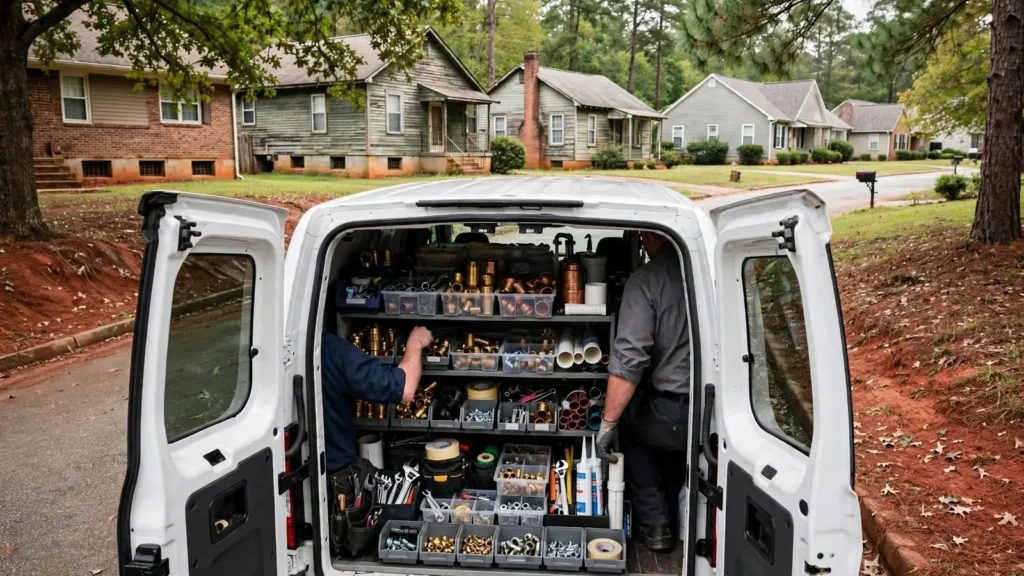
Replacing a kitchen faucet looks like the easiest plumbing job in the house. The new faucet comes with instructions, two hoses and a few nuts. And on a newer house with good valves under the sink, it often is that easy. The part nobody puts on the box is what you find under the sink once you're lying on your back with a flashlight in your mouth: valves that won't close, nuts fused to the old faucet by 20 years of drips, and a dishwasher line and garbage disposal in the way.
This is an honest look at when to replace a kitchen faucet yourself and when to hand it off, what to buy, and how the job goes, step by step.
Before you replace a kitchen faucet: the five-minute check
Empty the cabinet under the sink, grab a flashlight, and look at these. Your answers decide whether this is a DIY job.
| What to check | Good sign for DIY | Sign you'll want a plumber |
|---|---|---|
| Shutoff valves (the two small valves on the hot and cold lines) | Quarter-turn levers, or round handles that turn and close fully | Handles that won't turn, valves that drip at the stem, green or white crust, or no valves at all |
| Pipe coming out of the wall | Copper, PEX (colored plastic) or CPVC | Gray galvanized steel, especially with rust at the threads |
| The old faucet's mounting nuts | Plastic nuts, or metal nuts with little corrosion | Nuts buried in rust or mineral crust |
| Supply lines to the faucet | Flexible braided lines | Rigid chrome or copper tubes soldered or bent in place |
| Space under the sink | Room to reach the faucet's underside | A garbage disposal, deep basin or filter system blocking the way |
| Holes in the sink or counter | The number of holes matches the faucet you want | You want fewer or different holes in a stone counter |
Old shutoff valves: the most common reason to call a plumber
The little valves under the sink are called angle stops. In many Greenville County homes they haven't been touched since the house was built. Older ones are multi-turn compression valves with a rubber washer inside, and that washer hardens and stops sealing. Turning a valve like that for the first time in 20 years can do three things: nothing (it won't close), a slow drip that never fully stops, or a leak at the stem that wasn't there before.
Try each valve before you start. Close it, then open the faucet. If water still runs or the valve leaks at the handle, don't keep cranking on it. You have two options: shut off the main and replace the valves yourself (which means cutting or unthreading them, and on copper may mean soldering or a push-to-connect fitting), or have a plumber do it. Replacing both stops while the faucet is out is cheap insurance, and it's one of the most common add-ons to a faucet job.
Know where your main shut-off is before you start in either case. Our burst pipe guide shows where it usually is in Greenville-area homes.
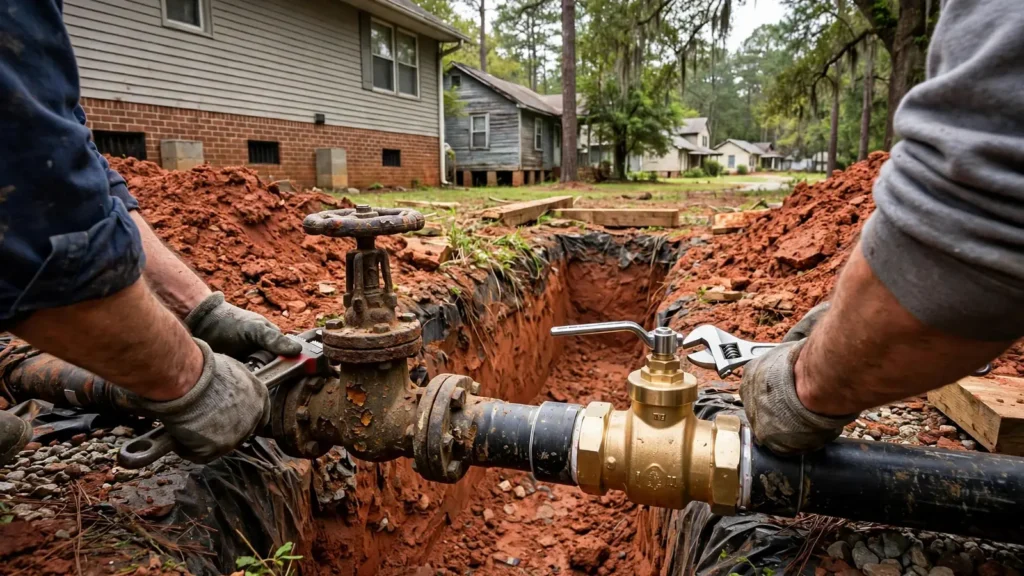
Tools and parts you'll need
- A basin wrench. This long-handled tool with a swiveling jaw reaches the nuts up behind the sink where a regular wrench can't. It's the one tool that makes this job possible for most people.
- An adjustable wrench and a pair of channel-lock pliers.
- A bucket, towels and a flashlight or headlamp.
- Penetrating oil, for corroded nuts. Spray them the night before.
- A hacksaw blade or an oscillating multi-tool, for nuts that won't move at all.
- Plumber's putty or silicone if your faucet's instructions call for it. Many newer faucets use a rubber gasket under the base and need neither.
- New supply lines if your faucet doesn't come with them attached. Measure the distance from the valve to the faucet and buy braided lines with the right end sizes; most stops take 3/8-inch compression.
- A cleaner and scraper for the old faucet's footprint on the sink.
How the job goes, step by step
- Clear the cabinet, turn off both stops, and open the faucet to relieve pressure.
- Disconnect the supply lines at the valves, with a bucket under them.
- Disconnect the sprayer, if there's a separate side spray, and any pull-down hose quick-connect under the sink.
- Remove the mounting nuts holding the old faucet to the sink, using the basin wrench. This is the step that takes five minutes or two hours.
- Lift out the old faucet and clean the sink surface. Old putty and mineral crust come off with a plastic scraper.
- Install the new faucet per its instructions: gasket or deck plate, faucet body, mounting hardware from below. Many new faucets mount with one large nut or a bracket you tighten from the top.
- Connect the pull-down or pull-out hose, and clip the hose weight where the instructions show. A weight in the wrong spot is why sprayers don't retract.
- Connect the supply lines to the stops, hand-tight plus a quarter turn.
- Remove the aerator, open the stops slowly and run water for a minute to flush debris. Then put the aerator back.
- Check every connection with a dry paper towel. Check again an hour later and the next morning.
If you have a refrigerator ice maker line teed off the cold stop, or an old saddle valve on the pipe, this is a good moment to fix it. Our guide to ice maker water line leaks explains why saddle valves are worth replacing.
How long it takes
A realistic estimate:
- Newer home, good valves, plastic mounting nuts, first-timer: about one to two hours, including a trip back to the store for the part you didn't know you needed.
- Older home, corroded nuts, cramped cabinet: half a day, sometimes more.
- Valves that need replacing: add an hour or more, and the house water is off for that time.
A plumber who does these regularly is often done in an hour or two, valves included. That's the trade-off: your afternoon versus a service call.
Valves under the sink won't shut off? Call a local plumber
What to buy: pull-down, pull-out and the rest
Pull-down vs pull-out
| Style | How it works | Best for |
|---|---|---|
| Pull-down | Tall, high-arc spout; the spray head pulls straight down into the sink | Deep single-bowl sinks and filling big pots. Needs clearance under a window or cabinet. |
| Pull-out | Lower spout; the wand pulls out toward you | Shallow sinks, low windows, and reaching outside the sink to fill a bucket |
| Standard spout with side sprayer | Fixed spout, separate sprayer in its own hole | Replacing like for like on a four-hole sink. Side sprayers are a common leak point. |
| Touchless | A sensor turns water on and off; runs on batteries or a plug | Cooks who want it. More parts to fail, and you need power under the sink for some models. |
Match the holes
Kitchen sinks have one to four holes. Most new faucets mount through one hole and come with a deck plate that covers three. A fourth hole can hold a soap dispenser, a filtered water faucet or a dishwasher air gap. With an undermount sink in a granite or quartz counter, the holes are drilled in the stone, and adding or changing holes is a countertop job, not a plumbing one.
WaterSense and flow rate
Here's something most faucet listings won't tell you: EPA's WaterSense program does not label kitchen faucets at all. Its label covers bathroom sink faucets, which must use no more than 1.5 gallons per minute, and EPA says it has no criteria for other faucet types. The federal maximum for any faucet is 2.2 gallons per minute at 60 psi. Many kitchen faucets are sold at 1.5 to 1.8 gpm anyway. Keep in mind that a lower flow doesn't save water when you're filling a pot; it just takes longer. It saves water when you rinse dishes with the tap running.
Lead-free, and why an old faucet is worth replacing
Since 2014, federal law has limited new faucets and fittings to a weighted average of 0.25% lead on surfaces that touch water. Older brass faucets weren't held to that limit and can still release small amounts of lead. Greenville Water reports no lead service lines in its system, so in an older house the faucet and fittings are part of what's left to think about. Look for a faucet certified to NSF/ANSI 61 and 372, which most brands sold in stores are.
Other buying advice
- Pick a brand that sells replacement cartridges and parts at local stores. A faucet you can rebuild in 10 years beats one you have to throw away.
- Look for ceramic disc cartridges and a lifetime warranty on drips.
- Check whether supply lines come attached. Attached lines are easier but sometimes too short.
- Don't buy the faucet the day you remove the old one. Do the under-sink check first, so you know what valves and lines you'll need.
Do you need a permit?
Greenville County's permit guidance ties plumbing permits to new fixtures or relocating fixtures. A straight swap in the same spot isn't listed, and in practice homeowners rarely pull a permit for one. We couldn't find county text that explicitly exempts it, though, and cities in the county run their own permit offices. If you're moving the sink, adding a fixture, or doing the faucet as part of a remodel, check with Greenville County Building Safety or your city first.
If you hire it out
Published ranges for faucet replacement in Greer and Greenville run about $127 to $510, with about $250 typical, according to the sources on our plumber cost guide. Replacing the shutoff valves, swapping a saddle valve, or fixing a leaking drain trap at the same visit costs more but usually less than a second trip. Two money-savers:
- Buy the faucet yourself if the plumber is fine installing customer-supplied fixtures. Ask first; some won't warranty a part they didn't supply.
- Bundle small jobs, like a running toilet or a dripping tub spout, into the same visit.
Ask for the price in writing before work starts, and make sure whoever comes out holds a South Carolina license. Our guides to choosing a plumber and checking a plumber's license cover both.
After the install: what to watch
Leave a dry paper towel on the cabinet floor under the sink for a few days. A drip from a compression fitting often doesn't show up until the line has been under pressure for a while. If the cabinet floor ever looks swollen or stained, or you smell mustiness under the sink, check the connections again; our leak detection guide covers what to do if you can't find the source.
Rather not wrestle the old faucet off? Call a local plumber
Kitchen faucet questions
Can I replace a kitchen faucet without turning off the main water?
Yes, if both shutoff valves under the sink close fully. Test them first by closing them and opening the faucet. If water still flows, you'll need the main off, or the valves replaced.
What is a basin wrench, and do I really need one?
It's a long tool with a swiveling jaw that grips the nuts behind the sink bowl. Most people can't reach those nuts without one. It's inexpensive and worth buying for this job.
Should I get a pull-down or pull-out kitchen faucet?
Pull-down suits a deep single bowl and tall pots, if you have clearance above the sink. Pull-out suits shallow sinks, low windows, and reaching outside the sink. Measure your clearance before deciding.
Are WaterSense kitchen faucets worth paying more for?
There's no such thing yet. EPA's WaterSense label covers bathroom faucets, not kitchen faucets. A kitchen faucet rated at 1.5 to 1.8 gpm saves some water on rinsing, but it won't fill a pot any faster.
What do I do with the extra hole from my old side sprayer?
Cover it with the faucet's deck plate if it lines up, or use it for a soap dispenser, filtered water faucet, or a cover cap made for sink holes.
Sources
- U.S. EPA WaterSense, Bathroom Faucets page (1.5 gpm maximum for labeled bathroom faucets; 2.2 gpm standard; no criteria for kitchen or other faucet types), checked Oct 2026.
- U.S. Department of Energy, faucet water conservation standard (2.2 gpm at 60 psi), 10 CFR Part 430.
- Reduction of Lead in Drinking Water Act (Public Law 111-380), effective January 4, 2014 (0.25% weighted average lead limit).
- Greenville Water, service line inventory and lead information, as summarized on the GVL Plumbers older homes page.
- Greenville County, Answer Book: Permits (plumbing permits for new or relocated fixtures), checked Oct 2026.
- Today's Homeowner (Greer, SC, Feb 2025) and This Old House faucet replacement costs, via GVL Plumbers plumber cost guide.