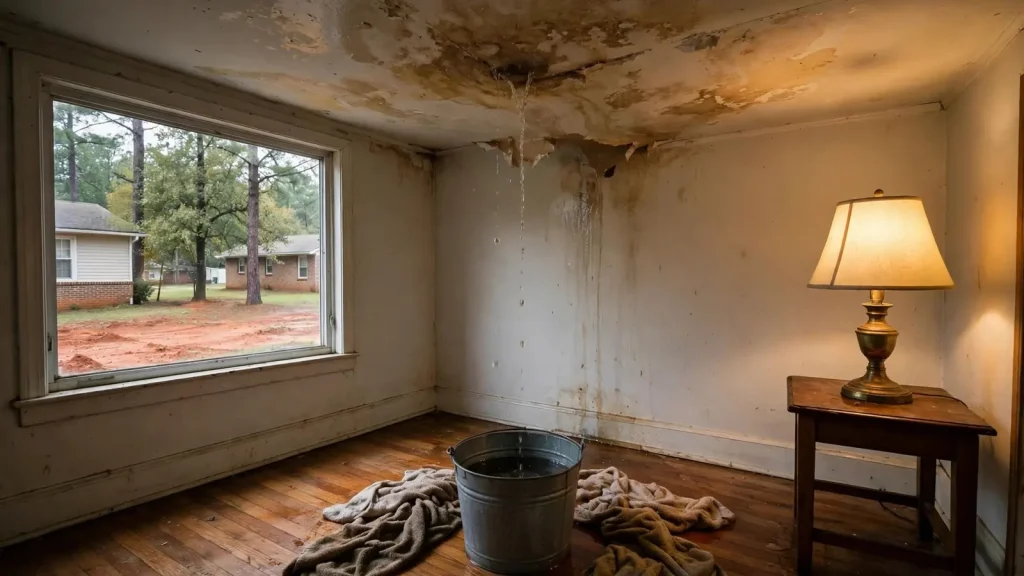
Washing machine hoses are the plumbing nobody thinks about. They sit behind the machine for years, under constant water pressure, and most people only look at them the day they move the washer. State Farm says a washer hose holds about 70 pounds of pressure, and that a failed one can put out an average of 650 gallons of water an hour. Be away for a weekend and that's close to 31,000 gallons in the house.
State Farm paid nearly $30 million on homeowner claims for washing machine hose failures in 2020, with an average claim of $10,200. Georgia topped its list of states by claims paid, at $10 million, so this isn't a problem that skips the Southeast. The fix is cheap: a pair of good hoses and 20 minutes.
Washing machine hose replacement: how often
Two published guidelines line up closely:
- Whirlpool's product help says to replace inlet hoses after five years of use to reduce the risk of hose failure, and to replace them sooner if you see bulges, kinks, cuts, wear or leaks.
- State Farm recommends replacing supply hoses every three to five years and doing a monthly check of the hot and cold lines for cracks, bulges and wet spots.
We'd use five years as the outer limit, not the target. Whirlpool also suggests writing the replacement date on the hose label with a permanent marker. That one habit solves the most common problem, which is that nobody remembers when the hoses were last changed. If you bought a resale home and don't know, assume they're due.
Inspect them whenever the washer is pulled out, and look closely in three spots: the crimped metal collar at each end (where most failures start), any spot where the hose bends sharply against the wall, and the rubber surface for cracking or a bulge like a small balloon. A bulge means the inner wall is already failing.
Rubber vs braided hoses
| Hose type | What it is | Our take |
|---|---|---|
| Plain black rubber | Reinforced rubber, often what comes in the box with a new washer | Replace with braided. Cheap, but the rubber hardens and cracks with age and heat. |
| Stainless steel braided | Rubber or PVC inner tube wrapped in a woven steel jacket | The standard upgrade. Resists bursting and kinking. The inner tube still ages, so replace on schedule. |
| Nylon or polymer braided | Similar inner tube with a synthetic braid | Fine if it's from a reputable maker. Whirlpool sells this type. |
| Hoses with a built-in flood stop | Braided hose with a valve at the faucet end that closes if flow suddenly spikes | Good extra protection against a full rupture. It won't catch a slow drip. |
Two buying tips. Get a length that reaches without stretching but doesn't need a big loop behind the machine; 4 to 6 feet covers most setups. And buy hoses with 90-degree elbows at the wall end if the washer sits close to the wall, so the hose doesn't kink right at the valve.
How to replace washer hoses yourself
- Unplug the washer and pull it out far enough to reach the valves. If it's gas or a stacked unit, have a second person help.
- Close both supply valves in the wall box. Lever valves turn a quarter turn; round handles turn clockwise.
- Put a towel and a bucket down, then unscrew each hose at the wall first, then at the washer. Some water will spill.
- Check the washer's inlet screens while the hoses are off. A clogged screen slows filling.
- Use the new rubber washers that come with the new hoses. Old ones can stick inside the fitting, so pick them out before you thread the new hose on.
- Hand-tighten, then snug a quarter turn more with pliers. Overtightening crushes the washer and causes drips.
- Turn the water on slowly and check every connection for a few minutes before you push the machine back.
- Write the date on the hose or on a strip of tape on the wall box.
Second-floor laundry rooms in newer homes
Much of Greenville County's housing is new. Census figures put about 87% of Simpsonville's homes at 1990 or later and about 38% of Fountain Inn's at 2010 or later, and many two-story plans from those years put the laundry upstairs, next to the bedrooms. It's convenient, but it changes the stakes. A hose that fails in a basement or garage soaks a concrete floor. One that fails upstairs runs through the subfloor, the ceiling drywall below, the insulation and often the light fixtures, and it can reach two floors before anyone notices. State Farm's advice is to put the washer on the ground floor or in a basement where possible. In many newer homes around Simpsonville and Five Forks and Fountain Inn, that isn't an option, so the answer is better protection.
Drain pans
A washer pan is a shallow plastic or metal tray under the machine. The type matters:
- A pan with a drain outlet, piped to a floor drain, a standpipe or outside can carry away a real leak. This is the one worth having upstairs.
- A pan with no drain only holds a few gallons. It catches drips and slow leaks, which is still useful, but a burst hose will overflow it in minutes.
We couldn't find a Greenville County rule that requires a washer pan in a house, so many builders leave them out. Adding a drained pan after the fact usually means pulling the washer, and sometimes opening the wall or floor to run the drain line, which is plumber work. If yours has a pan, check that the drain outlet is clear; lint and dust clog them.
Automatic shutoff valves and leak sensors
These range from a $20 alarm to a whole-house system:
| Device | What it does | Good for |
|---|---|---|
| Battery leak alarm | Sits on the floor and beeps (some send a phone alert) when it gets wet | Cheap early warning. Does nothing if nobody is home to hear it. |
| Washer shutoff valve with floor sensor | Motorized valves on the washer box close when the sensor gets wet | Second-floor laundry. Stops the water without anyone home. |
| Washer valve tied to the washer's power draw | Opens the valves only while the washer is running | Takes hose pressure off when the machine is idle |
| Whole-house shutoff on the main | Watches flow and closes the main on a leak or wet sensor | Covers the washer, ice maker, water heater and every other fixture |
If you do nothing else, State Farm's advice is free: turn the washer valves off when you'll be away for several days. Whirlpool's vacation guidance says the same thing.
Want a pan or shutoff valve under your washer? Call a local plumber
Don't forget the drain hose
Supply hoses get the attention, but laundry floods also come from the drain side. Watch for these:
- The drain hose slipping out of the standpipe during the spin cycle. Secure it to the standpipe with a strap, but don't seal it in tight; it needs an air gap.
- A standpipe that overflows during the drain cycle. That usually means a partial clog in the laundry drain from lint, which a plumber can clear. If the toilet or tub gurgles at the same time, the problem may be further down the line. Our post on a toilet that keeps clogging covers how to tell.
- Water around the base of the wall box, which can be a leak at the valves or the drain connection inside the wall.
What to do if a washer hose bursts
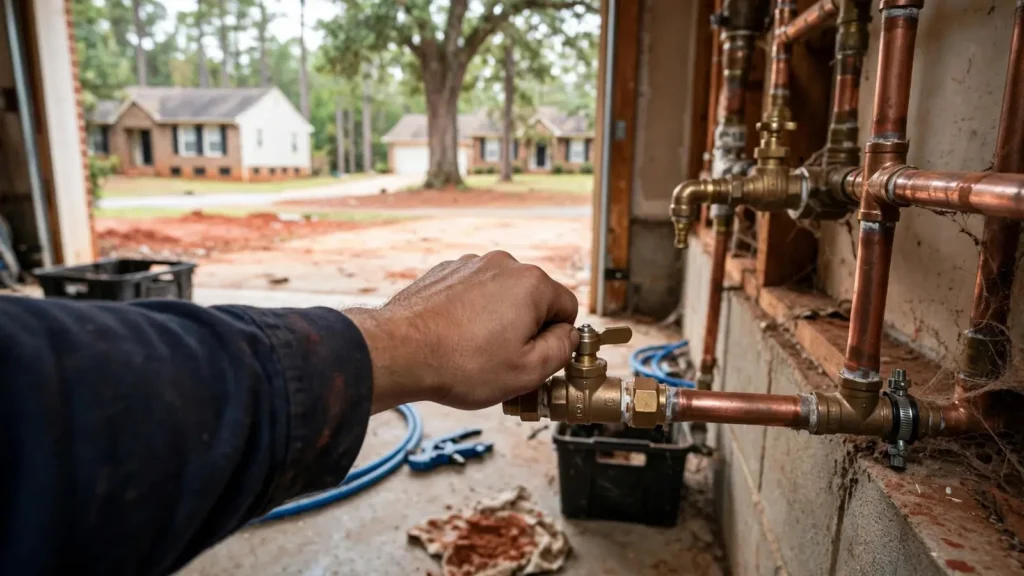
- Stay out of standing water near outlets and the machine. If you can reach the breaker panel safely, cut power to the laundry room.
- Close the washer valves. If you can't reach them or they won't turn, shut the main water valve. Our burst pipe guide shows where it usually is in Greenville-area homes.
- Check the ceiling below. If it's sagging or bulging with water, keep people and pets out from under it.
- Photograph everything before you clean up: the hose, the floor, the ceiling below, damaged belongings. Keep the failed hose; your insurer may want it.
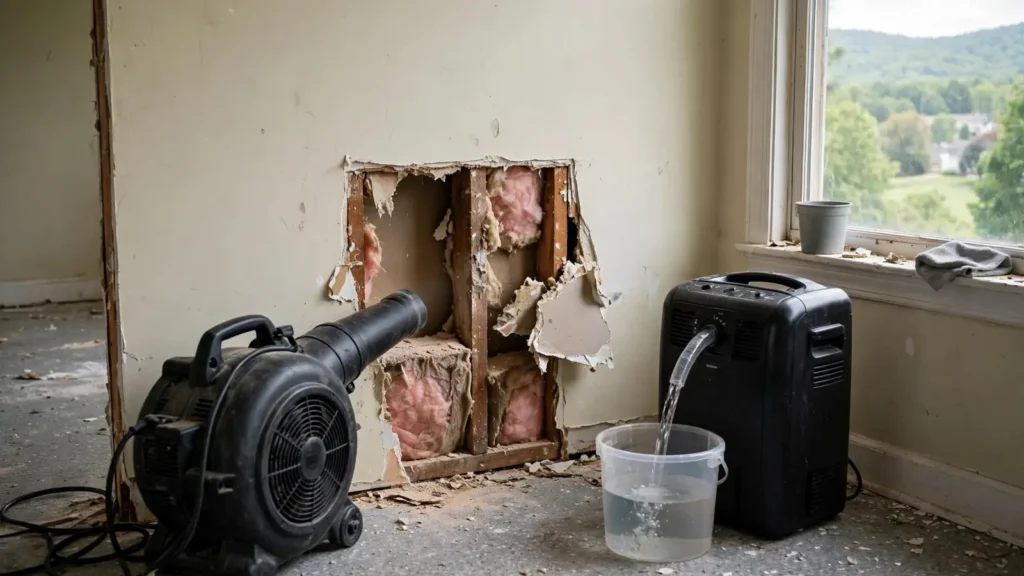
- Start drying fast. Fans and dehumidifiers within the first day or two make a big difference, and wet drywall and insulation often have to be cut out. The drying section of our burst pipe guide covers this.
- Call your insurer and a plumber to replace the hoses and check the valves.
If water is still coming in and you can't stop it, that's an emergency. Our emergency plumber page lists what to do while you wait.
What the water itself costs
The water bill is the smallest part of a hose failure, but it's still worth knowing. At State Farm's 650 gallons an hour, a hose that fails at 8 a.m. and runs until 5 p.m. sends out about 5,850 gallons. Outside City of Greenville limits, Greenville Water's 2026 volume charge is $2.68 per 1,000 gallons, and MetroConnects' 2026 sewer volume charge is $2.32, so that's about $29 before ReWa's treatment charge. A weekend's 31,000 gallons comes to about $155 on the same rates. The damage to floors, drywall and the room below is what costs thousands.
Some utilities will adjust a bill after a sudden, repaired leak. Ask Greenville Water (or Greer CPW, if you're on it) what it needs, and keep the plumber's invoice. Our leak detection guide explains how to read your meter to confirm everything is dry afterward.
The other hoses on the same schedule
While you're writing dates on washer hoses, do the same for the dishwasher supply line, the toilet supply lines, and the line behind the refrigerator. Ice maker lines fail the same way and often under hardwood or a slab, where they do slow damage nobody sees. Our guide to ice maker water line leaks covers those. For pricing on having a plumber swap valves, add a pan or install a shutoff device, see our plumber cost guide.
Laundry room leaking? Call a local plumber
Washer hose questions
How do I tell how old my washer hoses are?
Some hoses have a manufacture date printed on the collar or the hose itself. If there's no date and you didn't install them, assume they're overdue and replace them. Then write the date on the new ones.
Are the rubber hoses that came with my new washer good enough?
They'll work, but braided hoses are a cheap upgrade that's less likely to burst. In an upstairs laundry room we'd swap them out on day one.
Should I turn off the washer valves after every load?
State Farm points to manufacturer labels that say to turn the faucets off when the washer isn't in use, and says to at least close them when you're away for several days. A single-lever valve makes doing it after every load realistic.
Does a second-floor washer need a drain pan?
We couldn't find a Greenville County rule requiring one, but it's smart protection. Choose a pan with a drain line; a pan without one only holds a few gallons.
Will an automatic water shutoff lower my insurance premium?
Some insurers offer a discount for a water shutoff or leak detection device. Ask your agent which devices qualify before you buy one.
Sources
- State Farm Newsroom, "A $30M Load of Laundry: Washing Machine Hose Failure," July 27, 2021 (claims paid, average claim, 70 psi, 650 gallons per hour, replacement interval, state and month figures).
- Whirlpool Product Help, Non-Usage or Vacation Care for a Washing Machine (replace inlet hoses after 5 years; mark replacement date; turn off water supply), checked Oct 2026.
- Greenville Water, 2026 Rates and Fees page (residential volume charge $2.68 per 1,000 gallons outside City of Greenville), effective Jan 1, 2026.
- Fox Carolina, MetroConnects 2026 rate increase (volume charge $2.32 per 1,000 gallons), Oct 21, 2025.
- Census ACS 2020 to 2024 5-year estimates (housing age in Simpsonville and Fountain Inn), as summarized on GVL Plumbers town pages.