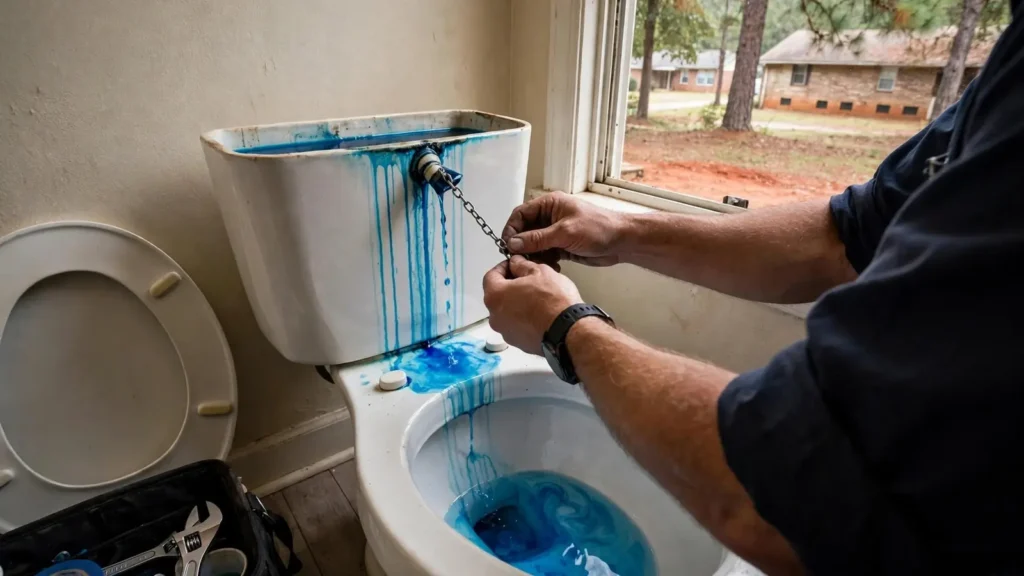
A running toilet is the leak people learn to live with. You hear it hiss at night, you jiggle the handle, it stops, and you forget about it until the next time. The trouble is that the water meter doesn't forget. EPA's WaterSense program says leaky toilets are most often caused by a worn flapper, and that a toilet running steadily can waste up to 200 gallons a day.
The good news: a running toilet is one of the few plumbing repairs most homeowners can handle. Below is how to find the failing part, what the wasted water costs on a Greenville-area bill, and when to replace the toilet instead.
How a toilet tank works, in one paragraph
Pushing the handle lifts the flapper at the bottom of the tank, the water drops into the bowl, and the flapper falls back to seal. The fill valve, the tall part on one side, then refills the tank until its float rises to the set height and shuts it off. A toilet "runs" when water keeps leaking out past the flapper, or keeps coming in because the fill valve never shuts off.
Step one: the dye test for a leaking flapper
This is the quickest way to tell a flapper leak from a fill valve problem.
- Lift the tank lid and set it somewhere flat and soft.
- Add a few drops of food coloring to the tank water. Dark blue or green shows up best. Dye tablets from the hardware store work too.
- Don't flush. EPA's version of the test says to wait 10 minutes. Waiting longer, 20 or 30 minutes, catches slower leaks.
- Look in the bowl. Any color means water is leaking past the flapper or the flush valve seat.
- Flush when you're done so the dye doesn't stain the tank.
If the bowl stays clear but the toilet still runs, the water is going out through the overflow tube instead. That points to the fill valve or the float, covered below.
What the sound and symptoms tell you
| What you notice | Most likely cause | Usual fix |
|---|---|---|
| Dye shows up in the bowl | Worn, warped or dirty flapper, or a rough flush valve seat | Clean the seat, replace the flapper |
| Tank refills for a few seconds on its own every so often (a "phantom flush") | Slow flapper leak lets the level drop until the fill valve kicks on | Replace the flapper |
| Water trickling into the top of the overflow tube | Float set too high, or a fill valve that won't shut off | Lower the float; replace the fill valve if that doesn't stop it |
| Runs until you jiggle the handle | Chain too short, tangled or caught under the flapper | Adjust the chain |
| Hissing or whistling while it fills, very slow refill | Worn fill valve, or debris in the valve | Flush out or replace the fill valve |
| Several toilets started running around the same time | House water pressure may be too high, often a failing pressure-reducing valve | Have a plumber test the pressure |
Replacing the flapper
Flappers are rubber, and rubber breaks down. EPA's Fix a Leak Week guidance says worn flappers should be replaced at least every five years, and that an old one can silently leak thousands of gallons a year. Chlorine in treated city water and in-tank bowl cleaner tablets both speed up that wear, which is one reason we'd skip the tablets.
- Turn off the water at the small shut-off valve on the wall behind the toilet. Turn it clockwise. If it won't turn or starts to drip at the stem, stop there and read the note below.
- Flush and hold the handle down to empty as much of the tank as possible.
- Unhook the chain from the handle arm and pop the flapper's ears off the pegs on the overflow tube (or slide the ring off, on older styles).
- Take the old flapper to the store. Most are 2-inch or 3-inch, and the size is often printed on the flush valve or inside the tank. Many newer toilets use brand-specific flappers or canister seals, so matching the old part saves a second trip.
- Wipe the flush valve seat (the ring the flapper sits on) with a rag or a soft scrub pad. Mineral film or grit there can keep even a new flapper from sealing.
- Install the new flapper, hook the chain, turn the water back on, and run the dye test again.
Getting the chain right
The chain should have a little slack with the flapper closed, about half an inch or a couple of links. Too tight, and the flapper can't seat fully, so water seeps by. Too loose, and the extra chain can fold under the flapper and hold it open, or the flapper won't lift high enough for a full flush.
Overflow tube height and the float setting
The overflow tube is the open pipe in the middle of the tank. Its job is to keep the tank from spilling onto the floor if the fill valve fails. When the float is set too high, the tank fills right to the top of that tube, a thin stream spills over the edge, and the fill valve keeps running to replace it. You'll see water rippling at the top of the tube.
Fluidmaster, which makes the most common replacement fill valve, says the tank water should stop about half an inch below the top of the overflow pipe. Most tanks also have a waterline mark molded inside. To lower the level:
- On a modern float-cup valve, turn the adjustment screw or slide the clip on the rod down a little.
- On an older ball-and-arm valve, turn the screw on top of the valve, or gently bend the brass arm so the ball rides lower.
- Flush, let it refill, and check where it stops. Adjust in small steps.
Also check the refill tube. It should clip to the overflow tube and squirt in from above. Fluidmaster warns against pushing it down inside the overflow pipe, because that can siphon water out of the tank and cause exactly the kind of constant refill you're trying to stop.
When the fill valve itself is the problem
If the level is set correctly and the valve still won't shut off, or it hisses and fills slowly, it's usually cheaper and quicker to replace the whole fill valve than to rebuild it. A universal fill valve fits most two-piece toilets and comes with instructions. The one detail that matters: the valve's critical level mark (stamped "CL" on the body) has to sit at least one inch above the top of the overflow tube. That's a backflow safety rule, and Fluidmaster's instructions spell it out. Most universal valves are height-adjustable for that reason.
Toilet still running after a new flapper? Call a local plumber
How much water a running toilet wastes, and what it costs here
EPA's figure for a toilet that runs constantly is up to 200 gallons a day. EPA also says the average household's leaks waste more than 9,300 gallons a year, and that a family of four using more than 12,000 gallons in a winter month probably has a serious leak. Toilets are the usual suspect.
Here's what that looks like at 2026 rates. Greenville Water's residential volume charge is $1.93 per 1,000 gallons inside City of Greenville limits and $2.68 outside. MetroConnects, which handles sewer collection for most of unincorporated Greenville County, raised its 2026 volume charge to $2.32 per 1,000 gallons. ReWa adds its own trunk and treatment charge of $7.09 per 1,000 gallons. Outside city limits on MetroConnects sewer, that's $12.09 for every 1,000 gallons that go through the meter, and ReWa's share is the biggest piece. Our high water bill guide breaks the whole bill down.
| Leak size | Gallons per month | Water only, inside city ($1.93) | Water only, outside city ($2.68) | Outside city: water + MetroConnects + ReWa ($12.09) |
|---|---|---|---|---|
| Running constantly (200 gal/day) | 6,000 | $11.58 | $16.08 | $72.54 |
| Same leak for a year | 73,000 a year | $140.89 | $195.64 | $882.57 |
| Slow flapper leak (example: 30 gal/day) | 900 | $1.74 | $2.41 | $10.88 |
So a $10 flapper pays for itself fast. On Greer CPW, another town system or a private well, the dollar figures change, but the gallons don't.
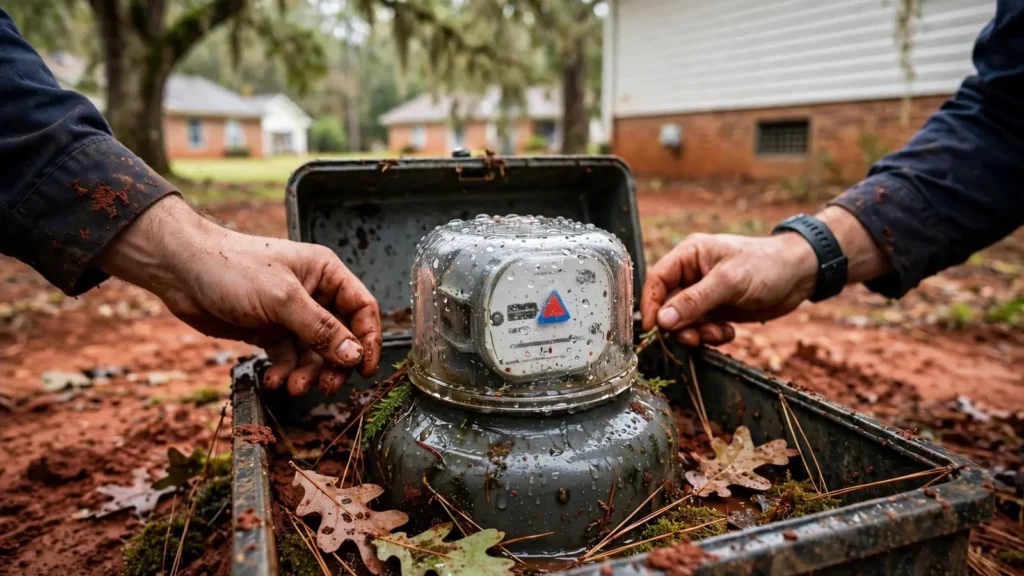
Not sure the toilet is the only leak? Our leak detection guide walks through the meter test, which tells you if water is moving anywhere in the house.
When to replace the toilet instead
Parts are cheap, so most running toilets should be repaired. Replacement makes sense when:
- The tank or bowl has a hairline crack, or there's water on the floor that isn't from the supply line or the tank bolts.
- It's an older high-volume toilet. EPA says inefficient models can use as much as 6 gallons per flush. The federal 1.6-gallon limit dates to the Energy Policy Act of 1992, so a toilet installed before the mid-1990s is probably using more. Plenty of Greenville homes built before then, from the 1950s ranches around Wade Hampton to 1970s and 1980s houses in Taylors and Mauldin, still have original toilets. Our guide to plumbing in older Greenville homes covers what else tends to be original in those houses.
- You've replaced the flapper and fill valve and it still won't hold, which can mean the flush valve seat itself is pitted or the tank is warped.
- It also clogs often. A toilet that runs and clogs is a strong candidate. Our post on why a toilet keeps clogging covers what to look for in a new one.
EPA says WaterSense-labeled toilets use 1.28 gallons per flush or less and can save a family nearly 13,000 gallons a year compared with older models. At the outside-city water plus MetroConnects rate in the table above, that's about $157 a year once ReWa's charge is included. Installed toilet prices from published Greenville-area sources are on our plumber cost guide.
When it's a plumber problem, not a tank problem
- New fill valves keep failing within months. High water pressure wears them out. Plumbing codes generally call for a pressure-reducing valve when pressure tops 80 psi, and when one fails, every toilet in the house can start acting up. Our Fountain Inn page covers PRVs in newer builds.
- Water is leaking under the tank, at the tank bolts, or around the base. That's a gasket or wax ring job.
- The shut-off valve behind the toilet is seized, corroded or dripping.
None of these is usually an emergency. A running toilet can wait for business hours; close the shut-off valve behind it between uses if the waste bothers you. If water is on the floor and spreading, that's different, and our emergency plumber page explains what to do first.
Running toilet, high bill? Call a local plumber
Running toilet questions
Why does my toilet refill by itself every half hour or so?
That's a phantom flush. Water is slowly leaking from the tank into the bowl, usually past the flapper, until the level drops far enough to trigger the fill valve. A dye test will usually confirm it, and a new flapper usually fixes it.
Does a running toilet raise my sewer bill too?
Usually, yes. Most sewer providers in the area bill by the gallons your water meter records, so water that runs down the toilet is charged once as water and again as sewer. MetroConnects' 2026 volume charge is $2.32 per 1,000 gallons, and ReWa bills treatment separately.
How often should a toilet flapper be replaced?
EPA recommends at least every five years. Replace it sooner if it feels stiff, slimy or warped, or if a dye test shows a leak.
Why is my toilet still running after I put in a new flapper?
Check three things: whether water is spilling into the overflow tube (lower the float), whether the chain is too tight or caught, and whether the flapper is the right size and style for your flush valve. A pitted flush valve seat can also keep a new flapper from sealing.
Sources
- U.S. EPA WaterSense, Fix a Leak Week page (dye test, flapper replacement every five years, 9,300 gallons per household per year, 12,000-gallon monthly benchmark), checked Oct 2026.
- U.S. EPA WaterSense, Residential Toilets page (toilet share of indoor use, up to 6 gpf for older models, 1.28 gpf WaterSense label, nearly 13,000 gallons saved per year), checked Oct 2026.
- U.S. EPA, Fix a Leak Week news release, March 2009 (worn flapper fix could save up to 200 gallons per day).
- Greenville Water, 2026 Rates and Fees page (residential volume charges $1.93 inside City of Greenville, $2.68 outside, per 1,000 gallons), effective Jan 1, 2026.
- Fox Carolina, MetroConnects 2026 rate increase (volume charge $2.32 per 1,000 gallons), Oct 21, 2025.
- ReWa, Rates, Fees and Charges page (trunk and treatment $7.09 per 1,000 gallons), checked Oct 2026; ReWa Six-Month Savings Program fact sheet.
- Fluidmaster, fill valve installation instructions (water level about 1/2 inch below overflow pipe; critical level mark 1 inch above overflow pipe; refill tube placement).
- Energy Policy Act of 1992 (1.6 gallons per flush federal maximum for new toilets).